Senzanki (Imabari-Style Fried Chicken)
Senzanki (Imabari-Style Bone-In Fried Chicken)
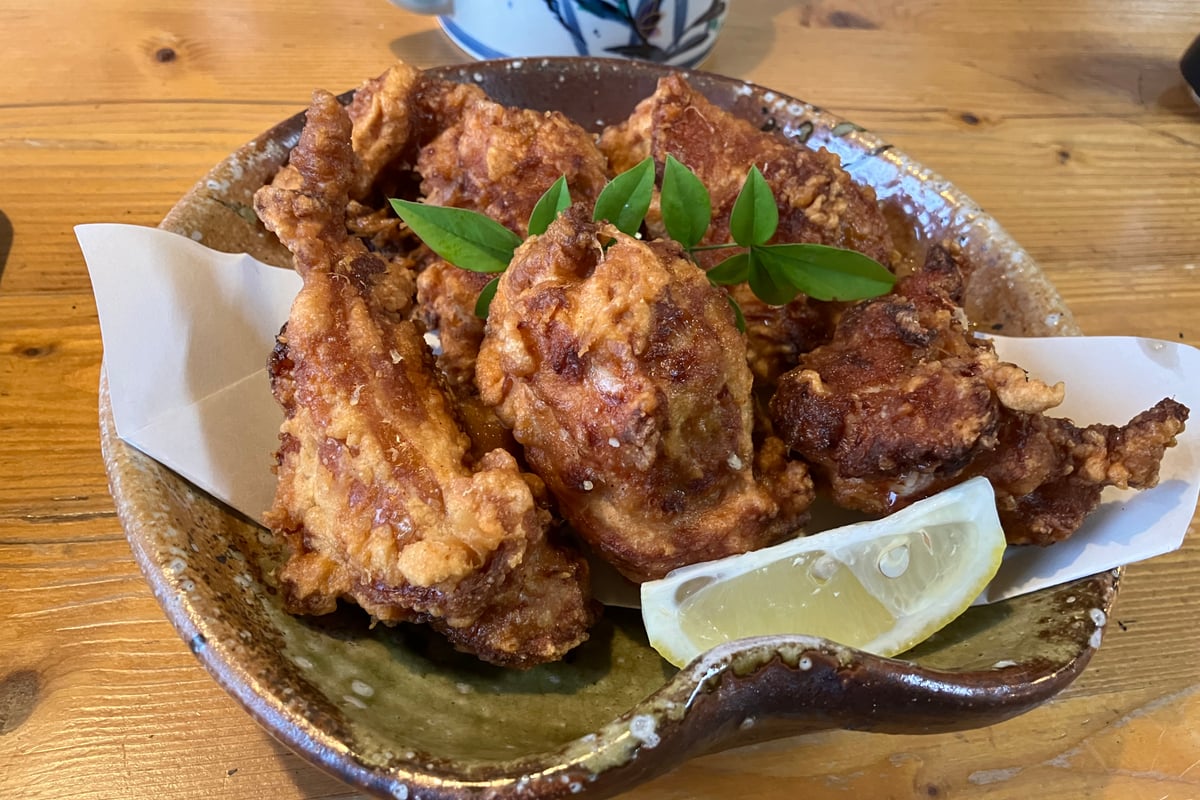
Image: Wikimedia Commons
Senzanki is a fried chicken dish (karaage) and a local specialty of the Toyo region (eastern Ehime), centered on Imabari City in Ehime Prefecture. The Ministry of Agriculture, Forestry and Fisheries' 'Our Regional Cuisines' introduces it as a dish in which bone-in young chicken is cut into bite-size pieces, marinated with light soy sauce, sake, ginger juice, garlic and other seasonings, coated in potato starch and fried. Frying the meat on the bone is said to bring out its savory flavor and let the marinade soak in well. The origin of the name is unclear: one theory holds that it was written '千斬切' ('cut a thousand times') because the chicken was chopped into a thousand pieces, and another holds that it is a corrupted form of a Chinese name for fried chicken. It has been eaten in every season, at celebrations, sports days and outings, and in everyday lunch boxes. In Imabari it is a staple at yakitori restaurants and izakaya, and it is said that connoisseurs start with 'kawa' (chicken skin) of Imabari Yakitori, cooked on an iron griddle, and finish with senzanki.
Origin
According to materials from the Ministry of Agriculture, Forestry and Fisheries, it is said to have begun in the Edo period when pheasants caught on Mt. Chikami (近見山) in Imabari City were fried, although no detailed records are said to have been found. Besides '千斬切,' the name is also written 'せんざん雉' (using the character for pheasant). Theories about the name include one that it came from chopping a whole chicken finely, as if cutting it a thousand times, and another that it is a corrupted pronunciation of a Chinese term for fried chicken such as '軟炸鶏.'
History
After World War II, it is said to have spread through the area after lines formed at a popular restaurant in Imabari City. There is also a theory that '軟炸鶏,' served at a restaurant called 'スター' (Star) that once stood in Minato-machi, Imabari City, was corrupted into 'senzanki.' Today it is sold at izakaya, farm stands and many specialty shops across the prefecture, and takeout is common. In Niihama City, it is called 'zanki' and is said to be made with boneless meat.
Features
Bone-in meat is the standard, and since there is no fixed cut, various parts are fried. Because the meat is fried on the bone, savory flavor comes out of the bone, and juices are said to burst out when you bite into it. In the Ministry of Agriculture, Forestry and Fisheries' description, the meat is marinated for about 20 minutes, coated with potato starch and fried at a medium temperature. Some recipes fry it in a batter of potato starch mixed with egg. Some restaurants serve it boneless to make it easier to eat, or let customers choose the level of spiciness.
Main Ingredients
Food Culture
It has been eaten in every season at celebrations, community gatherings, sports days and outings, and as a side dish in everyday lunch boxes. At yakitori restaurants in Imabari it is a standard dish alongside 'kawa' (chicken skin) cooked on an iron griddle, and it is said to be often ordered as the finishing dish after enjoying yakitori.
How It Differs from Home Cooking
Because it is easy to make, it is often made at home as well. At home, it is common to cut bone-in chicken into bite-size pieces, marinate it and fry it. Seasoning and frying methods differ from restaurant to restaurant; some serve it on the bone, while others serve it boneless to make it easier to eat.
Famous Shops
鳥林
愛媛県今治市南大門町1丁目
Described as a long-established Imabari Yakitori restaurant that has been in business for more than 40 years, located about a 5-minute walk from JR Imabari Station. It is sometimes counted among the 'Four Heavenly Kings of Imabari Yakitori.' In online reviews, its bone-in senzanki is especially well regarded.
世渡(せと)
愛媛県今治市黄金町1丁目5-20
A popular Imabari Yakitori restaurant known for chicken skin cooked on an iron griddle; senzanki is also a popular item on its menu. An article introducing it listed four pieces of senzanki at 500 yen. It is about a 15-minute walk from JR Imabari Station. It is open only in the evening.
まる屋
愛媛県今治市旭町4-3-32
A yakitori restaurant recognizable by its orange sign. According to a 2016 article, it served senzanki boneless to make it easier to eat, at a price of 500 yen. It is reported that for an extra charge you can choose a spiciness level from 1 to 3.
やきとり山鳥
愛媛県今治市末広町1丁目4-7
A family-run yakitori restaurant that uses '伊予水軍鶏,' a local chicken breed it developed itself. An article introducing it listed senzanki at 495 yen and chicken skin at 473 yen. It is about a 10-minute walk from JR Imabari Station and is closed on Mondays.
FAQ
Q. Where does the name 'senzanki' come from?
A. One theory is that it was called '千斬切' because a whole chicken was chopped finely, as if cut a thousand times; another is that it is a corrupted pronunciation of a Chinese term for fried chicken such as '軟炸鶏.' There is also a theory that it spread from the name of a dish at a restaurant that was once in Imabari City, and nothing is known for certain.
Q. Is it related to Hokkaido's zangi?
A. For zangi, too, there is a theory that it comes from '炸鶏' (zachi), a Chinese term for fried chicken, so similar theories have been handed down about how the two names came about. However, it is said to be uncertain whether senzanki and zangi are directly connected.