Image: Wikimedia Commons
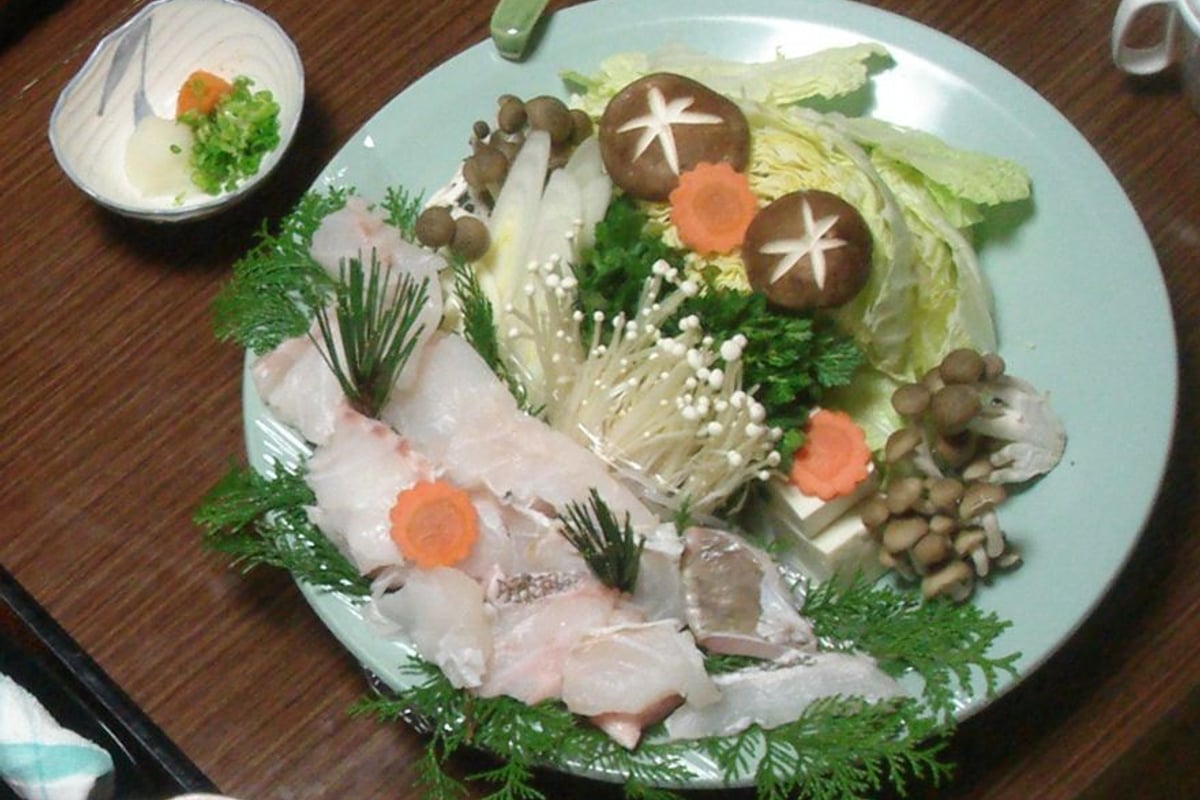
Kue nabe is a winter specialty of Wakayama Prefecture in which kue (longtooth grouper), a prized fish of the grouper family, is simmered with vegetables and other ingredients. Kue is a large fish that can exceed 1 meter in length, and because it is scarce it is also called a 'phantom luxury fish.' Its flavor is so highly regarded that there is a saying, 'Once you eat kue, you can't eat any other fish.' Wakayama Prefecture, which faces the Kii Channel, is known as a good kue fishing ground, and Hidaka Town in particular is famous as the 'Town of Kue.' At minshuku (family-run guesthouses) and ryokan in the town, full courses that serve kue nabe along with sashimi and karaage (deep-fried kue) are a specialty. In 2018, Hidaka Town's kue nabe took first place in Japan at the 'Nippon Zenkoku Nabe Grand Prix.' When kue is cooked in a hot pot, the gelatinous part around the skin melts out, creating a broth rich in savory flavor. Finishing with zosui (rice porridge) made from that broth is another pleasure. The season runs from late October to around February, and summer, after spawning, is also said to be good as the 'ura-shun' (second season).
Origin
Kue is a fish of the grouper family found along the coasts from western Japan to the East China Sea and the South China Sea. In Kyushu it is called ara, and in various other places moroko and other names, and it is sometimes written with the characters 九絵. The Kii Channel off Wakayama Prefecture is a good kue fishing ground, where kue have been caught by pole-and-line fishing and longline fishing. At Shirahige Shrine in Ao, Hidaka Town, the 'Ao Kue Festival,' in which kue is offered before the deity, is said to have been handed down for about 300 years, which suggests how old the ties between kue and this fishing town are.
History
The Ao Kue Festival was designated an Intangible Folk Cultural Property of Wakayama Prefecture in 1976 (Showa 51). The minshuku and ryokan of Hidaka Town have become known as inns that serve full kue courses, and the town is called the 'Town of Kue.' In January 2018 (Heisei 30), at the 'Nippon Zenkoku Nabe Grand Prix 2018' held in Wako City, Saitama Prefecture, Hidaka Town's kue nabe won the Grand Prix. It had placed third at the contest two years earlier, and the win is reported to have fulfilled a long-held wish to be number one in Japan.
Features
Kue has a layer of fat between the flesh and the skin, and the skin and ara (bones and head) also yield good stock. At many of Hidaka Town's minshuku and ryokan, they take the trouble to remove only the scales without peeling off the skin, preserving the flavor just beneath it. When put into the pot, the gelatin of the skin melts, creating a deeply flavored broth. Some establishments prepare a yuzu-flavored hot pot; it is eaten with yuzu ponzu or similar dipping sauces, and finishing with zosui is the standard.
Main Ingredients
Food Culture
At the 'Ao Kue Festival' handed down at Shirahige Shrine in Ao, Hidaka Town, the toya-shu (the festival's host group) and the wakashu (young men) scramble for a large kue in the 'kue-oshi' (kue pushing), praying for good catches and safety at sea. It is known as an unusual festival in which the kue itself is treated like a portable shrine (mikoshi).
How It Differs from Home Cooking
Because few kue are caught and the fish is expensive, there are not many opportunities to cook a whole one at home. At minshuku and other inns in Hidaka Town, the fish is carefully prepared, for example by removing only the scales and leaving the skin on, and a distinctive feature is that it is served as a full course in which you can enjoy sashimi, karaage, hot pot, and zosui all at once.
Famous Shops
割烹 岬
和歌山県日高郡日高町比井673
A restaurant on the first floor of 岬旅館 that serves kue dishes all year round. It is run by the owner, who is also a fisher, and is known for the freshness of its fish. You can enjoy dishes such as usu-zukuri (thinly sliced sashimi), yuzu-flavored hot pot, seared sushi, and karaage. Examples include a kue full course for about 13,200 yen and a kue set meal for about 2,900 yen.
料理宿 橋本荘
和歌山県日高郡日高町産湯736-1
An inn known for its cuisine near Ubuyu Beach, serving kue dishes made from fish chosen by the owner's discerning eye. The kue nabe set starts from about 11,440 yen on weekdays, and the kue full course from about 20,240 yen. Reservations for two or more people are required. In summer, hamo (pike conger) dishes can also be enjoyed.
民宿 はまよし
和歌山県日高郡日高町志賀3960-1
A minshuku overlooking Yura Bay that serves dishes focused on live, wild kue. Examples include a live kue nabe course from about 19,800 yen and a wild kue full course from about 23,650 yen.
FAQ
Q. Are kue and ara the same fish?
A. Some areas of Kyushu call kue 'ara,' but the fish whose standard Japanese name is 'ara' is a different species from kue. Because they share the same name, care is needed, as the two are easily confused. In Wakayama Prefecture the fish is called kue and is enjoyed as kue cuisine in places such as Hidaka Town.