Iwakuni-zushi (Layered Pressed Sushi of Iwakuni)
Iwakuni-zushi (Layered Pressed Sushi of Iwakuni)
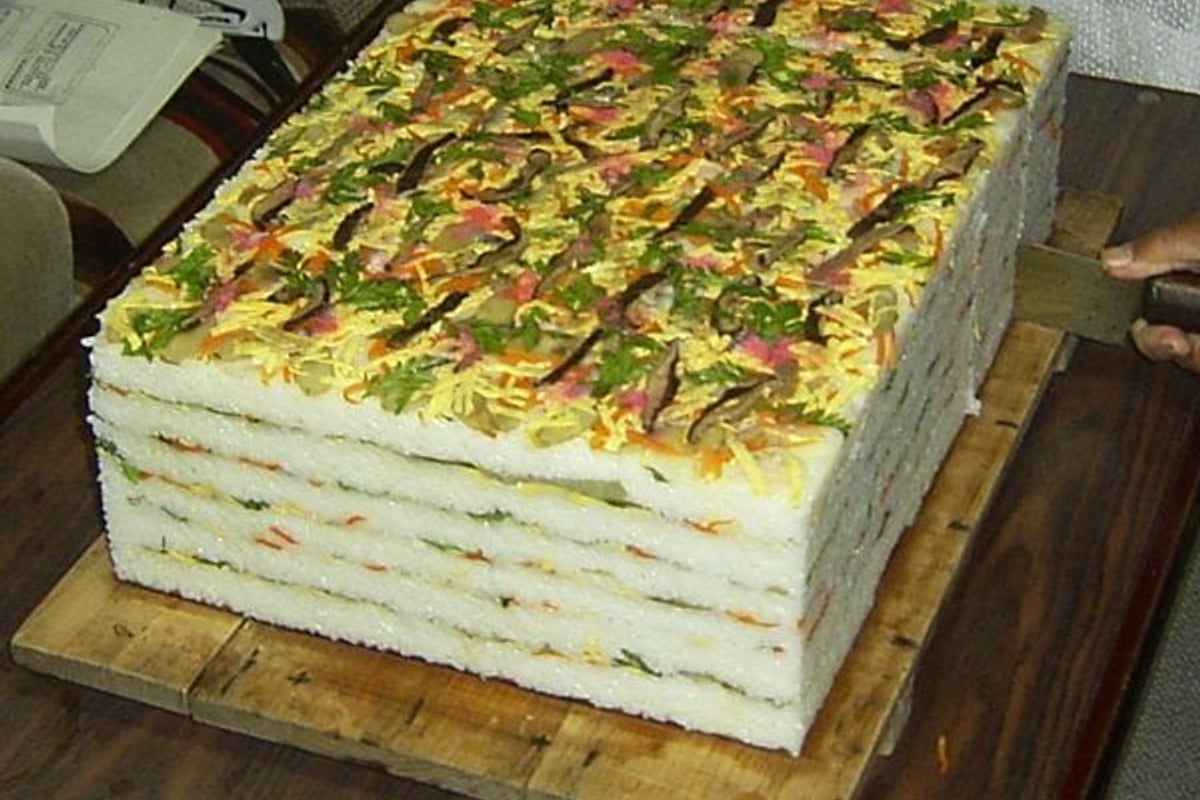
Image: Wikimedia Commons
Iwakuni-zushi is a pressed sushi handed down in Iwakuni City, Yamaguchi Prefecture. Sushi rice and toppings are layered alternately many times in a large wooden frame and pressed from above. Toppings include vinegar-pickled Iwakuni lotus root, a local specialty, as well as kinshi tamago (thin strips of egg crepe), shiitake mushrooms and denbu (sweet fish flakes), and chisha (a leafy vegetable similar to red leaf lettuce) is placed between the layers. Its hallmark is a gorgeous appearance, with colorful layers revealed in the cross-section when it is cut. It is said to be a dish associated with the Kikkawa family, who ruled Iwakuni, and because it was presented to the domain lord, it is also called 'Tonosama-zushi' (lord's sushi). It has been made for festivals and celebrations, and sometimes 4 to 5 sho (a traditional Japanese unit of volume) of rice is cooked at once to make a large quantity. In fiscal 2021, it was recognized as the Agency for Cultural Affairs' '100-Year Food' (in the Traditional 100-Year Food category). Today it can be enjoyed at eateries and ryokan (Japanese inns) around Kintai Bridge (Kintaikyo), and it is also sold for takeout.
Origin
Iwakuni flourished as a castle town ruled by the Kikkawa family. There are various theories about the origin of Iwakuni-zushi. The Agency for Cultural Affairs' introduction relates that because the cross-section of lotus root resembles the Kikkawa family crest, the 'Kuyo-mon' (nine-star crest), the first domain lord, Kikkawa Hiroie, made it a preserved food for going up to the castle. The Ministry of Agriculture, Forestry and Fisheries introduces a theory that it was devised as a food easy to carry to the castle on top of the mountain. There is also a theory that it was made as an offering to the domain lord.
History
It is said to have been presented to the domain lord in the Edo period, and under the name 'Tonosama-zushi' it was made as a celebratory gift and an offering. Some wooden frames are said to have been as large as about 60 cm square, and craftsmen sometimes stood on the lid to press the sushi firmly. According to the Agency for Cultural Affairs, in 1988 (Showa 63), a liaison council of local Life Improvement Practice Groups named this dish 'Iwakuni-zushi.' Since then, the council has continued working to spread it through efforts such as standardizing the seasoning and food education (shokuiku) activities.
Features
Chisha is laid on the bottom of the sushi frame, and sushi rice mixed with minced fish such as horse mackerel (aji) is packed in. On top, kinshi tamago, shiitake, denbu, vinegar-pickled lotus root and other toppings are arranged, and chisha is placed again to build up the next layer. After 3 to 5 layers are stacked, a wooden lid is placed on top and weighted to press it firm. When it is eaten, it is cut into square individual portions. Simmered conger eel (anago) is sometimes used as a topping.
Main Ingredients
Food Culture
Iwakuni-zushi is an indispensable dish for festivals and celebrations. Iwakuni City has been actively growing lotus root since the Edo period and is the prefecture's top producing area, and its Iwakuni lotus root adds color to the dish. At home, methods using a bento box or cake mold, and even a milk carton as the mold, have been devised.
Famous Shops
平清(ひらせい)
山口県岩国市岩国1丁目2-3
A Japanese restaurant in a renovated old townhouse right near Kintai Bridge. It is introduced as a long-established restaurant where you can enjoy Iwakuni-zushi and other local dishes of Iwakuni. A tourism information site lists the popular 'Janome Gozen' set meal at 1,980 yen. It is open mainly for lunch, and dinner is said to be by reservation only.
半月庵
山口県岩国市岩国1丁目17-27
A kappo ryokan (a Japanese inn known for its cuisine) said to have begun as a tea room in 1869 (Meiji 2), and also known as the setting of Uno Chiyo's novel 'Ohan.' For lunch, a limited-quantity 'Iwakuni-zushi Zen' set meal is introduced from about 1,700 yen. Prices differ depending on when information was published, so it is best to check before visiting.
岩国国際観光ホテル
山口県岩国市岩国1-1-7
A hotel near Kintai Bridge where you can try making a single serving of Iwakuni-zushi using a mini wooden frame. You layer vinegared rice with kinshi tamago, Iwakuni lotus root and other toppings and press them, and you can eat the sushi you made on the spot. Yamaguchi Tourism Navi (やまぐち観光ナビ) lists the fee as 2,200 yen, and advance reservations are required.
View details →FAQ
Q. Why is it called 'Tonosama-zushi'?
A. It comes from the tradition that, in the Edo period, it was presented to the domain lord of the Kikkawa family, who ruled Iwakuni. The Agency for Cultural Affairs' introduction says that because the first domain lord, Kikkawa Hiroie, made it a preserved food for going up to the castle, it was called 'Tonosama-zushi' at the time. There are various theories about its origin, and none has been firmly settled.