Image: Wikimedia Commons
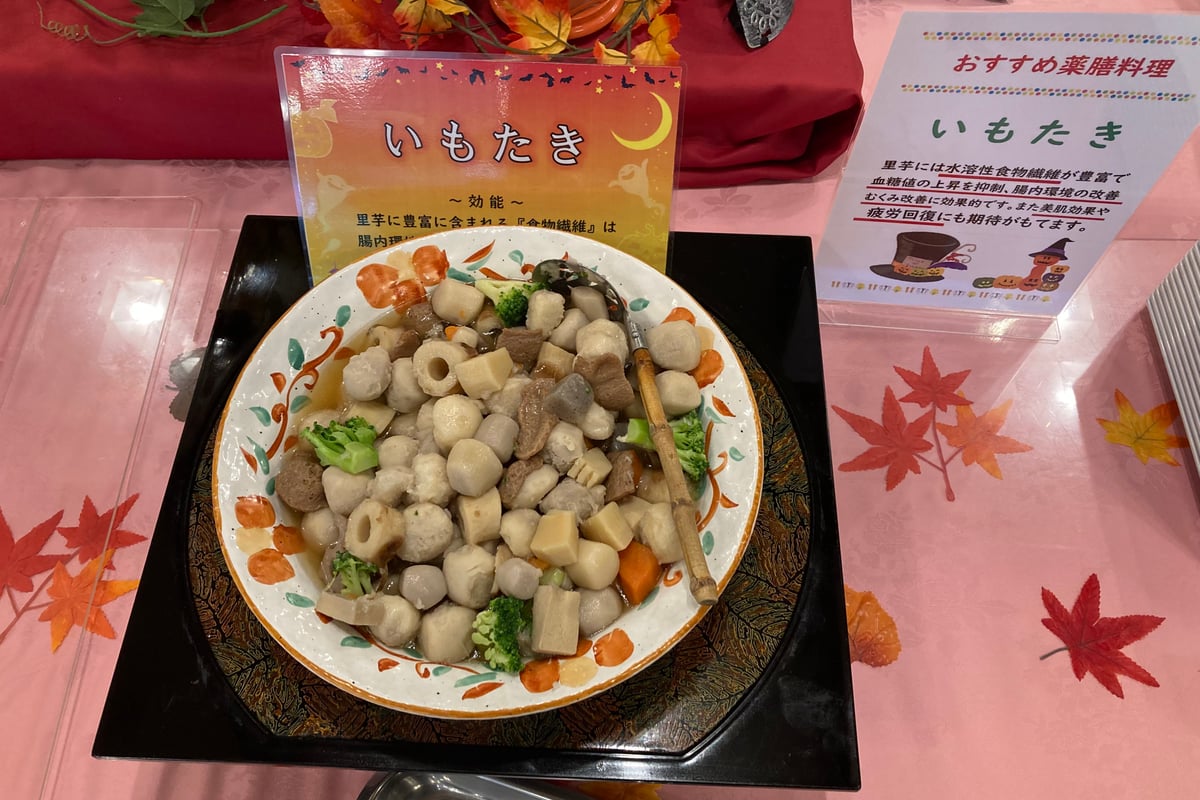
Imotaki is a hot pot dish from Ehime Prefecture in which taro takes center stage and is simmered in dashi broth with chicken, konnyaku, shiitake mushrooms, fried tofu and other ingredients. It is said to have originated in Ozu City and is known as an event in which people gather around pots on the banks of the Hiji River from late summer into autumn, enjoying it while also viewing the moon. In Ozu during the Edo period, farmers are said to have cooked taro harvested in summer on the riverbank and eaten it at gatherings called 'okomori,' held to strengthen ties among them. 'Kanko Imotaki' (sightseeing imotaki) began in 1966 (Showa 41), and at its peak it is said to have drawn more than 70,000 visitors a year. Even today, from late August to around mid-October, the registered restaurant you reserve with prepares the food and seating at the venue. Taro is considered a good-luck symbol of prosperity for one's descendants, and imotaki has spread to various places in the prefecture, such as Saijo City and Toon City, becoming a seasonal autumn tradition of Ehime.
Origin
According to materials from the Ministry of Agriculture, Forestry and Fisheries, the history of imotaki is said to go back more than 350 years, to when the Kato family were lords of the Ozu domain. It is said to have begun when each person brought taro, a local specialty, to the pot served at okomori gatherings. Ozu City's public relations magazine explains that in the Ozu area, okomori were held twice a year, in spring and autumn, from the Edo period, and that in autumn taro harvested in summer was cooked and eaten on the riverbank.
History
In 1966 (Showa 41), 'Kanko Imotaki' began as a tourism project of Ozu City, aimed at letting many people enjoy this traditional local event. At its peak, it is said to have attracted more than 70,000 people a year. On the first day of the season, the 'Hatsunie-kai' (first cooking ceremony) is held, and in 2026 it was announced to take place on August 28 at Konan Picnic Land in the Hiji River Green Space. It spread to various places in the prefecture, beginning in Saijo City in 1972 (Showa 47), for example.
Features
The star of Ozu imotaki is a taro called 'natsu-imo' (summer taro), a specialty of Ozu. It is characterized by its strong stickiness and fluffy texture, and a long-established variety called 'Onna-wase' is grown. The seasoning and ingredients differ from one registered restaurant to another: some cook it in bonito and kombu dashi, some use chicken bone broth, and some add hasuimo (taro stalks) or quail eggs. Adding udon at the end to finish the meal is also introduced as a way of eating it.
Main Ingredients
Food Culture
Ozu imotaki is an event in which family and friends gather on the riverbank and sit around a pot to enjoy the cool evening air and moon viewing. First you apply to a registered restaurant by phone, and when you go to the venue on the reserved date and time, mats, portable gas stoves and tableware are ready along with the food. According to the Ozu City Tourism Association, the price starts at 3,300 yen per person, and reservations are required for groups of five or more.
How It Differs from Home Cooking
Imotaki is also often made at home and is passed down from parents to children. It is sometimes made in school lunches and home economics classes. In Ozu, registered restaurants and others sell 'imotaki sets' with all the ingredients, and the city's public relations magazine in 2023 listed them at 3,500 to 4,950 yen for three to five servings.
Famous Shops
料苑 たる井
愛媛県大洲市若宮465-1
A registered imotaki restaurant that preserves a flavor handed down since the grandfather's generation. It uses chicken and shiitake dashi with soy sauce from a long-established local brewer, finishing it with the gentle sweetness characteristic of Ozu. The taro, shiitake and fried tofu are from Ozu, and hasuimo is also included. The city's public relations magazine in 2023 listed it from 2,500 yen per person (excluding tax), with orders accepted for five or more people.
よねざわ
愛媛県大洲市大洲610
A registered restaurant that has kept the same flavor since 1966, when Kanko Imotaki began. It cooks Ozu-grown taro, chicken, shiitake and konnyaku in bonito and kombu dashi. The city's public relations magazine in 2023 stated that riverbank imotaki was suspended and that it was being served at the restaurant. It was from 2,000 yen per person (excluding tax).
にし川
愛媛県大洲市田口甲392-6
A registered restaurant that uses only ingredients from Ozu: taro, konnyaku, shiitake, fried tofu, hasuimo and bone-in chicken. It is described as having many customers who order udon to finish the meal. An imotaki set meal can also be enjoyed at the restaurant, and guests staying at ホテルにし川 can use a shuttle service to the riverbank.
| Carefully Made Imotaki from Ozu, Ehime (retort pouch) | A retort-packed imotaki certified under 'Ozu Ee-mon Selection,' a regional brand of Ozu City. The suggested retail price is listed as 1,080 yen (including tax) for one pouch serving two. It can be purchased at places such as まちの駅あさもや, 産直市愛たい菜 and 道の駅清流の里ひじかわ. |
|---|
FAQ
Q. Is imotaki held outside Ozu City as well?
A. According to materials from the Ministry of Agriculture, Forestry and Fisheries, imotaki is held at more than ten places in the prefecture, mainly in Nanyo (southern Ehime). It is described as having been held around the riverbed of the Kamo River in Saijo City and on the riverbed of the Shigenobu River in Toon City. Gathering in large groups around pots on the riverbed in autumn, combined with moon viewing, is the way it is enjoyed in common across these places.