Image: Wikimedia Commons
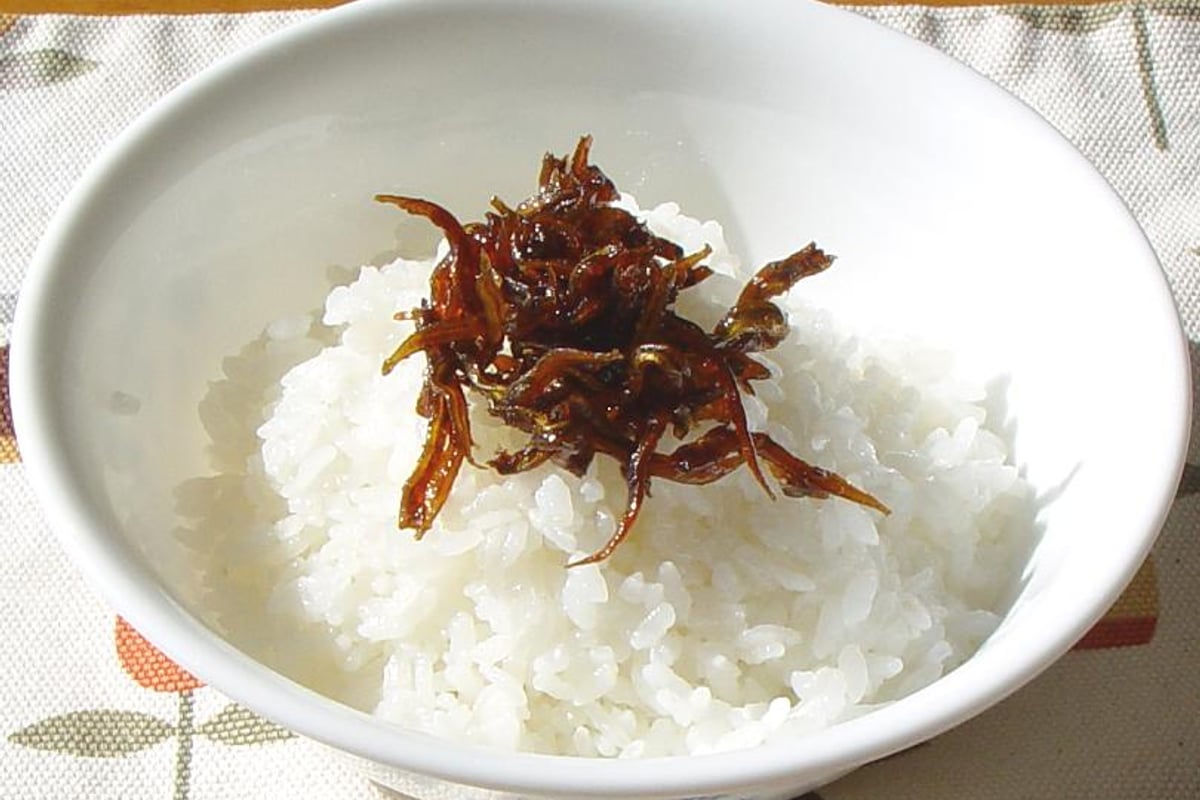
Ikanago no kugini is a tsukudani made by simmering shinko, the juvenile fish of the sand lance (ikanago; a small fish of the family Ammodytidae in the order Perciformes), with soy sauce, sugar, ginger, and other seasonings until sweet and savory. It has long been made along Hyogo Prefecture's Seto Inland Sea coast, including Harima, Settsu, and Awaji. It is called 'kugini' ('nail-simmered') because the finished fish look like bent, rusty nails. Kobe is considered its birthplace, and it was originally a dish made in fishing households. From the 1980s onward, it became widely known among ordinary households as well. The shinko fishing season opened every year between late February and early March and lasted only about a month. Locally it is said that 'when you smell ikanago, spring is on its way', and the dish is cherished as a seasonal sign of spring. In the past, many households bought shinko by the kilogram, cooked them at home, and sent the kugini to relatives and acquaintances. In recent years, however, catches have dropped sharply and the fishing season has become shorter, making shinko hard to obtain.
Origin
Kugini is a dish that has been made in fishing households along the Seto Inland Sea coast. It already appears in 滋味風土記, written by 魚谷常吉 in 1935 (Showa 10). Komagabayashi in Nagata Ward, Kobe, and Tarumi in Tarumi Ward of the same city are cited as its birthplace. When fresh shinko are cooked right after being caught, the flesh firms up immediately and curls into a bent shape. Its resemblance to rusty nails is the origin of the name.
History
Kugini spread to ordinary households from the 1980s onward. Women of the fisheries cooperatives in Akashi City adapted the recipe for home cooking and worked to popularize it, for example by holding cooking classes. In 2009 (Heisei 21), the Ikanago no Kugini Promotion Association was established, and it holds the 'Kugini Literary Prize' and the 'Kugini Contest'. Meanwhile, according to Hyogo Prefecture, catches have declined to below 2,000 tonnes since 2017 (Heisei 29). The prefecture is working on resource conservation by moving the closing date of the fishing season earlier.
Features
The basic ingredients are shinko, soy sauce, sugar (zarame, a coarse sugar), and ginger, and mirin or sake may also be added. The shinko are added little by little to the boiling seasonings and cooked without stirring with chopsticks or the like until the liquid has reduced, because stirring would break the fish apart. The fresher the shinko, the more cleanly they finish in neat curves, without their heads or bellies breaking off. The sweet-savory flavor and the aroma of ginger go well with rice, and its good keeping quality is one of the merits of tsukudani.
Main Ingredients
Food Culture
When the season opened, supermarkets and fish shops in Hyogo Prefecture set up sections for shinko. Cooking 1 kg or more at once in a large pot, then exchanging it with neighbors or sending it to family far away, was one of the pleasures of spring. In 2026 (Reiwa 8), fishing in Osaka Bay was voluntarily suspended, and fishing in the Harima-nada also ended after just two days.
How It Differs from Home Cooking
Kugini is originally a dish cooked at home, and each household has its own 'family flavor' in the ratio of soy sauce to sugar and the amount of ginger. At first the seasoning was strong, made for fishermen, but it spread after being adapted for home cooking. Some shops sell their handmade kugini by weight, for example in 100 g units.
Famous Shops
座古海産
兵庫県明石市本町1-1-14
A shop selling salted and dried seafood in Akashi's Uontana shopping street. Along with local Akashi products such as dried octopus, chirimen (dried baby fish), and wakame seaweed, it sells homemade kugini. It is known as a shop highly regarded locally, and its kugini costs about 860 yen for 120 g. It is about a 5-minute walk from JR Akashi Station.
| 伍魚福 'Ikanago no Kugini' | Kugini made by 伍魚福, a maker of chinmi (savory delicacies) headquartered in Nagata Ward, Kobe. The name 'kugini' is a registered trademark of the company. It is one of the flagship products of the company, which handles about 400 kinds of chinmi, and is popular as a souvenir that lets people take home the taste of spring in Kobe. |
|---|
FAQ
Q. Why is it called 'kugini'?
A. It was named because the cooked ikanago turn brown and look like bent, rusty nails (kugi). The fresher the shinko, the faster the flesh firms up and curls, so the nail-like shape comes out clearly. No actual nails are cooked with the fish.