Hiroshimana-zuke (Pickled Hiroshimana Greens)
Hiroshimana-zuke (Pickled Hiroshima Greens)
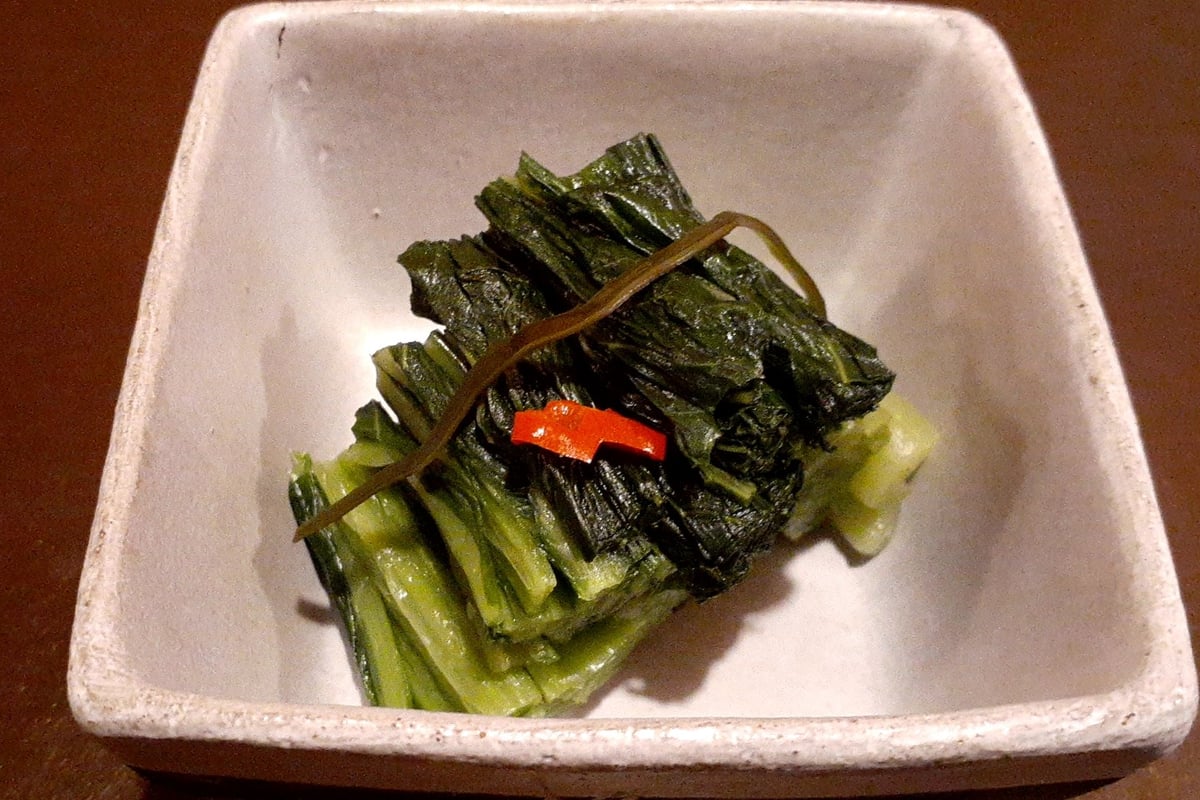
Image: Wikimedia Commons
Hiroshimana-zuke is a pickle made by salting Hiroshimana, a traditional vegetable of Hiroshima Prefecture. Along with Kyushu's takana-zuke and Shinshu's Nozawana-zuke, it is counted as one of Japan's three great leafy-green pickles. Hiroshimana is a leafy vegetable of the Brassicaceae (mustard) family with large, broad leaves, and a single plant can grow to about 2 kg. The main growing area is the Kawauchi district of Asaminami Ward, Hiroshima City. It has long been cultivated there, on well-drained land lying between the Ota River and the Furukawa River. Almost all of the Hiroshimana harvested in winter is processed into pickles. There are two kinds: asazuke, pickled for a short time and enjoyed for its fresh green color and crispness, and furuzuke, aged for a long time to bring out sourness and umami. Its hallmarks are a sharp, wasabi-like aroma and a mild pungency. It is a familiar accompaniment to rice for people in the prefecture and is also popular as a gift representing Hiroshima.
Origin
There are several theories about the origin of Hiroshimana. One dates it to the Edo period and holds that it began when seeds were brought back from Kyoto during sankin-kotai (the alternate attendance system). Many older people still call it 'Kyona,' and Kyoto's mibuna is also thought to be its root. The other theory dates it to the Meiji era. It holds that 木原才次 of Kawauchi Village brought back seeds of Kannonji hakusai (Chinese cabbage) when he visited Nishi Hongan-ji Temple in Kyoto, and improved them by crossing them with the local Kyona. Hiroshima Prefecture materials date this to Meiji 25 (1892).
History
In Showa 8 (1933), an exposition was held at the Hiroshima Prefectural Industrial Promotion Hall (today's Atomic Bomb Dome). Exhibiting there is said to have prompted the unification of the names, which had varied from farm to farm, into 'Hiroshimana.' In Hiroshima, along with the kakibune (oyster restaurant boats) that served oyster dishes, Hiroshimana also became known as a food that goes well with oysters. Before the war, long-pickled furuzuke was the mainstream, but after the war asazuke came to be preferred. Valued as a gift as well, it became an important specialty product of Hiroshima. In the Kawauchi district, growers protect the seeds by preventing cross-pollination with other varieties, and have continued cultivation lessons with a local elementary school for more than 30 years.
Features
Hiroshimana has little fiber and is tender, and when exposed to frost its leaves firm up and its tangy flavor intensifies. It is harvested from mid-November to around the end of January. First comes arazuke (preliminary pickling), in which the greens are rubbed with salt to draw out bitterness, and the pickle is then finished through repeated re-pickling. Asazuke is pickled for about three to four days and is characterized by a vivid green color, a crisp bite and a wasabi-like aroma. Furuzuke is aged for more than half a year; it has the sourness and umami that come from lactic acid fermentation and turns nearly the color of tortoiseshell (amber). In recent years, makers have also added their own touches, such as adding kombu or chili peppers.
Main Ingredients
Food Culture
The classic way to eat it is cut into fairly large pieces and placed on hot rice. 'Hiroshimana musubi,' rice balls wrapped in Hiroshimana-zuke, are a familiar taste for people in the prefecture and often go into bento lunch boxes. In Asaminami Ward, the main growing area, Hiroshimana is called 'mochina' and is also used as an ingredient in zoni (rice cake soup). Furuzuke is also well suited to ochazuke (rice with tea poured over it).
Famous Shops
山豊 長楽寺店
広島県広島市安佐南区長楽寺2-13-2
A directly managed shop of 山豊 (Yamatoyo), which makes pickles centered on Hiroshimana-zuke. Hiroshimana grown by contract farmers is prepared by hand through a three-stage pickling process: arazuke, nakazuke and honzuke. Its flagship Hiroshimana-zuke '安藝菜' (Akina) and other products are certified as Hiroshima City's 'The Hiroshima Brand' (ザ・広島ブランド).
View details →| 山豊 '安藝菜' (Akina) | Hiroshimana-zuke made by 山豊 (Yamatoyo; Asaminami Ward, Hiroshima City). Contract-grown Hiroshimana is pickled in three stages, bringing out its crisp bite and wasabi-like aroma. Hiroshima City's introduction of certified products lists a 250 g pack at 486 yen (tax included). It is sold at shops in Hiroshima Station and Hiroshima Airport, at expressway service areas in the prefecture and elsewhere, and is available from October to around June of the following year.Where to buy →PR |
|---|---|
| JA広島市 '本場川内特産 広島菜漬' (Authentic Kawauchi Specialty Hiroshimana-zuke) | Hiroshimana grown by farmers in the Kawauchi district, pickled by the traditional method at the Hiroshimana-zuke Center of JA広島市 (JA Hiroshima City) in Kawauchi, Asaminami Ward, Hiroshima City. It is described as having a mild flavor, a tangy pungency and a crisp bite. Hiroshima City's introduction of certified products lists a 250 g pack at 486 yen (tax included), and it can also be bought at farmers' markets in the prefecture and on online shopping sites.Where to buy →PR |