Hamada Nodoguro (Blackthroat Seaperch of Hamada)
Hamada Nodoguro (Blackthroat Seaperch of Hamada)
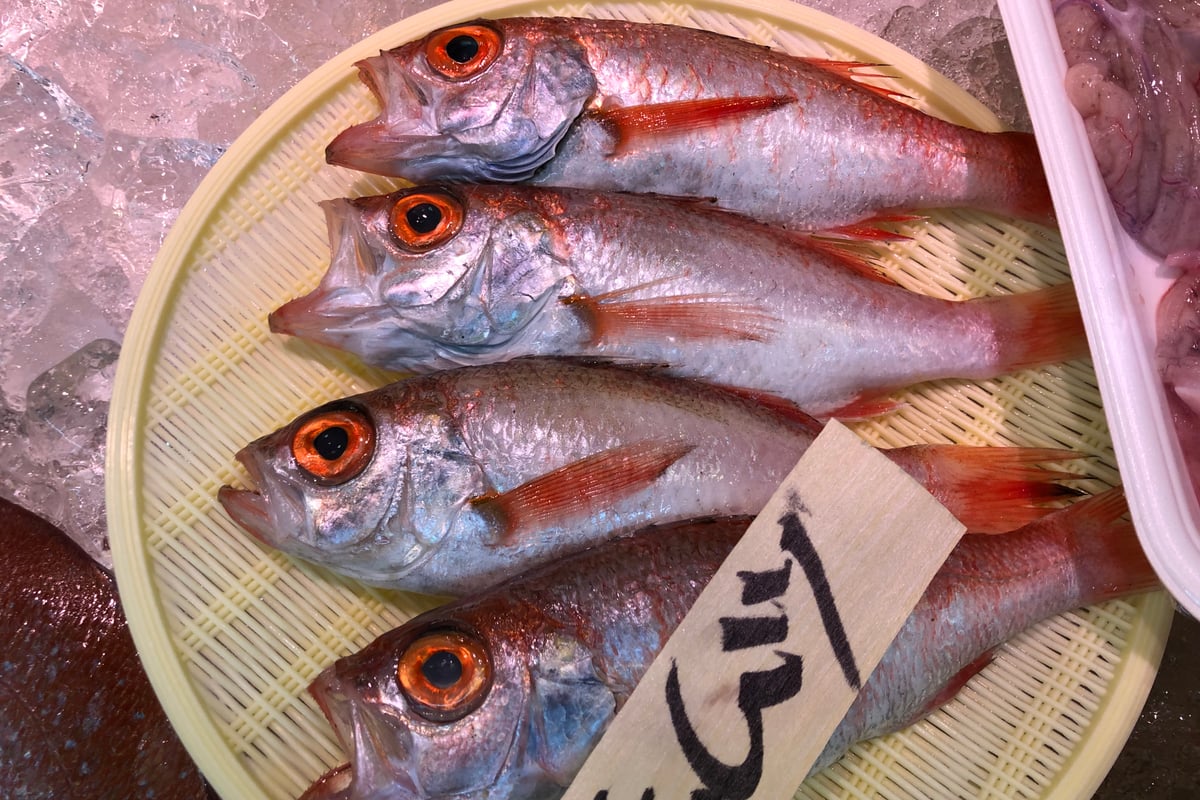
Image: Wikimedia Commons
Hamada Nodoguro refers to akamutsu (its standard Japanese name) landed at Hamada Fishing Port in Hamada City, Shimane Prefecture. Although its body is red, the inside of its mouth is black, so in Shimane and elsewhere it is called nodoguro (literally 'black throat'; blackthroat seaperch). It is a deep-sea fish that lives at depths of around 200 m off the San'in coast, and at Hamada Port it is landed mainly by offshore bottom trawlers. Although it is a white-fleshed fish, it is a premium fish rich in fat; akamutsu caught in the western waters off San'in reaches a fat content of over 30% at most, said to rival the toro (fatty belly) of tuna. In 2009, Hamada City designated nodoguro as the city fish. Together with aji (horse mackerel) and karei (flounder), the city is promoting it as a brand under the name 'Donchicchi Sangyo' (the three Donchicchi fish), and fish that meet the requirements are shipped under the name 'Donchicchi Nodoguro.' It is enjoyed simmered (nitsuke) or salt-grilled, and himono (dried fish), prepared one fish at a time by hand, is also a Hamada specialty. It can be bought at local public markets and dried-fish shops.
Origin
Akamutsu is a fish that lives in the deep sea at depths of around 200 m off the San'in coast, where fat-rich plankton and crustaceans are abundant. At Hamada Fishing Port, the catch is landed by offshore bottom trawlers whose fishing grounds are the continental shelf from the southwestern Sea of Japan to Kyushu. Hamada Port is designated as a Specified Class 3 Fishing Port, one of only a limited number in Japan. According to Shimane Prefecture materials, even among nodoguro, those caught in the western part of the prefecture, mainly by offshore bottom trawling, are said to carry more fat.
History
According to the Ministry of Agriculture, Forestry and Fisheries' 'Nippon Dentoshoku Zukan' (an illustrated guide to Japan's traditional foods), nodoguro was not a very popular fish until around the 1950s. In recent years it has come to be prized nationwide as a premium fish that rivals madai (red sea bream), hirame (olive flounder), and torafugu (tiger puffer). Hamada City designated nodoguro as the city fish in 2009. The 浜田市水産物ブランド化戦略会議 (Hamada City marine products branding strategy council), made up of producers, the market, processors, research institutions, local government, and others, is promoting the 'Donchicchi' brand together with aji and karei.
Features
'Donchicchi' is a baby-talk word for the musical accompaniment (hayashi) of kagura, which later came to refer to Iwami Kagura as a whole. Likening the fish to the kagura that represents Iwami, the word was used as the name for the fish that represents Hamada. Donchicchi Nodoguro is limited to fish of 80 g or more caught from August to May of the following year by offshore bottom trawlers belonging to the branding strategy council. Hamada nodoguro has been shown to have a higher fat content than fish from other areas, and the prefectural fisheries experimental station has also tried selling fish with their measured fat content displayed.
Main Ingredients
Food Culture
In making himono in Hamada, the innards and the dark, blood-rich flesh (chiai) are removed by hand one fish at a time so as not to damage the soft flesh of freshly caught nodoguro. The saltiness and soaking time are adjusted according to the size of the fish and the day's weather. Himono is said to be best simply grilled as is, without seasoning. Nodoguro has also been used as a fish in season in heka, an iron-pot dish eaten in places such as Oda City.
Famous Shops
はまだお魚市場(山陰浜田港公設市場)
島根県浜田市原井町
A public market at Hamada Port that held its grand opening in July 2021. Fresh fish and processed seafood landed at Hamada Fishing Port are lined up for sale, and the Donchicchi three fish (aji, nodoguro, and karei) can also be purchased. Sales hours are from 8:00 to 15:00, and the second floor houses a restaurant that uses ingredients from the Iwami region.
お魚のなかだ
島根県浜田市国分町1981-186
An eat-in space attached to a fresh fish shop, where seafood bowls made with the day's fish are popular. It is introduced as also offering the 'Nodoguro Zukushi Don,' a bowl topped only with nodoguro. According to a listing on 旅色 (a travel media site), the budget is about 1,500 to 2,000 yen, and service may end once the fish runs out.
| 香住屋「のどぐろ一夜干し」 | Overnight-dried nodoguro (ichiya-boshi) from 香住屋, a Hamada dried-fish specialist described as founded in Taisho 10. Large nodoguro caught off San'in are processed one fish at a time using only natural salt. The shop also offers 'Nodoguro Mirin-boshi,' soaked in a seasoning liquid cooked in its own kettles. |
|---|
FAQ
Q. Are nodoguro and akamutsu different fish?
A. They are the same fish. Its standard Japanese name is akamutsu, and because the inside of its mouth is black although its body is red, it is called nodoguro in Shimane and elsewhere. In Hamada, fish that meet conditions such as the fishing season and a weight of 80 g or more are shipped under the name 'Donchicchi Nodoguro.'