Image: Wikimedia Commons
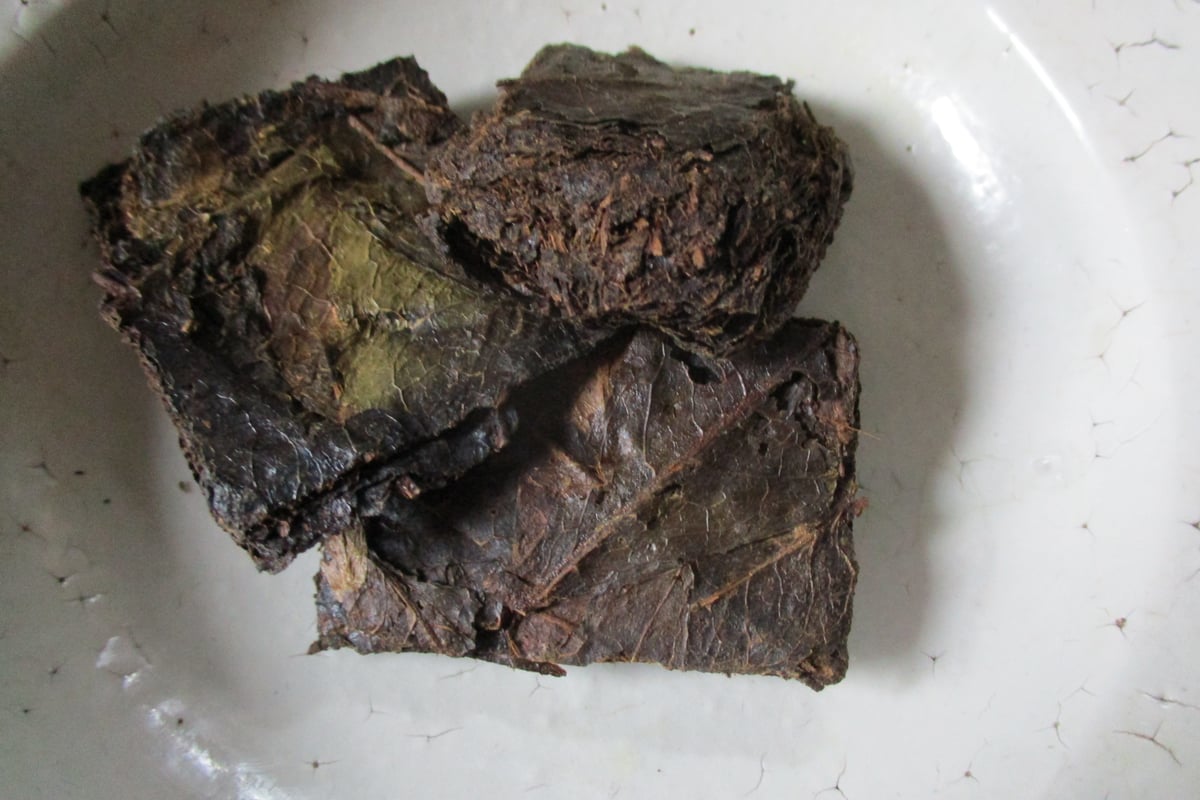
Goishicha is a post-fermented tea made in Otoyo Town, Nagaoka District, Kochi Prefecture. Post-fermented tea is tea whose leaves are fermented by the action of microorganisms after being heated. Goishicha is made through two stages of fermentation: one in which mold is allowed to grow on steamed tea leaves, and lactic acid fermentation in which the leaves are packed into tubs. The name is said to come from the way the fermented leaves, cut into squares and laid out to dry in the sun, look like rows of black go stones. It is characterized by a refreshing sourness from lactic acid fermentation. In the Edo period, it was shipped to places such as the Shiwaku Islands in the Seto Inland Sea, where it was used to make chagayu (tea rice porridge). Around 1975 (Showa 50), the number of producing farms dropped to just one, but production was later revived. In March 2026 (Reiwa 8), the 'Production Techniques of Goishicha in Otoyo' were designated a national Important Intangible Folk Cultural Property. It can be purchased at places in the town such as the roadside station 道の駅大杉 (Osugi).
Origin
When and how goishicha first came to be made is not clear. Based on descriptions in Nanroshi, a gazetteer of Tosa compiled in the Edo period, it is thought to have been made by the 18th century. One theory holds that its roots lie in suancha (sour tea) handed down in the mountainous areas of Yunnan Province in China, and it is also said that the method was brought by wako pirates in the Muromachi period, but there are various theories. In Tosa, it is said to have been a valuable specialty that was exchanged for salt.
History
Goishicha was rarely drunk locally, and from the Edo period it was shipped to places such as the Shiwaku Islands in the Seto Inland Sea. In the late Meiji period, production is said to have reached about 20,000 kan (about 75 tons). After the war, production shrank, falling to 13 households in 1966 (Showa 41) and to just one household in Otoyo Town around 1975 (Showa 50). After it was introduced on television as a healthy tea, among other things, some farms resumed production, and in 2010 the Otoyo Town Goishicha Cooperative was established.
Features
The raw material is leaves from tea plants descended from yamacha (wild mountain tea) that once grew naturally in the mountains, and today the Yabukita variety is also used. From late June to around July, when the leaves have thickened, almost all the leaves, not just the young ones, are cut and steamed in tubs for about one to two hours. The steamed leaves are piled on straw mats and left for about a week to 10 days, during which mold forms and they ferment while exposed to air (aerobic fermentation). They are then packed into tubs with the juice released during steaming, weighted down, and fermented with lactic acid bacteria for about 10 to 20 days with air shut out (anaerobic fermentation). The fermented leaves are cut into squares of about 2.5 to 4 cm and dried in the sun over several days, choosing sunny weather. Goishicha and Ishizuchi Kurocha from Saijo City, Ehime Prefecture, are said to be the only two-stage fermented teas in Japan. Because fermentation is affected by the weather and temperature, the makers' experience and intuition are indispensable.
Main Ingredients
Food Culture
On islands such as Shishijima in the Shiwaku Islands of the Seto Inland Sea, 'Shiwaku chagayu,' in which seasonal vegetables and rice are cooked in goishicha, has long been made. The used tea leaves are also said to have been used to strengthen fishing nets and ropes, taking advantage of their astringent components. In Otoyo Town, where the tea is produced, the roadside station serves 'Goishicha-zen,' a meal featuring rice cooked in goishicha and goishicha udon.
Famous Shops
道の駅 大杉
高知県長岡郡大豊町杉743-1
A roadside station in Otoyo Town, the home of goishicha, where you can buy goishicha. It is also said that you can try 'Goishicha-zen,' a meal combining rice cooked in goishicha and goishicha udon. Its business hours are said to be 8:00 to 17:00.
View details →大豊町碁石茶協同組合
高知県長岡郡大豊町黒石343-1
A cooperative formed by producers in the town to preserve the traditional production method. It sells goishicha under the name 'Honba no Honmono' (the genuine article from its home region), and on online shops a 50g pack sells for somewhere in the 3,000-yen range and a pack of six tea bags for about 500 yen. Prices are subject to change.
FAQ
Q. What does goishicha taste like?
A. It is characterized by a refreshing sourness from lactic acid fermentation. Its flavor is said to be close to other post-fermented teas such as Pu'er tea and Awa Bancha, and it is sometimes likened to red wine. Even if people find it a little unusual at first, many are said to get used to it as they keep drinking it.
Q. How is it different from Awa Bancha and Ishizuchi Kurocha?
A. All of them are post-fermented teas handed down in the Shikoku Mountains. Awa Bancha from Tokushima Prefecture is made with a single stage of fermentation, in which the tea leaves are boiled, rubbed and packed into tubs. Goishicha and Ishizuchi Kurocha from Ehime Prefecture differ in that they are made with two stages of fermentation, in which mold is first grown on steamed tea leaves before they are packed into tubs.
Q. Is goishicha designated as a cultural property?
A. In 2018, together with Awa Bancha and Ishizuchi Kurocha, it was selected as an 'Intangible Folk Cultural Property Requiring Measures Such as Making Records' under the title 'Production Techniques of Fermented Tea in the Shikoku Mountains.' Then, on March 24, 2026, the 'Production Techniques of Goishicha in Otoyo' were designated a national Important Intangible Folk Cultural Property.