Image: Wikimedia Commons
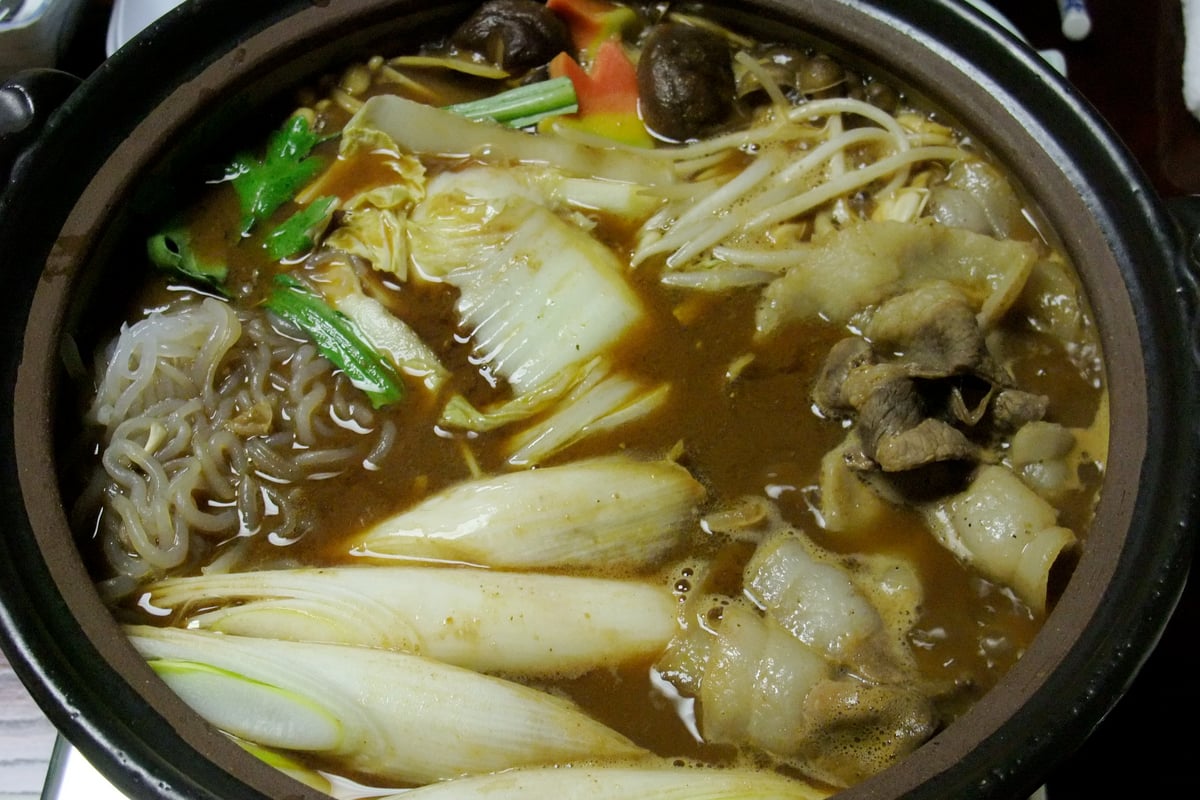
Botan nabe is a local dish of Tamba-Sasayama City, Hyogo Prefecture, in which wild boar meat (shishiniku) is simmered with vegetables in a miso-based broth. One explanation of the name is that the thinly sliced boar meat is arranged on a large platter like the petals of a peony (botan). Tamba-Sasayama is known as one of Japan's leading boar hunting grounds, and the dish is at its best from around mid-November, when the hunting season opens, to mid-March. According to the Ministry of Agriculture, Forestry and Fisheries, the dish is said to have begun around 1908 (Meiji 41), when the Army's 70th Infantry Regiment, stationed in Sasayama Town, put the meat of boars caught during training into miso soup. At first it was called 'ino nabe' (boar pot). In 1931 (Showa 6), the word 'botan nabe' was used in the lyrics of the folk song 'Sasayama Kouta,' and the name is said to have spread from there. Local ryori ryokan (inns known for their cuisine) and others served it as a winter specialty, and it also became a dish for entertaining guests at New Year and on special occasions. In 2022 it was recognized as one of the Agency for Cultural Affairs' '100-Year Foods.'
Origin
According to the Ministry of Agriculture, Forestry and Fisheries' 'Uchi no Kyodo Ryori' (Our Local Cuisine), the Army's 70th Infantry Regiment was stationed in Sasayama Town, Taki District, around 1908 (Meiji 41). The soldiers are said to have put the meat of boars they caught during training into miso soup, and this is said to be the origin of botan nabe. At first it was called 'ino nabe.' It is also said that soldiers who had come to know the taste of boar meat spread its reputation after returning to their hometowns, which helped make Sasayama's boar meat known throughout Japan. There are several theories about the dish's origin.
History
In 1931 (Showa 6), the predecessor of the Sasayama City Chamber of Commerce and Industry invited submissions of lyrics for the folk song 'Sasayama Kouta.' A work by a local, 斎藤子郊, was chosen, and the word 'botan nabe' is said to have appeared for the first time in its fourth verse. Because 'ino nabe' did not fit the song's seven-five syllable meter, the name was reportedly changed by association: the 'shishi' (lion) of 'karajishi botan' (the classic pairing of the Chinese lion and the peony), 'shishi' also being a word for wild boar, called the peony to mind. Later, local ryori ryokan began serving boar meat arranged like peony petals, and the dish became established as a winter specialty.
Features
The basic method is to simmer the ingredients in a broth made by dissolving a blend of white and red miso into dashi made from kombu and katsuobushi (dried bonito flakes). Besides boar meat, the ingredients include napa cabbage, burdock root, green onion, carrot, yama-no-imo (taro), and grilled tofu. The longer the boar meat simmers, the more tender it becomes, and its fat brings out sweetness and richness. Another characteristic is sprinkling on ground sansho pepper to taste. The arrangement of red lean meat and white fat laid out like a flower on a large platter is also visually striking.
Main Ingredients
Food Culture
In Tamba-Sasayama, botan nabe is served at many restaurants and inns in the city from around mid-November, when boar hunting opens, to around mid-March. It is also a dish for entertaining guests at New Year and on special occasions. In 2022 it was recognized as one of the Agency for Cultural Affairs' '100-Year Foods' and also received the Special Award from the expert panel.
Famous Shops
料理旅館 丹波篠山 近又
兵庫県丹波篠山市二階町81
A long-established ryori ryokan said to have been founded in 1609 (Keicho 14). It stands in the castle town near the ruins of Sasayama Castle and is known as one of the inns where botan nabe originated. The Kobe Shimbun has reported that the head of its predecessor, '近又楼,' devised this dish in the mid-Meiji period. One example of a botan nabe course is about 19,800 yen (tax included).
囲炉裏料理 いわや
兵庫県丹波篠山市火打岩495-1
A restaurant where you can enjoy rich miso-flavored botan nabe while sitting around an irori hearth in an old folk house. Tender boar meat is simmered with plenty of local vegetables. Botan nabe is served from November to the following March, and reservations are required. It is about 20 minutes by taxi from JR Sasayamaguchi Station.
丹波篠山 猪肉専門店 おゝみや
兵庫県丹波篠山市乾新町40(本店)
A boar meat specialty shop founded in 1949 (Showa 24). In addition to selling boar meat, it serves botan nabe and other gibier (game) dishes at locations such as its Jokamachi (castle town) store (丹波篠山市北新町118-1). It has also been selected for 'Five-Star Hyogo' (五つ星ひょうご) by the Hyogo Prefectural Products Association.
| おゝみや 'Botan Nabe Set' | A set from the boar meat specialty shop おゝみや for enjoying botan nabe at home. It includes 400 g of sliced boar loin for hot pot and the shop's own botan nabe miso (150 g × 2 packs). The regular price is about 13,750 yen, and early-reservation discounts are sometimes offered depending on the season. |
|---|
FAQ
Q. Why is it called 'botan nabe'?
A. One explanation is that the boar meat is arranged on a large platter like a peony (botan) flower. Another theory holds that the name began when 'ino nabe' was changed to 'botan nabe,' which fit the seven-five syllable meter, in the lyrics of the 1931 (Showa 6) folk song 'Sasayama Kouta.' The peony is said to have been suggested by the 'shishi' (lion) of 'karajishi botan.'