Image: Wikimedia Commons
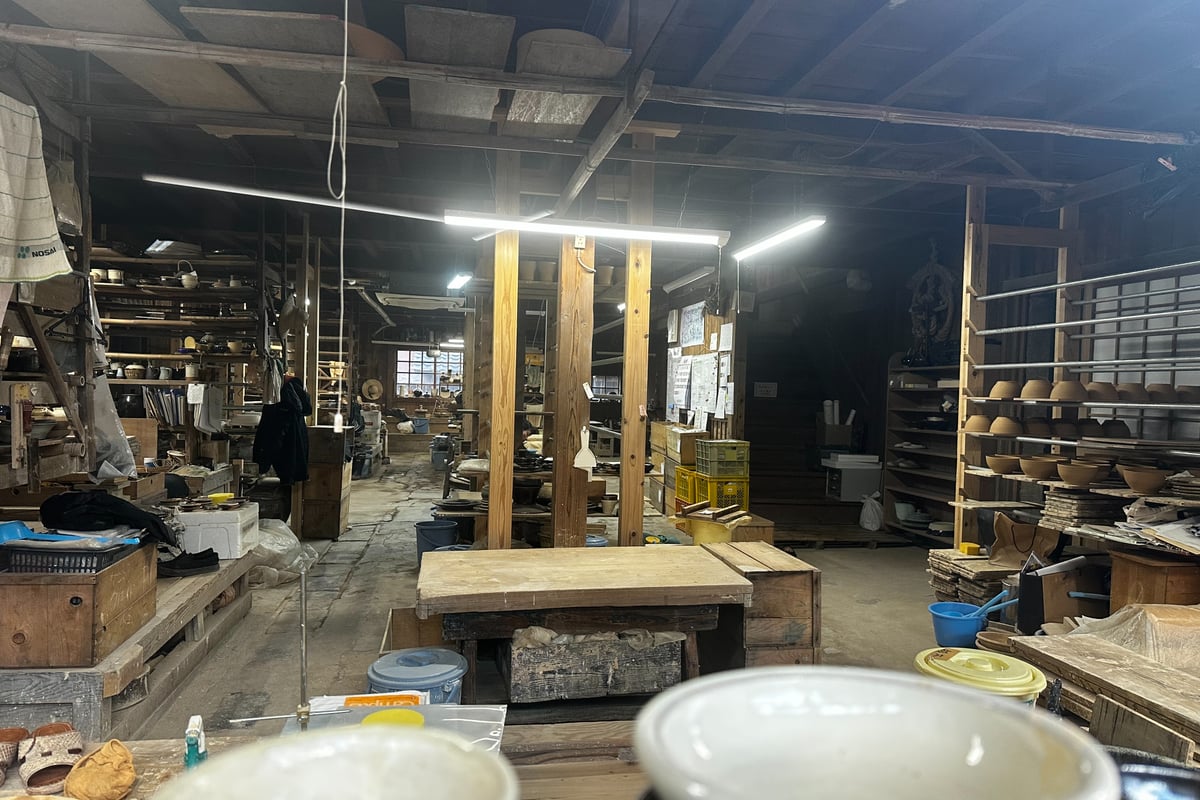
Shussai-gama is a mingei (folk craft) kiln in Shussai, Hikawa Town, Izumo City, Shimane Prefecture. It was founded in 1947 (Showa 22) by five young men who aspired to build a rural-industry community, with the cooperation of two supporters. Under the guidance of leading figures of the Mingei movement such as Kawai Kanjiro, Hamada Shoji, Yanagi Muneyoshi and Bernard Leach, it has continued to make practical vessels for everyday life. Valuing local raw materials, the kiln blends all of its own clay and glazes, mainly from raw materials produced in Shimane Prefecture. Another feature is that it has kept firing its climbing kiln (noborigama) since its founding. Its vessels include black glaze, amber glaze (ame-yu), white slip glaze (shirokake-ji-yu), namako glaze and gosu (cobalt blue) glaze, and its deep blue vessels, also called 'Shussai Blue', have become popular. Next to the workshop is くらしの陶・無自性館, an exhibition and sales space in a relocated rice storehouse from the early Meiji era. It is designated a Shimane Prefecture Furusato Traditional Craft under the name 'Shussai-yaki'.
Origin
Shussai-gama was founded in August 1947 by five young men: 井上寿人, 陰山千代吉, 多々納弘光, 多々納良夫 and 中島空慧. The starting point was the idea of creating a place in a postwar farming village where people could work together on crafts. The five learned techniques at kilns in various places, including 袖師窯 in Matsue, and took the pieces from their first firing out of the kiln in September 1948. Around this time they met Kawai Kanjiro and Hamada Shoji, and they are said to have been deeply moved by the ideas of mingei.
History
Having decided to join the Mingei movement, the group named the kiln Shussai-gama after the place name. In 1951 Yanagi Muneyoshi visited the kiln, and in 1952 the members studied under Yoshida Shoya of Tottori. In 1953 they also received guidance from Bernard Leach. In 1955 the kiln became an enterprise cooperative in which each member held one share and took part equally in management, and in 2015 it was reorganized into a stock company. In 2004 a series supervised by the designer Yanagi Sori, son of Yanagi Muneyoshi, was also launched.
Features
Based on the mingei spirit of 'making healthy, warm, practical pottery', Shussai-gama aims to make sturdy, affordable vessels that do not grow tiresome and can be used every day. It uses clay from Oda City, Unnan City and Izumo City in Shimane Prefecture and fires at 1,250 to 1,300 degrees. It makes a wide range of everyday vessels, including plates, bowls, rice bowls, tea utensils, sake ware and vases. The gosu-glazed plate with tessha (iron-oxide pigment) applied to the rim is one of its representative pieces and was selected in 2008 for an exhibition organized by the Japan Foundation (国際交流基金).
Techniques
Firing in a climbing kiln
A method of firing in a kiln with multiple firing chambers lined up along a slope. Shussai-gama has kept firing its climbing kiln since its founding, and today it unloads its six-chamber climbing kiln several times a year. Kerosene kilns and electric kilns are also used.
Blending raw materials in-house
All clay and glazes are blended at the kiln, mainly from raw materials produced in Shimane Prefecture. Valuing local clay and glaze materials is one of the shared aspirations held by the founding members. A raw materials area for preparing materials has also been set up on the premises.
A variety of glazes
Black glaze, amber glaze, white slip glaze, namako glaze, gosu glaze and others are used as suits each piece. Gosu is a pigment that produces a blue color, and the gosu-glazed plate with tessha applied to the rim is a representative vessel of Shussai-gama. Its deep blue vessels are also called 'Shussai Blue'.
Materials Used
Production Process
- 1
Refining the clay
Clay dug within the prefecture is refined into potter's clay suitable for vessels.
- 2
Shaping
Vessels are formed on a potter's wheel or by other means.
- 3
Bisque firing
The dried vessels are fired once.
- 4
Glazing
Glazes blended in-house are applied.
- 5
Loading the kiln
The vessels are arranged inside the kiln.
- 6
Main firing
The vessels are fired at a high temperature of 1,250 to 1,300 degrees.
| Main Production Areas |
|
|---|
Artisans & Workshops
出西窯
A kiln at 3368 Shussai, Hikawa Town, Izumo City. It is a cooperative kiln started by five young men in 1947, and its members still continue their work together with one mind. Shimane Prefecture materials list it as 企業組合出西窯 (Shussai-gama enterprise cooperative), the designated business for Shussai-yaki (it was reorganized into a stock company in 2015).
Official site →How to Buy
- くらしの陶・無自性館
- An exhibition and sales space next to the workshop where you can pick up and choose Shussai-gama vessels. Open from 9:30 to 18:00, closed on Tuesdays (except public holidays). A 2024 article introduced prices such as gosu-glazed bowls from 1,650 yen and morning cups at 2,750 yen.Where to buy →PR
- Online shop and retailers
- The official website links to an online shop and also publishes a list of retailers across Japan. The series directed by Yanagi Sori is sold nationwide through 柳ショップ in Tokyo.Where to buy →PR
Hands-on Experiences
出西くらしのvillage
島根県出雲市斐川町出西
An area centered on the Shussai-gama shop, with the bakery café 'ル コションドール' and the select shop 'Bshop'. At the café you can enjoy lunch and sweets served on Shussai-gama vessels. The café is open from 9:30 to 17:00 and is closed on Tuesdays and the second and fourth Wednesdays.
View details →FAQ
Q. Are Shussai-gama and Shussai-yaki different things?
A. Both refer to the vessels of the same kiln. Shimane Prefecture has designated it as a Furusato Traditional Craft under the name 'Shussai-yaki'; according to prefectural materials, the designation date was December 12, 1995, and the designated business is Shussai-gama. The kiln's name comes from 'Shussai', the place name in Hikawa Town, Izumo City, where it is located.
Q. What does the name '無自性館' mean?
A. It comes from the words of the philosopher 山本空外, whom Shussai-gama regarded as its teacher: 'Because all things follow from many conditions, they necessarily have no self-nature.' In other words, everything is thanks to others, and there is no achievement anywhere that is one's own. The building opened in 1998, the kiln's 50th anniversary, in a relocated rice storehouse from the early Meiji era.