Image: Wikimedia Commons
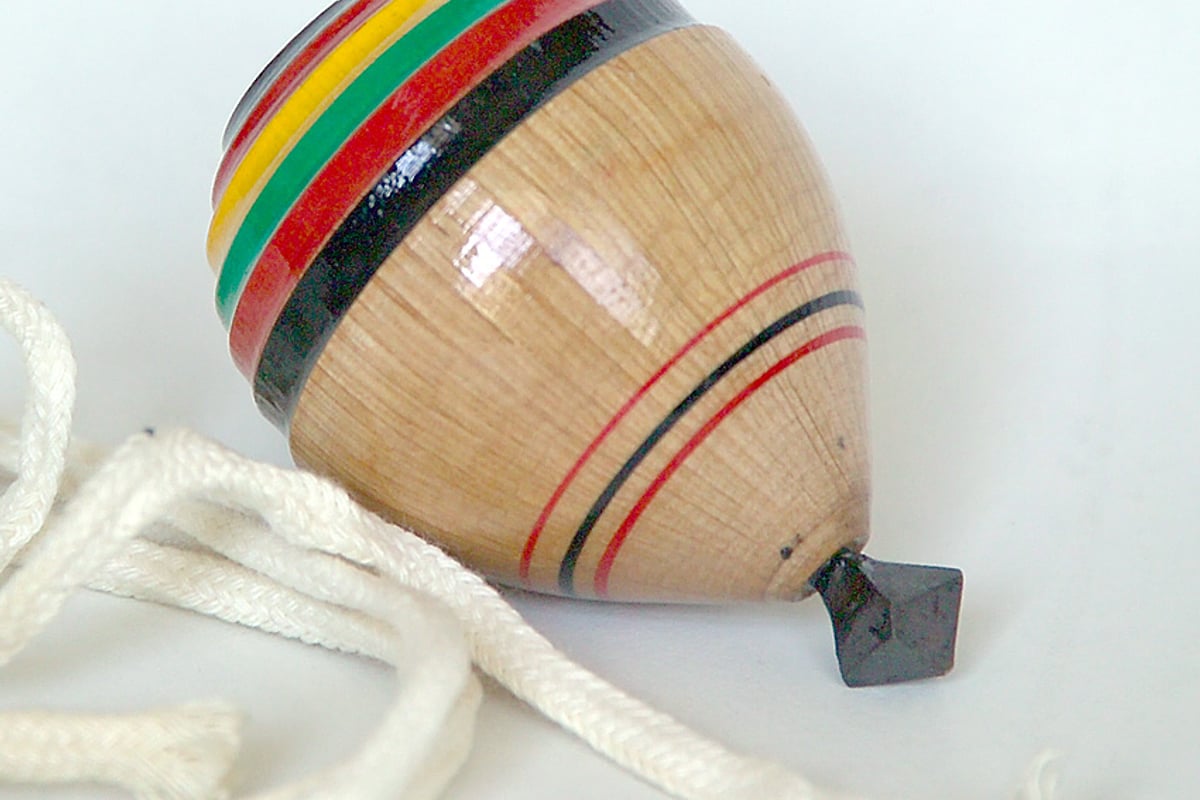
Sasebo tops (Sasebo-goma) are wooden spinning tops handed down in Sasebo City, Nagasaki Prefecture. They are characterized by a rounded body shaped like a rakkyo (Japanese scallion bulb) and an iron tip called a 'ken' (sword) driven into the point. The upper part of the body is painted in five colors, blue (green), red, yellow, white and black, a color scheme said to be influenced by the Chinese theory of yin-yang and the five elements. The top is spun by winding a cord around it and throwing it, and because it is played by striking an opponent's top, it is also called a 'kenka-goma' (fighting top). Its shape is said to belong to a Taiwanese or Indian lineage, and it is said to have come to Nagasaki from the south by way of China. In 1993 (Heisei 5), it was designated a Nagasaki Prefecture Traditional Craft. Today, 佐世保独楽本舗 (Sasebo Koma Honpo) continues to make it. Now that children's play has changed, it is also enjoyed as a good-luck item for the New Year, a gift for seasonal festivals (sekku) and an interior decoration.
Origin
According to Nagasaki Prefecture's introduction, the shape of Sasebo tops belongs to a Taiwanese or Indian lineage and is said to have come to Nagasaki from the south by way of China. 佐世保独楽本舗 says the tops were originally made by fishermen and have a history of about 300 years. Few historical records clearly show when or by what route they arrived, and these accounts are told as tradition.
History
According to the history of 佐世保独楽本舗, the shop's predecessor was 山本貞右衛門商店, founded in 1907. From around 1915 it focused on its toy and spinning top divisions. Full-scale production of the tops as folk crafts is said to have begun around 1949, after the war. In 1960 the shop developed a portable lathe and began demonstration sales of top making. The tops are also said to have been chosen as souvenirs for the 1964 Tokyo Olympics. In 1993 they were designated a Nagasaki Prefecture Traditional Craft, and the designation is described as covering tops made at this shop.
Features
The material is matebashii (Lithocarpus edulis), a broadleaf tree of the beech family. The body is shaped like a rakkyo and is top-heavy, so when it is held upside down and thrown, it rights itself and spins. The five colors on the upper part are also said to represent the world or the universe. The iron ken at the tip is diamond-shaped and made by hand one at a time. It is said that there is even a guardrail in Sasebo City modeled on these tops.
Techniques
Five-color painting
The upper part of the body is painted in five colors: blue (green), red, yellow, white and black. The white makes use of the natural color of the wood. The color scheme is said to be influenced by the theory of yin-yang and the five elements (a way of thinking that explains all things through the five elements of wood, fire, earth, metal and water), and the five colors are said to signify the world or the universe.
Ken (sword)
An iron core driven into the tip of the top, finished in a distinctive diamond (regular octahedron) shape. 佐世保独楽本舗 is said to make each one by hand. In kenka-goma, players compete by striking an opponent's top with this ken.
Materials Used
| Main Production Areas |
|
|---|
Artisans & Workshops
佐世保独楽本舗
A shop in Shimaji-cho, Sasebo City, that continues to make Sasebo tops. Its predecessor was 山本貞右衛門商店, founded in 1907, and the second-generation 山本貞右衛門 received the Nagasaki Prefectural Citizens' Award in 1983. It is said to make more than 300 kinds of tops for every season.
Official site →How to Buy
- 佐世保独楽本舗 shop
- The tops can be purchased at the shop, about a 10-minute walk from JR Sasebo Station. A tourism information site lists Sasebo tops from about 2,000 yen and kenka-goma from about 1,000 yen. Prices and business days and hours may change, so it is best to confirm by phone (0956-22-7934).Where to buy →PR
Hands-on Experiences
佐世保独楽本舗のワークショップ
長崎県佐世保市島地町9-13
Workshops such as making your own original top are held by reservation. The official website states that they are limited to groups such as schools and companies. There is a fee, and details and fees need to be confirmed through the inquiry form.
View details →FAQ
Q. How is kenka-goma played?
A. According to 佐世保独楽本舗, everyone first spins their tops at the same time with an underhand throw called 'hiki-goma,' and players are ranked in order of how long their tops spin. Then, starting from the last-place player, each throws overhand in a 'nage-goma' to strike the other tops. The rules are said to differ by region.
Q. Is there a call before spinning?
A. Before starting to spin, players are said to call out 'Ikinagashomon shokurabe.' It is described as meaning roughly 'let's compete to see who can spin the longest.' The ending of the phrase is also said to differ by region.
Q. Can a beginner spin one?
A. Tie a knot at one end of the cord, hold the other end down with your thumb, and wind the cord clockwise around the ken. Hold the knot between your ring finger and little finger, with the ken facing up. Pull your arm back and throw forward, and because the top is top-heavy, it naturally rights itself and spins.
Q. Are the tops known overseas?
A. According to 佐世保独楽本舗's chronology, from 1961 exports to Germany, Italy and France and exhibits at trade fairs in New York and San Francisco began in earnest. It is also said that in the Showa 20s, ryugo tops were ordered from Italy and France for use as buttons.