Image: Wikimedia Commons
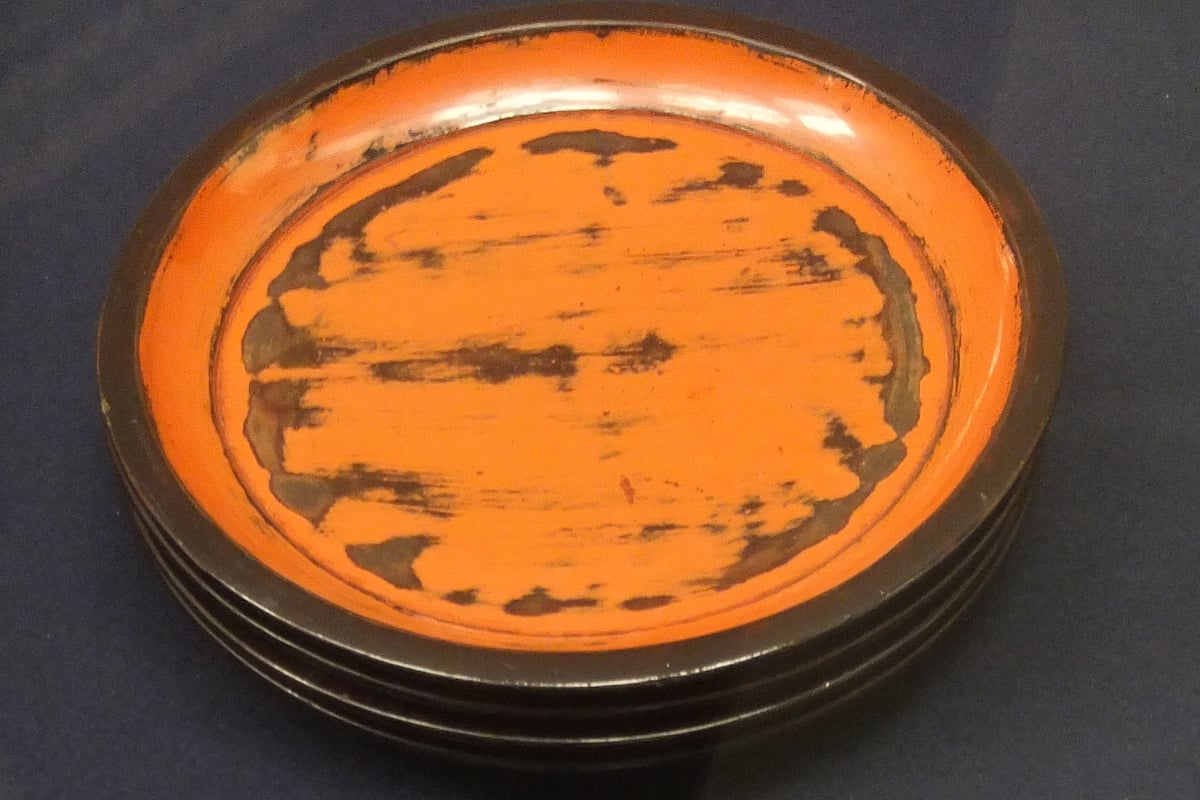
Negoro Nuri is vermilion lacquerware associated with Negoro-ji temple in Iwade City, Wakayama Prefecture. It is finished by applying vermilion urushi lacquer over an undercoat of black lacquer. Its appeal lies in the way the vermilion surface wears away with long use, revealing the black beneath here and there to form a distinctive pattern. It is said to have begun when monks at medieval Negoro-ji made the tableware, furnishings and Buddhist implements used at the temple. In 1585 (Tensho 13), most of the temple was burned in Toyotomi Hideyoshi's attack on Negoro, and lacquerware making at Negoro came to an end. The craftspeople are said to have moved to various places and passed on the techniques, and 'Negoro' also became a name for high-quality, durable vermilion lacquerware. Locally, in 1993 the then Iwade Town held training courses for craftspeople as a revival project, and the skills are being handed down once again. In 2007 (Heisei 19), it became a Wakayama Prefecture Governor-Designated Local Traditional Craft under the name 'Negoro-ji Negoro Nuri'.
Origin
Negoro-ji is a temple whose founder is Kakuban, who was active on Mount Koya (Koyasan) in the late Heian period. In 1288 (Shoo 1), Raiyu moved the temple registry of Daidenpo-in (大伝法院) to Negoro, and it became the headquarters of the Shingi Shingon school. Negoro Nuri is said to have begun when the monks of this temple made their own everyday tableware, furnishings and Buddhist implements. Vessels layered with black and vermilion lacquer were born as tools for daily life at the temple.
History
In the Muromachi period, Negoro-ji grew into a religious city with 450 monks' lodgings (2,700 according to one account). However, in 1585 it burned down in Hideyoshi's attack on Negoro, except for the Daishi-do hall, the Great Pagoda (Daito) and a few other buildings, and the craftspeople are said to have moved to places such as Kuroe in Kainan and Wajima. When the temple's vessels came out into the world during the haibutsu kishaku (anti-Buddhist movement) of the Meiji era, old Negoro pieces with worn vermilion came to be valued as works of art. Locally, revival training courses began in 1993, and the craft received prefectural designation in 2007.
Features
Negoro Nuri consists of simple vermilion-lacquered vessels without painted patterns. Vermilion lacquer is applied over black lacquer, and the more the piece is used, the more the vermilion wears away and the black beneath emerges. This mottled scenery of vermilion and black has long been favored by tea masters. It is said that 19 of the 26 steps in total are devoted to the undercoating, and layering the undercoat many times makes the piece durable. Pieces left in black lacquer without vermilion are called 'kuro-negoro' (black Negoro).
Techniques
Undercoating
The process that underpins the durability of Negoro Nuri. Of the 26 steps in total, 19 are said to be undercoating work, in which layers of lacquer undercoat are applied again and again to harden the wood base. In 2025, 池ノ上辰山 of Iwade City made a production process sample showing each of these steps one by one.
Layering black and vermilion lacquer
Black lacquer is applied over a robust undercoat, and finally vermilion lacquer is applied only once to finish. Because the vermilion layer is thin, it wears away with use and the black appears. This change over time is the true highlight of Negoro Nuri.
Togidashi
A technique in which the finished vermilion surface is polished so that the black shows through here and there. It is done to intentionally recreate, in new vessels, the texture of old Negoro pieces used over many years.
Materials Used
| Main Production Areas |
|
|---|
Artisans & Workshops
伊藤惠(紀州根来塗初根工房)
A Negoro Nuri lacquerer born in Iwade City. 伊藤惠 studied Japanese-style painting at 奈良芸術短期大学 and took the Negoro Nuri instructor training course started by Iwade Town in 1993. 伊藤惠 opened 紀州根来塗初根工房 within the grounds of Negoro-ji and holds workshops alongside production work.
池ノ上辰山
A maker of Negoro Nuri in Iwade City, born in 1959. In 2025, 池ノ上辰山 completed the 'Negoro Nuri production process sample', showing each of the 26 steps one by one, and placed it in the 岩出市民俗資料館 (Iwade City folk museum). It was also introduced in the special exhibition 'NEGORO 根来-赤と黒のうるし' (Negoro: red and black lacquer) held in Osaka the same year.
How to Buy
- 道の駅 ねごろ歴史の丘「花笑み館」
- The shop building of a roadside station (michi-no-eki) at 根来2020-1, Iwade City. It carries Negoro Nuri and other souvenirs from across Wakayama Prefecture. The shop is open from 10:00 to 18:00. Located near Negoro-ji and the 岩出市民俗資料館, it is easy to stop by along with a visit to them.
- 紀州根来塗初根工房
- 伊藤惠's workshop within the grounds of Negoro-ji. As examples of items for sale in 2022, vermilion bowls and katakuchi (lipped bowls) were 66,000 yen and sake cups from about 20,900 yen, and ebony chopsticks were also offered. Workshops are also held at the studio.
Hands-on Experiences
岩出市民俗資料館(根来塗工房)
和歌山県岩出市根来2306-1
It has a Negoro Nuri workshop where the production process can be observed on Wednesdays and Saturdays. Public courses on Negoro Nuri are also held. Admission is free; open from 9:00 to 16:30 and closed on Tuesdays (open on national holidays). In 2025, 池ノ上辰山's production process sample was also added to the collection.
FAQ
Q. Is it damage when the vermilion wears off and the black shows through?
A. No. In Negoro Nuri, where vermilion lacquer is applied over black lacquer, the vermilion wearing away with use to reveal the black is part of its character. This scenery of vermilion and black has long been favored by tea masters, and it is recreated in new vessels through togidashi.
Q. Does 'Negoro Nuri' refer only to pieces made at Negoro-ji?
A. Originally it referred to the vermilion lacquerware of Negoro-ji, but later it also came to be used as a general term for high-quality, durable vermilion lacquerware regardless of period or production area. Pieces made in Iwade City have received prefectural designation as 'Negoro-ji Negoro Nuri'.
Q. What is the relationship between Negoro Nuri and Kishu Shikki?
A. There is a theory that Negoro craftspeople moved to Kuroe in Kainan City after the attack on Negoro in 1585, and Kishu Shikki is also said to carry on the tradition of Negoro Nuri. However, there is also a theory that Kishu Shikki originated with kijishi (wood-turners) of the Omi lineage.