Image: Wikimedia Commons
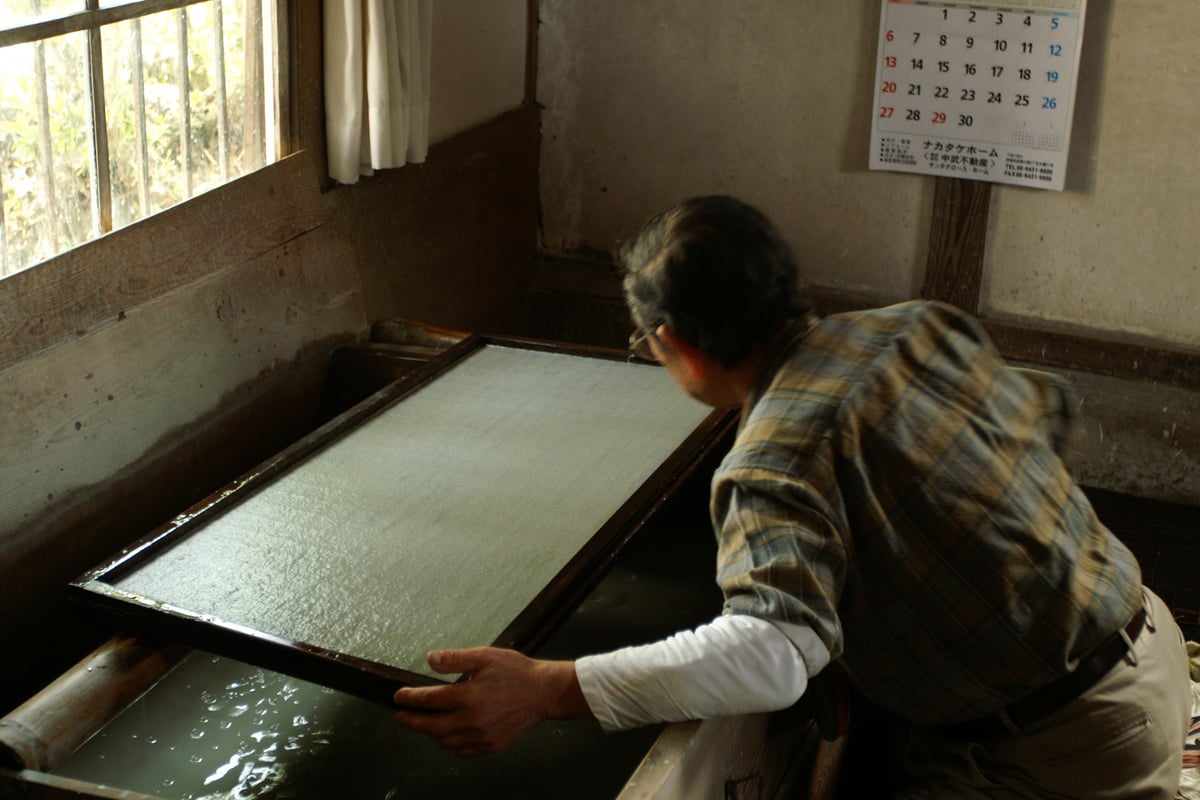
Najio-gami is handmade washi paper made in Najio, 塩瀬町, Nishinomiya City, Hyogo Prefecture. It is known for a unique technique in which mud from the area is mixed into the fibers of gampi (a shrub of the daphne family, Thymelaeaceae, used as a raw material of washi) before the paper is formed. Because it contains mud, it is said to be less prone to insect damage, less likely to fade or discolor in sunlight, and less prone to shrinking and stretching. The technique is said to have come from Echizen (Fukui Prefecture), and in the Edo period the area prospered so much from papermaking that it was called 'Najio Sengen' (Najio of a thousand households). It was valued as paper for han-satsu (domain paper money) and for fusuma (sliding doors) and folding screens, and today it is still used to make the base paper for hakuuchi-gami (paper for beating gold leaf), used when beating gold and other metal leaf thin, as well as maniai-shi (fusuma paper). It has also been used in the restoration of cultural properties such as Nijo Castle and Nishi Honganji. It was designated a Hyogo Prefecture Intangible Cultural Property in 1983 and a Hyogo Prefecture Designated Traditional Craft in 1993. In 2002, 谷野武信 was recognized as the holder of the national Important Intangible Cultural Property 'Najio gampi paper' (名塩雁皮紙).
Origin
Papermaking in Najio is said to have begun with techniques brought from Echizen. According to a widely known legend, 東山弥右衛門 of Najio married into a papermaking family in Echizen as an adopted son-in-law, learned the techniques, and returned to Najio to start papermaking. Theories about when the techniques arrived range from the Bunmei era (1469-1487) to the Keicho and Genna eras (1596-1624). In 1855, people engaged in papermaking erected a monument honoring the virtues of 東山弥右衛門.
History
The Kefukigusa, a book on haikai poetry published in 1638, lists 'Najio torinoko' among the products of Najio. Because it did not fade in the sun and could be stored for a long time, from around the mid-Edo period it was used as paper for the han-satsu of domains in the Kinki and Chugoku regions. Demand was also high for its use as the top and under layers of high-grade fusuma and folding screens, and Najio flourished so much that it was called 'Najio Sengen.' At the end of the war there were 25 to 26 papermakers, but their number declined with postwar changes in lifestyles and with development. Today only a few workshops make the traditional washi.
Features
The greatest feature of Najio-gami is that local mud is mixed with gampi when the paper is formed. The mud is taken from the bedrock of Najio, and four kinds of different colors are used selectively: white 東久保土, pale yellow 天子土, light brown 蛇豆土, and a blue earth. Mixing in mud is said to prevent insect damage and to make the paper resistant to heat, with little shrinking, stretching or discoloration. Noriutsugi is used for the neri (mucilage added to the paper stock). The main products today are base paper for leaf beating and kizuki (unblended) maniai-shi.
Techniques
Mixing in Mud
Mud of different colors taken from the bedrock of Najio is strained through a cotton bag and mixed into the gampi paper stock before the paper is formed. In Nishinomiya City's courses, tuff from Najio (rock formed from consolidated volcanic ash) is added to the raw materials when making paper. The shade of the paper changes depending on the type of mud.
Base Paper for Hakuuchi-gami
Hakuuchi-gami is the paper used to sandwich gold or silver leaf when beating it thin. In gold leaf production areas, handmade washi from Najio and elsewhere is used as the base paper, and it is finished by repeatedly soaking it in a liquid mixed with rice straw lye, persimmon tannin (kakishibu), egg white and other ingredients and then drying it. Najio has a paper mill that specializes in making hakuuchi-gami.
Materials Used
Production Process
- 1
Peeling and Removing the Black Bark
The bark of gampi is peeled, and the black outer bark is meticulously removed to leave the white bark. This is painstaking handwork.
- 2
Boiling and Beating
The white bark is cooked in a cauldron to soften it, then washed and beaten to break the fibers down finely, a process called 'kokai' (beating). Remaining impurities are removed by hand.
- 3
Papermaking (Sheet Forming)
Mud from Najio is added to the paper stock and the paper is formed. By changing the type of mud added, papers of different shades are produced.
- 4
Board Drying
The formed sheets are pasted onto drying boards to dry. In Nishinomiya City's courses, the sheets are dried for two days and then peeled from the drying boards to finish them.
| Main Production Areas |
|
|---|
Artisans & Workshops
谷徳製紙所
A paper mill at 2-2-23 Najio, Nishinomiya City. It is the workshop of 谷野武信, who was recognized in 2002 as the holder of the national Important Intangible Cultural Property 'Najio gampi paper' (名塩雁皮紙), and it produces every type of Najio gampi paper. Its paper has been used in the restoration of cultural properties such as Nijo Castle, Nishi Honganji and Katsura Imperial Villa.
馬場製紙所
A paper mill at 1-21-18 Najio, Nishinomiya City, that has continued since the early Meiji era. 馬場和比古, the fourth-generation head, specializes in making hakuuchi-gami and received the Merit Award of the Traditional Craft Industry Grand Prize in 2011. 馬場和比古 is a member of the Najio-gami Technique Preservation Society (名塩紙技術保存会) and also serves as a papermaking promotion committee member at the Najio Washi Learning Center (名塩和紙学習館).
Hands-on Experiences
名塩和紙学習館
兵庫県西宮市名塩2丁目10番8号
An annex of the Nishinomiya City Local History Museum (西宮市郷土資料館), built in 1989. The second floor displays the history and tools of Najio-gami, and admission is free (closed on Mondays and during the year-end and New Year holidays). Papermaking courses cost about 700 to 1,000 yen for junior high school students and older, and applications are made by postcard or through the city's online application form. Group sessions require a telephone reservation at least one month in advance.
View details →FAQ
Q. Why is mud mixed into the paper?
A. Because mixing in mud makes the paper less prone to insect damage, resistant to heat, and less likely to shrink, stretch or discolor. Because it does not fade in the sun and can be stored for a long time, it has been valued for han-satsu, fusuma and the restoration of cultural properties.
Q. How is Najio-gami related to making gold leaf?
A. Gold leaf is made by sandwiching it between sheets of paper called hakuuchi-gami and beating it thin. Handmade washi from Najio and elsewhere is mainly used as the base paper for hakuuchi-gami. Najio also has a paper mill that specializes in making hakuuchi-gami.