 1 / 2
Image: Wikimedia Commons
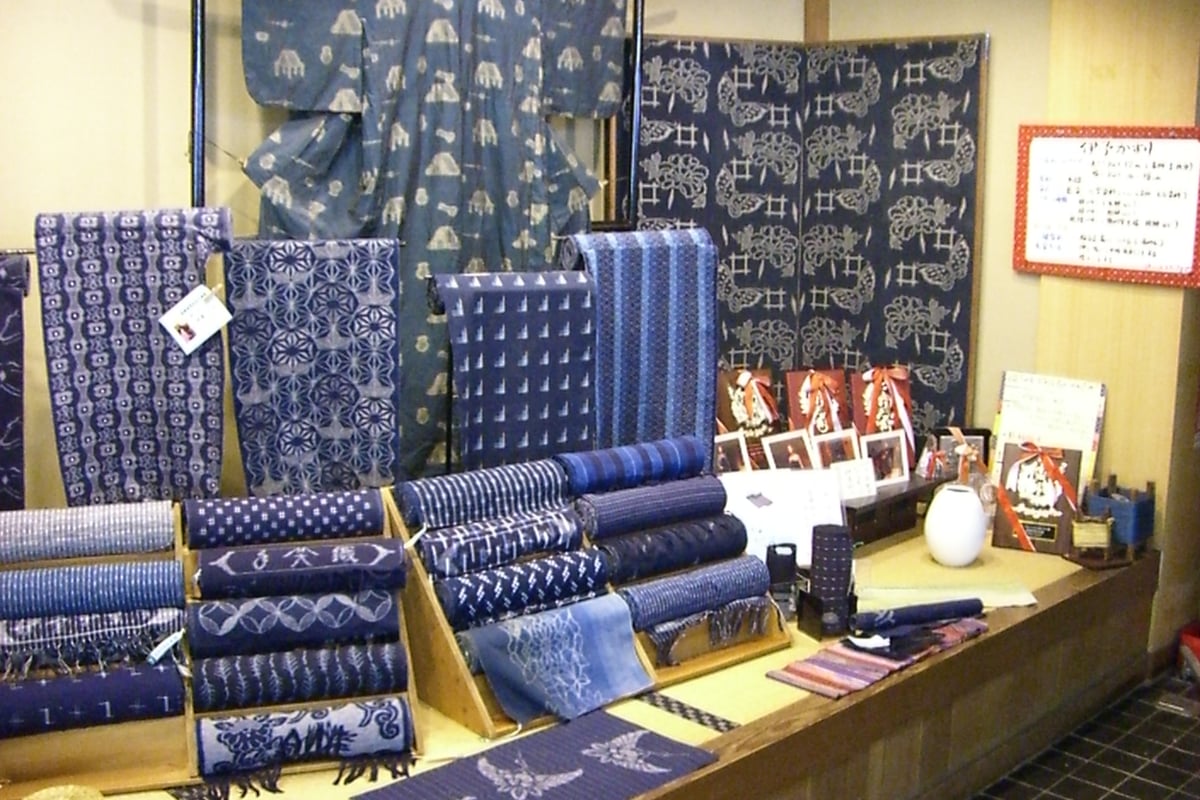
Iyo Kasuri is a cotton kasuri (ikat) that has been made mainly in Matsuyama City, Ehime Prefecture. Kasuri is a textile in which the parts of the yarn meant to form the pattern are bound with thread to keep them from taking the dye, and the indigo-dyed yarns are then woven while the pattern is aligned. It is counted, along with Kurume Kasuri (Fukuoka Prefecture) and Bingo Kasuri (Hiroshima Prefecture), as one of Japan's Three Major Ikat Weaves. It is said to have been devised in the Kyowa era of the late Edo period (1801-1804) by Kagiya Kana of Imazu in Iyo District (present-day Nishihabu-machi, Matsuyama City). It was also called 'Imazu-gasuri.' Production grew greatly in the Meiji period, and in 1904 (Meiji 37) it is said to have become the largest in output in Japan. Igeta (parallel-cross) and cross patterns, with their striking contrast of white and navy, are representative, and because it is durable, it was used for everyday clothes and work clothes. It is a Traditional Specialty Product (designated by Ehime Prefecture), and in 2025 (Reiwa 7) the techniques of Iyo Kasuri were designated an Intangible Cultural Property of the prefecture. At 伊予かすり会館 (Iyo Kasuri Kaikan) in Okaido, Matsuyama City, visitors can view exhibits and try indigo dyeing.
Origin
Kagiya Kana was born in 1782 (Tenmei 2) in Imazu, Habu Village, Iyo District. While weaving a striped cotton called Iyo Yuki, a side job for farming households, she is said to have gotten the idea for kasuri when she saw that white marks from tied rope remained on old bamboo used in a thatched roof. She devised it in the Kyowa era, and in 1830 (Tenpo 1) she worked out a way to weave new kasuri patterns on a loom for weaving stripes. In 1844 (Koka 1), she is said to have started indigo-dyed Imazu-gasuri, which later became Iyo Kasuri.
History
In the Bunka era (1804-1818), Kikuya Shinsuke adapted the takabata (high loom) of Nishijin in Kyoto for cotton kasuri, and production advanced under the protection of the Matsuyama domain. In the Meiji period, output grew greatly, and in 1904 it is said to have become the largest in Japan, accounting for about 25% of the nation's kasuri production. Right after the Russo-Japanese War, annual production is also said to have reached about 2.47 million tan (bolts). After that, demand fell as lifestyles became Westernized, and only a very small number of producers remain.
Features
It centers on kon-gasuri, in which white patterns appear on an indigo-dyed navy ground, and there is also shiro-gasuri, in which patterns are brought out on a white ground. Because wide spacing is left between motifs and the lines are thick, it is said to have a rustic charm. Representative patterns are igeta and crosses, and e-gasuri (pictorial kasuri) depicting cranes, turtles and the like was once also a distinctive feature. The indigo is said to grow brighter the more it is washed; large-patterned cloth was used for futon covers, and medium- and small-patterned cloth for everyday clothes and work clothes.
Techniques
Kukuri (Resist Binding)
Before the yarn is dyed, the parts meant to form the pattern are tightly bound with other thread or similar material so that indigo cannot soak in. When the binding is undone after dyeing, only those parts remain white. During weaving, these white parts are aligned little by little to form the pattern.
Indigo Dyeing and Hand Weaving
The bound yarn is dyed with indigo to a navy color. When weaving, the weaver checks the pattern while working so that the white parts of the warp and weft do not shift out of alignment. Some makers today are working on natural indigo vats, in which indigo is fermented with lye from wood ash (aku), and on restoring the Kikuya-style takabata loom.
Materials Used
| Main Production Areas |
|
|---|
Artisans & Workshops
白方興業株式会社
A company in Matsuyama City that operates 伊予かすり会館 and has worked to pass on the techniques of Iyo Kasuri. In cooperation with craft shops, it has also been involved in developing products suited to modern life, such as Iyo Kasuri floor cushions dyed with natural indigo.
イオリ工芸(白方宣年さん)
A workshop founded in 2005 by 白方宣年, who served as chief researcher of Iyo Kasuri at 白方興業. He works on fermenting natural indigo and restoring the Kikuya-style takabata loom, and in 2025 he was certified as a holder of the prefecturally designated Intangible Cultural Property of Iyo Kasuri.
How to Buy
- 伊予かすり会館 (Art Labo KASURI)
- 伊予かすり会館, on the Matsuyama Ropeway shopping street, sells everyday items made with Iyo Kasuri, such as coasters, pouches and noren (shop curtains). It is open from 9:00 to 17:00 and closes irregularly.Where to buy →PR
Hands-on Experiences
伊予かすり会館(Art Labo KASURI)
愛媛県松山市大街道3-8-1
A facility that moved from Kumanodai, Matsuyama City, in 2019, with exhibits conveying the history of Iyo Kasuri. Visitors can try indigo dyeing and making Hime Daruma (Princess Daruma Dolls); advance reservations by phone are required. It is about a 5-minute walk from the Okaido stop on the city streetcar.
View details →鍵谷カナ頌功堂
愛媛県松山市西垣生町1253
An octagonal hall built in 1929 (Showa 4) by the Iyo Textile Trade Association to honor the achievements of Kagiya Kana; it is a national Registered Tangible Cultural Property. It was designed by Kigo Shichiro, who also designed the main building of the Ehime Prefectural Office. Kana's grave, designated a prefectural historic site, is at nearby Choraku-ji Temple.
FAQ
Q. What are Japan's Three Major Ikat Weaves?
A. The term refers to three kasuri: Iyo Kasuri (Ehime Prefecture), Kurume Kasuri (Fukuoka Prefecture) and Bingo Kasuri (Hiroshima Prefecture). All are cotton kasuri in which patterns are woven with indigo-dyed yarn, and they have been loved as everyday clothes and work clothes for their durability.
Q. Is Iyo Kasuri still made today?
A. With falling demand, only a very small number of makers remain, but the techniques continue to be passed down. In 2025, the techniques of Iyo Kasuri became an Intangible Cultural Property designated by Ehime Prefecture, and 白方宣年 and 村上君子 were certified as holders.
Q. What patterns does Iyo Kasuri have?
A. Patterns such as sarashidama, fuso, kobai, kufu-gasuri, kagasuri (mosquito kasuri) and yane-gasuri (roof kasuri) have been woven. From around the end of the Meiji period, iroiri-gasuri, which adds colors other than indigo, was also made. Today, the focus is said to be on simple patterns spread across the whole cloth, such as cross kasuri and igeta kasuri.