Image: Wikimedia Commons
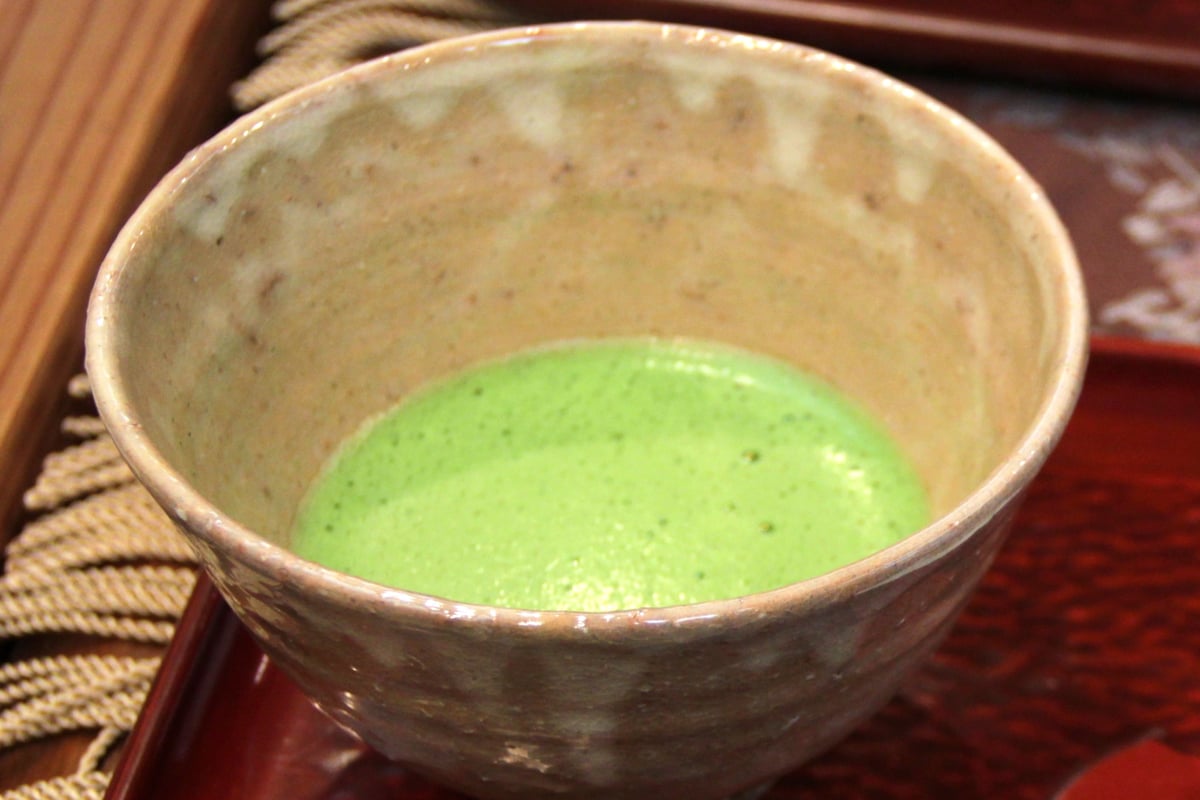
Hagi-yaki (Hagi ware) is pottery fired mainly in Hagi City, Yamaguchi Prefecture, as well as in Nagato City, Yamaguchi City and Abu Town. It is said to have begun in the early Edo period, when Mori Terumoto, lord of the Hagi Domain, had the potter brothers Ri Shakko (李勺光) and Ri Kei (李敬), whom he had invited from the Korean Peninsula, open an official domain kiln. Its appeal lies in the soft feel of its clay, which is only lightly vitrified in firing, and in its high water absorbency. With use, tea and sake seep in through the fine cracks on the surface (crazing, or kannyu), and the color of the vessel gradually changes. This is called 'Hagi no Nanabake' (the seven changes of Hagi) and has long been cherished by tea masters. Shapes and decoration are simple, and painted decoration is rarely applied. Instead, people enjoy the variations in color produced by the clay, the glaze and the flames of the climbing kiln (noborigama). In the world of the tea ceremony there is a saying, 'first Raku, second Hagi, third Karatsu', and Hagi tea bowls have been rated as masterpieces second only to Raku ware. In 2002 (Heisei 14), Hagi-yaki was designated a Traditional Craft by the Minister of Economy, Trade and Industry. More than 100 kilns are scattered throughout Hagi City, and some facilities offer hands-on experiences in hand-building (tebineri) and painting.
Origin
Hagi-yaki is said to have begun when, after the Bunroku and Keicho campaigns (1592-98), Mori Terumoto brought the brothers Ri Shakko and Ri Kei from the Korean Peninsula. When the Mori clan moved to Hagi, the brothers built the domain's official kiln at Matsumoto (present-day Chinto, Hagi City) in the castle town. The most common view is that the kiln was opened around 1604 (Keicho 9), but the dates vary depending on the source. Ri Kei later received the name 'Saka Koraizaemon' (坂高麗左衛門) from the domain lord, and the name has been passed down through the generations to the heads of the Saka family.
History
At first its style was close to Korean Koryo tea bowls (Korai chawan), and it later incorporated elements such as the style of Raku ware, developing into Hagi's own tea ceramics. Around 1657, a branch of Ri Shakko's descendants moved their kiln to Sannose in Fukawa-Yumoto, Nagato City, giving rise to the 'Fukawa Hagi' lineage (some accounts give 1653). The lineage at Matsumoto in the castle town came to be called 'Matsumoto Hagi', and in 1663 Miwa Kyusetsu opened the Miwa kiln. Hagi-yaki declined after losing the domain's patronage with the Meiji Restoration, but figures such as Sakakura Shinbei XII revived it as tea ceramics. In 1970 and 1983, two members of the Miwa family were recognized as holders of an Important Intangible Cultural Property (Living National Treasure).
Features
The main raw material is Daido clay (daido-tsuchi), a clay mixed with sand and gravel found around Hofu City, blended with iron-rich Mishima clay and white Mitake clay. Because the ware is fired at a relatively low temperature and only lightly vitrified, it is soft and readily absorbs water. The change in color as tea or sake seeps in is also called 'chanare' (seasoning by tea). Many pieces are covered with a milky white straw-ash glaze (warabai-yu) or a transparent ash glaze. Among tea bowls, the wari-kodai (also called kiri-kodai), a foot ring (kodai) with part of it cut away, is another shape characteristic of Hagi-yaki.
Techniques
Slip coating and hakeme (brush marks)
A technique in which a slip (deisho) made by dissolving white clay in water is applied to a formed vessel while it is still half-dry, to adjust the color of the body. Hakeme, in which white clay is brushed on and the brush marks are left visible, as well as inlay (zogan) and stamped decoration (inka), are also used, and decoration is kept restrained.
Straw-ash glaze and climbing-kiln firing
The basic glazes are wood-ash glaze, straw-ash glaze and iron glaze; straw-ash glaze turns milky white when fired, while ash glaze becomes transparent. The vessels are packed into a multi-chambered climbing kiln, and the chambers are fired one after another starting from the lowest, raising the temperature to about 1,250 to 1,300°C. Kiln transformation (yohen), in which colors change depending on how the flames strike each piece, gives every piece its own expression.
Materials Used
Production Process
- 1
Preparing the clay
Daido clay, Mishima clay and Mitake clay are blended, refined by elutriation (suihi) and trodden underfoot to remove air bubbles.
- 2
Forming
Shapes are made by wheel throwing, hand-building (tebineri), press molding (oshigata), slab building (tatara) and other methods, then dried in the shade for 2 to 3 days.
- 3
Trimming and slip coating
The shape is refined with a trimming tool (kanna) and the foot ring is carved out, and white clay is applied as needed.
- 4
Bisque firing
The pieces are fired slowly at about 700 to 800°C for around 15 to 16 hours.
- 5
Glazing
Glazes such as ash glaze and straw-ash glaze are applied.
- 6
Main firing
The pieces are packed into the climbing kiln and fired at about 1,250 to 1,300°C, then cooled for a full day and night to several days before being taken out.
| Main Production Areas |
|
|---|
Artisans & Workshops
坂倉新兵衛窯
A kiln at Sannose in Fukawa-Yumoto, Nagato City, and one of the prestigious kilns of the Fukawa Hagi lineage descended from Ri Shakko. The 12th-generation head is regarded as the 'restorer of Hagi-yaki' (Hagi-yaki chuko no so), who spread Hagi-yaki as tea ceramics. 坂倉正紘, son of the 15th-generation head and heir to the kiln, makes works such as ido-style tea bowls blended with a large proportion of Mishima clay. Visits require an inquiry in advance.
Official site →天龍窯
A kiln in Chinto, Hagi City, with a shop and a factory on the same site. It handles a wide range of wares, from vessels of contemporary design to Japanese-style pieces and tea bowls by individual artists, and series such as 'Hanabira' (花びら) and 'Rinka' (凛花) come in different colors and sizes. Visitors can also try wheel throwing and tour the factory.
Official site →How to Buy
- 萩焼会館
- A large Hagi-yaki store at 3155 Chinto, Hagi City, carrying a wide selection of Hagi-yaki, from tea utensils to everyday tableware. There are also modern-design Hagi-yaki and painted vessels made in collaboration with an Arita ware kiln. Souvenirs such as famous local sweets are also sold, and it is open from 8:30 to 17:00.Where to buy →PR
Hands-on Experiences
萩焼会館
山口県萩市椿東3155
You can try painting a teacup (30 minutes, from about 2,200 yen) and hand-building (60 minutes, about 3,300 yen per piece). Reception hours are 9:00 to 11:30 and 13:30 to 15:30, and groups of 10 or more need a reservation. Shipping for the fired pieces is charged separately.
View details →吉賀大眉記念館
山口県萩市椿東10426-1
A memorial museum displaying works by the potter Yoshika Taibi (吉賀大眉); admission is included in the experience fee. Painting starts from about 2,200 yen for a teacup, hand-building from about 3,520 yen, and electric wheel throwing has a basic fee of 3,300 yen plus a charge depending on the item made. It is open on Fridays, Saturdays, Sundays and national holidays.
View details →FAQ
Q. What is 'Hagi no Nanabake'?
A. Because Hagi-yaki is only lightly vitrified and absorbs water, tea and sake seep in through the fine cracks on its surface (crazing). The way the color of the vessel gradually changes over long use is called 'Hagi no Nanabake' (the seven changes of Hagi). Among tea masters, this change has been prized as part of the vessel's charm.
Q. What is the difference between Matsumoto Hagi and Fukawa Hagi?
A. The lineage that has continued at Matsumoto (Chinto, Hagi City) in the Hagi castle town is called Matsumoto Hagi, and the lineage that has continued at Sannose in Fukawa-Yumoto, Nagato City, is called Fukawa Hagi. Fukawa Hagi is said to have begun with a kiln opened by Ri Shakko's descendants and others who moved there in the early Edo period. Both have been handed down as official kilns of the domain.