Goto Baramon Kites
Goto Baramon-dako (Demon Kites of the Goto Islands)
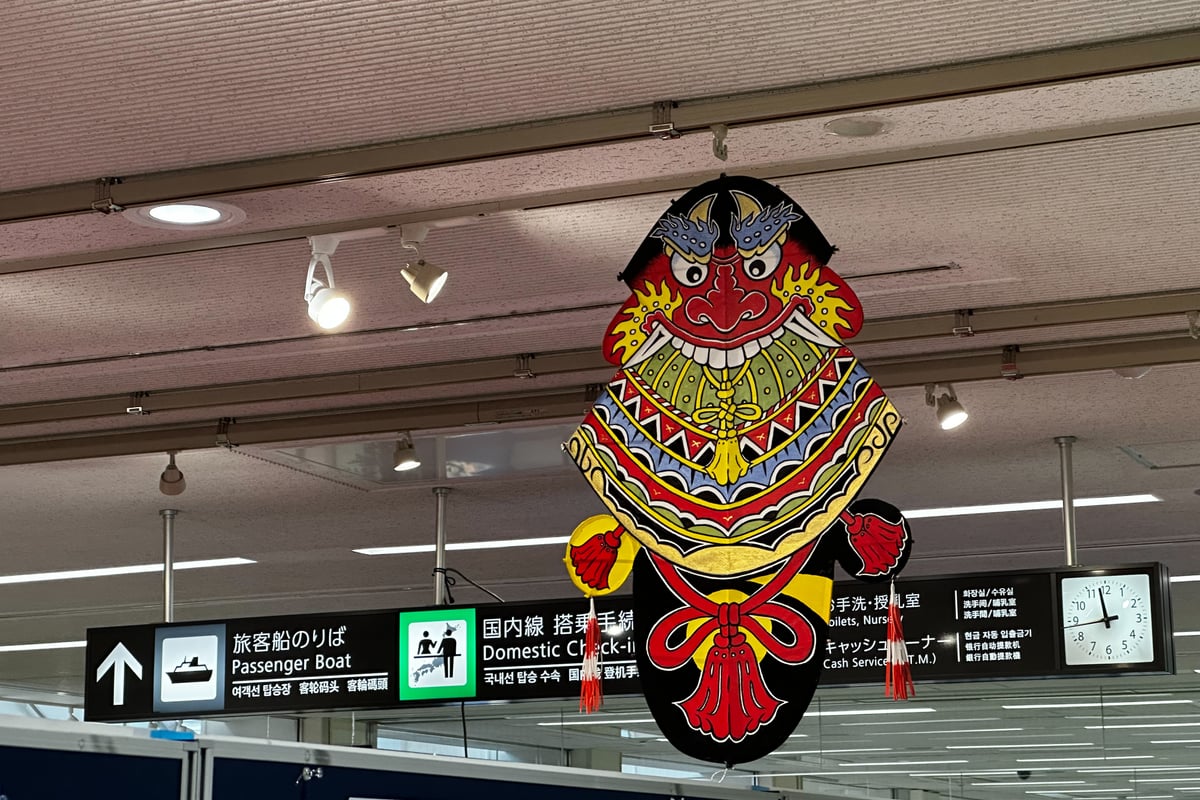
Image: Wikimedia Commons
Goto Baramon kites (Goto baramon-dako) are kites that have long been made and handed down on Fukue Island in Goto City, Nagasaki Prefecture. 'Baramon' is said to derive from 'baraka,' a word in the Goto dialect, and to describe an energetic or rough-and-tumble person. They are characterized by a demon at the top, the back view of a warrior's helmet in the middle section, and a swirl in a storm at the bottom. The design is described as expressing the bravery of a warrior who keeps moving forward even with his helmet bitten by a demon. An 'unari' (hummer) is attached to the top of the kite, producing a distinctive humming sound when the kite is flown. There is a custom of fathers and grandfathers flying the kite on a boy's first seasonal festival (hatsu-zekku) to ward off misfortune and pray for the child's healthy growth and success in life. In 1993 (Heisei 5), they were designated a Nagasaki Prefecture Traditional Craft. Today they are also cherished as good-luck items, decorated with the name of a child or a shop and displayed as charms against evil.
Origin
According to 五島民芸 (Goto Mingei), baramon kites have long been made on Fukue Island in the Goto Islands. There are various theories about the origin of the name, and it is said to derive from the dialect word 'baraka' (energetic, rough) or from 'barakamon,' meaning a cheerful, boisterous person. The origin of the demon-and-helmet design is unclear, but a folktale is handed down about a samurai who escaped a demon thanks to his helmet.
History
It is said to be the custom for a grandfather or father, thinking of his child, to make a kite and fly it high in the sky on a boy's first seasonal festival. 五島民芸 has been making and selling them by hand one at a time since 1965 (Showa 40). On May 21, 1993, the shop's baramon kites were designated Nagasaki Prefecture Traditional Craft No. 10. In recent years there have been many orders for decorative kites bearing names, and a kite-flying festival is also held at Mt. Onidake.
Features
The design consists of three tiers, from the top: a demon, the back view of a warrior's helmet, and a storm swirl. The shape of a cross (cruz) can be seen within the picture. This hints at a connection with the islands' history as a home of Hidden Christians, but its origin is said to be unknown. A tourism commentary by the Ministry of Land, Infrastructure, Transport and Tourism states that the demon-and-helmet design is unique to Goto. The warrior depicted is said to be Watanabe no Tsuna, and the frame is described as consisting of 14 crossed bamboo pieces.
Techniques
Unari (hummer)
A part attached above the demon's head, made of a bamboo bow strung with cord. When it catches the wind it vibrates and produces a distinctive humming sound. This sound is said to drive away bad luck, and it carries the wish to ward off misfortune from the child.
Painting
The demon and helmet are painted in vivid colors on washi (Japanese paper) pasted onto the bamboo frame. The colors and decoration are said to be decided by the maker. 五島民芸's decorative kites of 80 cm or more are covered with cloth and are described as being made to resist tearing.
Materials Used
| Main Production Areas |
|
|---|
Artisans & Workshops
五島民芸
A shop in Kamiotsu-machi, Goto City, that makes and sells baramon kites. It has been making them by hand one at a time since 1965, and its head is 野原一洋. It also creates designs featuring a dragon or cranes at sunrise, and visitors are said to be able to watch the production for free. It is about 2 minutes by car from Fukue Airport.
Official site →How to Buy
- 五島民芸 (shop and mail order)
- Besides buying at the shop, you can order by phone or fax and have kites shipped anywhere in Japan. The official website lists a decorative kite about 80 cm tall at 5,500 yen and one about 100 cm tall at 11,000 yen. Prices may change. The 80 cm size is said to be unsuitable for flying, so it is reassuring to tell the shop how you plan to use it when choosing.Where to buy →PR
Hands-on Experiences
五島コンカナ王国ワイナリー&リゾート
長崎県五島市上大津町2413
It was announced that a baramon kite painting experience would be offered year-round from February 2025. The fee is 2,500 yen per person, it takes about 60 minutes, and you can take your kite home. Apply by phone or at the front desk by 18:00 the day before. Please confirm fees and availability in advance.
View details →鬼岳で遊ぼう!バラモン凧揚げ大会
長崎県五島市上大津町 鬼岳園地
A kite-flying festival held at Onidake Park in Saikai National Park. In 2026 it was held on May 3, and participation is described as free. Inquiries go to the Goto City Tourism Association (0959-72-2963). The date changes from year to year, so please check in advance.
View details →FAQ
Q. Can baramon kites actually be flown?
A. Some kites can be flown, but 五島民芸 says the 80 cm size is not suitable for flying. Some hometown tax donation (furusato nozei) gifts are also clearly marked as not flyable. If you want to fly one, it is reassuring to tell the seller how you will use it and check when buying.
Q. On what occasions are they given?
A. There is a custom of giving them on a boy's first seasonal festival to ward off misfortune and pray for healthy growth. Some sources place this festival on the 3rd day of the 3rd month of the lunar calendar, and others on May 5. Today there are said to be many orders for kites with names to display at home or to celebrate a shop opening.