Tarai Udon (Udon Served in a Wooden Tub)
Tarai Udon (Kama-age Udon Served in a Wooden Tub)
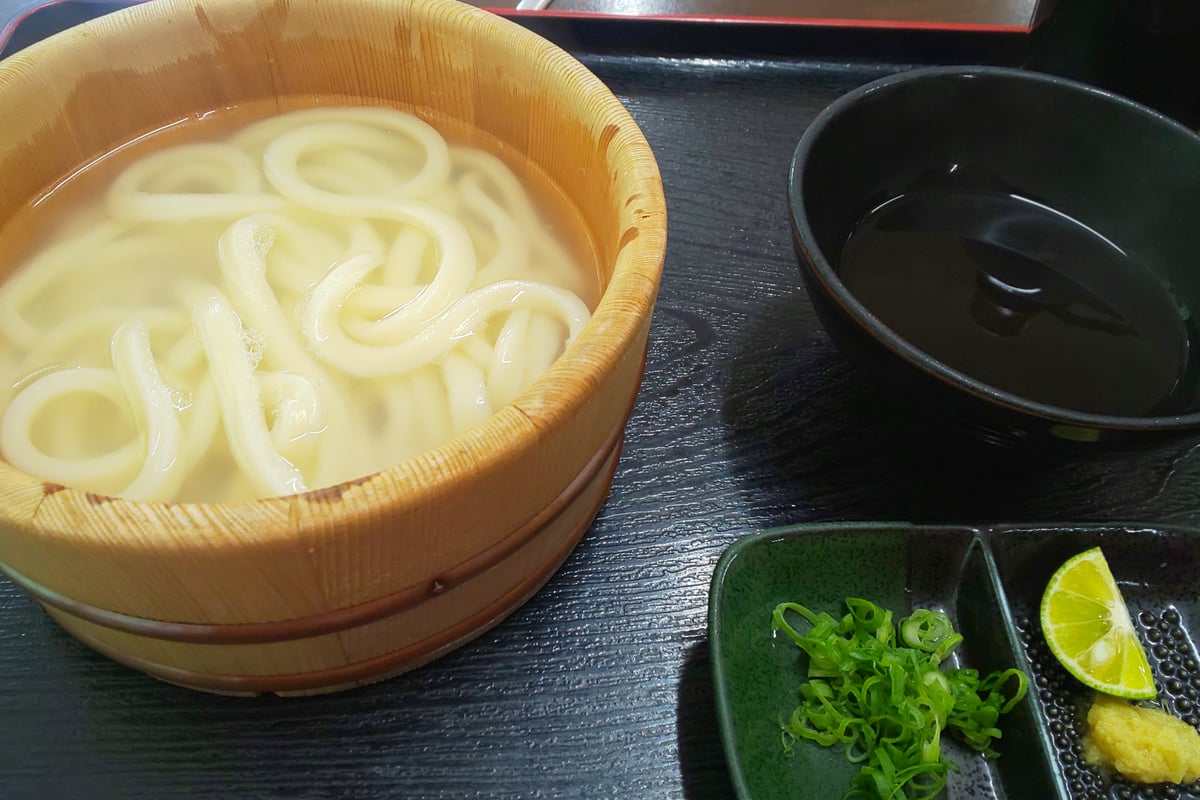
Image: Wikimedia Commons
Tarai Udon is a local dish handed down in the Gosho (御所) district of Donari-cho (土成町), Awa City, Tokushima Prefecture. Boiled udon is served together with its cooking water in a large wooden tarai (tub). Several people gather around it, and each scoops up the noodles and dips them in a dipping sauce. It is a type of kama-age udon, in which freshly boiled noodles are eaten while still in their hot water. It is said to have begun in the late Edo period, when woodcutters working in the upper reaches of the Miyagochidani River (宮川内谷川) boiled and ate udon on the riverbank. In the past, the dipping sauce was made with dashi (broth) from jinzoku (a river fish of the goby family) caught in the river. The name is said to come from a remark by the then governor of Tokushima Prefecture in the early Showa era, who described it as 'udon in a vessel like a tarai.' Today, specialty restaurants line the Miyagochidani River, and 'Gosho no Tarai Udon' has also been certified as one of the Agency for Cultural Affairs' '100-Year Foods.'
Origin
It is said to have begun in the late Edo period in a valley in the upper reaches of the Miyagochidani River in the former Gosho Village, where woodcutters set up a kamado (cooking stove) on the riverbank and boiled udon. Because handing out udon one portion at a time to many woodcutters in the mountains was troublesome, the style of everyone scooping from a single vessel is said to have developed. It is also said that people who had finished their work gathered around a large tub to enjoy it as a feast rewarding their labor.
History
Gosho was a place where wheat and sweet potatoes were the main crops, and udon was a dish for celebrations and for entertaining guests. In the early Showa era, a governor of Tokushima Prefecture who came on an inspection visit enjoyed udon served in a tub-shaped vessel called a 'hanbo' and described it as 'udon in a vessel like a tarai.' This is said to be the origin of the name. Many sources give the year as 1931 (Showa 6), while some accounts give 1929 (Showa 4). In fiscal 2024, following an application by the Awa City Tourism Association, it was certified as one of the Agency for Cultural Affairs' '100-Year Foods.'
Features
After the udon is boiled, it is transferred together with its cooking water to a wooden tub and served. Because the noodles sit in hot water, they do not cool easily and keep their smooth, slippery texture. The dipping sauce was originally made with dashi from jinzoku caught in the Miyagochidani River. Jinzoku is a local name for small fish of the goby family, also called kawayoshinobori or gori. To tone down their strong flavor, the jinzoku are said to be grilled plain before use. Today, as catches have declined, many shops use dashi made from iriko (dried sardines) and the like. Green onions and ginger are served as condiments.
Main Ingredients
Food Culture
The way to eat Tarai Udon is for family or friends to gather around a single tub, each scooping up udon with chopsticks. As a dish shared among many people, it has been eaten at gatherings of those close to one another. November 7 is designated 'Gosho no Tarai Udon Day.'
Famous Shops
じんぞくたらいうどん 樽平
徳島県阿波市土成町宮川内字上畑102
A shop along the Miyagochidani River that, as its name suggests, is known for a dipping sauce made with jinzoku dashi. Because the thick udon is boiled only after an order is placed, it is said to take about 20 to 30 minutes to be served. While waiting, you can go down to the riverside, and there is seating in tatami rooms and at horigotatsu (sunken) tables.
かねぎん坂野
徳島県阿波市土成町宮川内落久保104
A shop located near the border with Kagawa Prefecture. It serves somewhat thick kama-age udon, eaten with house-made dashi, as 'Gosho's famous Tarai Udon.' A listing in a tourist guide gives the price of Tarai Udon as from about 620 yen. The smooth, slippery texture of the noodles is a highlight, and there is also a range of side dishes.
一天 たらいうどん
徳島県阿波市土成町宮川内字上畑93-3
Located about 5 km from the Donari IC of the Tokushima Expressway along National Route 318 toward Kagawa. It is said to be characterized by extra-thick noodles about 1 cm wide. It is described as offering a wide variety of side dishes, including kamameshi (rice cooked in a small pot). It stands beside a mountain stream, and from inside you can also watch water being released from the dam.
FAQ
Q. When was the name 'Tarai Udon' given?
A. The name is said to come from a remark by a governor of Tokushima Prefecture who visited the former Gosho Village in the early Showa era and commented on udon served in a tub-like vessel. Many sources give the year as 1931 (Showa 6), and some accounts give 1929 (Showa 4). The dish itself is said to have been eaten since the late Edo period.