 1 / 2
Image: Wikimedia Commons
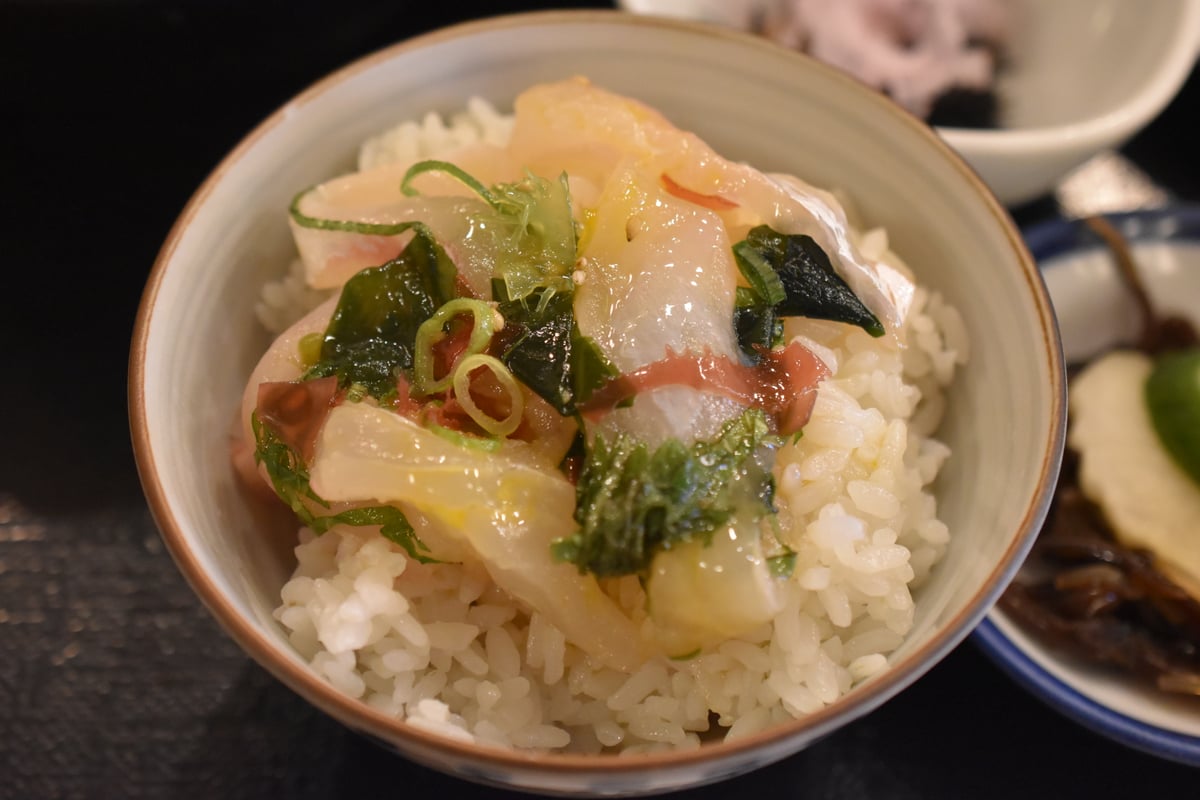
Taimeshi (sea bream rice) is a representative local dish of Ehime Prefecture, and it broadly comes in two types. One is a cooked-in style, in which a whole sea bream is cooked together with the rice, and after cooking the flesh is flaked and mixed into the rice. It has long been enjoyed in Chuyo and Toyo (central and eastern Ehime), such as in the Hojo area of Matsuyama City and in Imabari City. The other is the Nanyo (southern Ehime) way of eating it, in which slices of raw sea bream sashimi are mixed with a sauce combining soy sauce, mirin, raw egg, sesame and dashi broth, and then poured, sauce and all, over hot rice. The former is called 'Hojo Taimeshi' and the latter 'Uwajima Taimeshi,' and in fiscal 2021 (Reiwa 3) both were recognized as '100-Year Foods' by the Agency for Cultural Affairs. Ehime Prefecture is active in red sea bream farming, and according to the prefecture's fisheries statistics, its farmed production has ranked first in Japan for more than 30 consecutive years. Sea bream is regarded as an auspicious fish and is also served at celebrations, and today both kinds of taimeshi can be enjoyed at many restaurants in the prefecture.
Origin
Hojo Taimeshi has a legend associated with the time Empress Jingu brought her ship to Kashima Island off the coast of Hojo. According to the story, fishermen of Kazahaya Bay presented her with sea bream and offered her rice cooked with the sea bream placed on top. Uwajima Taimeshi is said to have begun as a shipboard meal of the Iyo Suigun (Iyo naval forces), which were based on Hiburijima Island. It is said that after a drinking party with sashimi and sake served in tea bowls, they put rice into the tea bowls that still held leftover sake, topped it with sashimi soaked in soy sauce, and ate it.
History
According to materials from the Ministry of Agriculture, Forestry and Fisheries, Uwajima Taimeshi is also said to have begun as a dish eaten by Nanyo fishermen when they went out fishing as far as the Hyuga-nada Sea off Kyushu, because it could be made even on boats where fire could not be used. At that time, horse mackerel, which was caught in abundance, was often used, and the version made with showy sea bream is said to have come to be called 'taimeshi' in particular. In Chuyo, the cooked-in style was long the mainstream, but today there are restaurants that serve both kinds of taimeshi, and both are also enjoyed at home.
Features
For the cooked-in style, a sea bream with its scales and innards removed is placed on the rice together with kombu, seasoned with light-colored soy sauce, sake and salt, and cooked. Hojo Taimeshi is said to be characterized by being made only with sea bream and kombu for dashi, without adding ingredients such as burdock, carrot or fried tofu. For Uwajima Taimeshi, thinly sliced red sea bream is mixed with the sauce and poured, sashimi and all, over hot rice. Taimeshi made with raw sea bream is described as a way of eating unique to Uwajima, even within Japan as a whole.
Main Ingredients
Food Culture
Sea bream is regarded as an auspicious fish, and in Ehime taimeshi is eaten throughout the year and is also often served at celebrations. Materials from the Ministry of Agriculture, Forestry and Fisheries note that because it is a mixed rice dish, it is easy to eat even for children who do not like fish. Processed products such as ekiben (station box lunches) and 'taimeshi no moto' (taimeshi seasoning mixes) are also sold.
Famous Shops
かどや 本店
愛媛県宇和島市鶴島町1-23
The main shop of かどや (Kadoya), which opened in May 1955 (Showa 30) as a small eatery in front of Uwajima Station, and which reopened at a new location in August 2024. It serves Uwajima local dishes such as Uwajima Taimeshi and jakoten. It is about a 3-minute walk from JR Uwajima Station, and there are also branches in Matsuyama City and in Tokyo.
View details →郷土料理 大衆割烹 ほづみ亭
愛媛県宇和島市新町2-3-8
A local cuisine restaurant about a 5-minute walk from JR Uwajima Station. Its Uwajima Taimeshi is described as being served with the sea bream sashimi steeped in a slightly sweet sauce. A travel guide lists Uwajima Taimeshi at 1,600 yen, but prices may change. You can also try 'satsuma,' made with grilled sea bream and barley miso.
郷土料理 五志喜 本店
愛媛県松山市三番町3-5-4
A local cuisine restaurant in Matsuyama City said to have been founded in 1635 (Kan'ei 12). It is described as offering both Matsuyama (Hojo) Taimeshi, in which sea bream is cooked with the rice, and Uwajima Taimeshi, topped with sashimi, so that you can compare the two. Tai somen (sea bream with somen noodles), made with five-colored somen, is also a specialty.
太田屋 北条店
愛媛県松山市北条774
Said to be a long-established inn dating back to the Edo period and known as the originator of Chuyo-style taimeshi. The taimeshi set meal is listed at 1,890 yen, and 'sugata-daki,' in which a whole sea bream is cooked, is described as starting from around 6,000 yen for four servings and requiring a reservation. On Kashima Island, reached by boat from Hojo Port, there is also a seasonal Kashima branch.
FAQ
Q. What is the difference between 'Hojo Taimeshi' and 'Uwajima Taimeshi'?
A. Hojo Taimeshi is a cooked-in rice dish in which a whole sea bream is cooked together with the rice, and the flesh is flaked and mixed into the rice. Uwajima Taimeshi is eaten by mixing raw sea bream sashimi with an egg-based sauce and pouring it, sauce and all, over hot rice. The major difference is whether the sea bream is cooked or eaten raw.
Q. Are there any dishes similar to Uwajima Taimeshi?
A. In Tsushima Town, Uwajima City, there is 'roppo,' which has been eaten since the Meiji period. It is a dish in which seasonal fish is marinated in a sauce of six ingredients, namely sake, soy sauce, mirin, sugar, sesame and raw egg, and poured over rice, and it is also said to be 'the originator of Uwajima Taimeshi.' It was recognized as a '100-Year Food' by the Agency for Cultural Affairs in fiscal 2021.