 1 / 2
Image: Wikimedia Commons
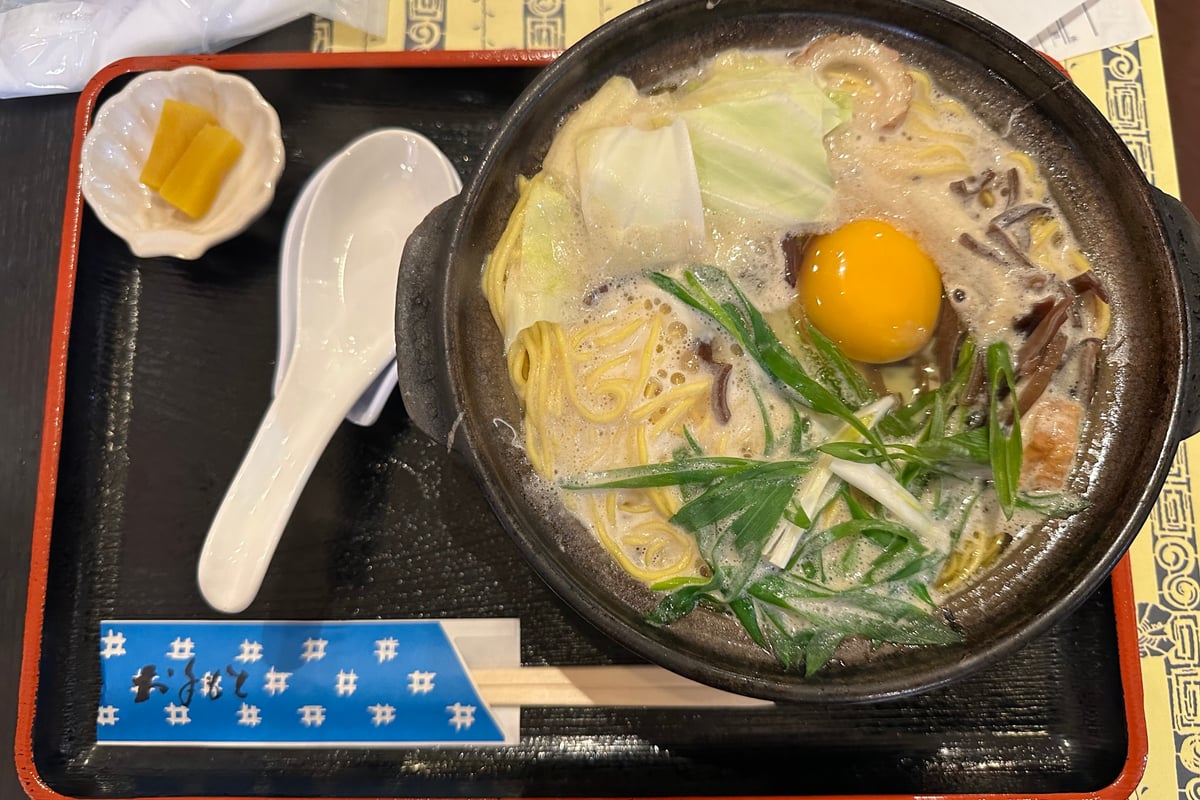
Susaki Nabeyaki Ramen is a local ramen born in Susaki City, Kochi Prefecture. It is brought to the table in its clay pot, still bubbling at a boil. The soup is soy sauce-flavored and made from the bones of oyadori (mature hens), and the noodles are thin, straight noodles boiled slightly firm. The toppings are a simple combination of oyadori meat, green onion, chikuwa (tube-shaped fish cake) and a raw egg, and takuan (pickled daikon radish) is served on the side. It is said to have originated at 谷口食堂 (Taniguchi Shokudo), which opened in Susaki City shortly after the war. It reportedly began when ramen for delivery was put into enamel pots so it would not get cold, and these were eventually replaced by clay pots. As of the end of March 2011, just over 40 shops in Susaki City were said to serve nabeyaki ramen. Many people add rice at the end to make zosui (rice porridge), and some use the lid of the clay pot as a small plate while eating.
Origin
According to Susaki City, the dish is said to have originated at 谷口食堂 (Taniguchi Shokudo), which opened shortly after the war (its owner was the late Mr. Taniguchi Hyoma). Because ramen delivered in ordinary bowls would get cold, the shop began delivering it in enamel pots, which were later replaced by clay pots. It is described as having been called 'nabeyaki chuka soba' at the time and affectionately known by the nickname 'nabechu.'
History
谷口食堂 (Taniguchi Shokudo) closed in 1980 (Showa 55) because it had no successor. However, more and more shops in the city carried on its flavor, and most of today's shops are said to trace their lineage to 谷口食堂. In 2002 (Heisei 14), a volunteer group called 'Susaki Specialty Nabeyaki Ramen Project X' was formed, centered on the Susaki Chamber of Commerce and Industry. The group revived the recipe by interviewing descendants of the 谷口食堂 family and its regular customers, and in 2013 it opened a limited-time shop at the Shin-Yokohama Raumen Museum.
Features
Project X has set out 'seven definitions' of nabeyaki ramen. They include a soy sauce soup made from oyadori chicken bones; thin, straight noodles cooked slightly firm; toppings of oyadori meat, green onion, chikuwa and a raw egg; a clay pot as the vessel (enamel or iron pots are also acceptable); serving it at a boil; and takuan on the side. In the 谷口食堂 flavor revived by the group, oyadori is used for both the soup and the toppings, and the chikuwa is made by the local けんかま (Kenkama).
Main Ingredients
Food Culture
In Susaki, many people also make nabeyaki ramen at home, and some reportedly buy noodles and soup at a shop and cook them in their own clay pots. People eat it in their own ways, such as leaving the egg unbroken and enjoying it soft-cooked at the end, or breaking it at the start and coating the noodles with it. Susaki City's local mascot character, Shinjo-kun (しんじょう君), also uses nabeyaki ramen as a motif.
Famous Shops
橋本食堂
高知県須崎市横町4-19
A long-established nabeyaki ramen shop founded in 1975 (Showa 50). Its soup combines chicken bones with soy sauce from a local brewery, with chicken oil floating on the surface. A 2020 article listed prices of 580 yen for a regular, 680 yen for a large and 800 yen for an extra large, while another travel guide gives 630 yen for a regular. Many customers order rice to turn the rest into zosui.
View details →まゆみの店
高知県須崎市栄町10-14
A shop specializing in nabeyaki ramen that aims to recreate the flavor of 谷口食堂 (Taniguchi Shokudo), where the dish originated. When ordering, you can choose the strength of the soup and the firmness of the noodles, and there are also kimchi and curry versions of nabeyaki ramen. A travel guide lists nabeyaki ramen (regular) at 950 yen. It is closed on Wednesdays and closes once everything is sold out. Prices are subject to change.
View details →すさき駅前食堂
高知県須崎市原町1-5-20
A diner a one-minute walk from JR Susaki Station, run by a nonprofit organization (NPO). It is known for its chicken-bone soy sauce soup simmered with vegetables and fruit for 5 to 6 hours, and there is also a set with chirimen-don (rice topped with tiny dried fish) eaten with yuzu ponzu. A 2020 article listed the regular size at 660 yen. A guide on how to eat the dish is also available.
View details →鍋焼きラーメンのがろ~ 須崎本店
高知県須崎市鍛治町7-15
A shop known for its 'W soup' (double soup) combining oyadori and seafood broths, and unusually for Susaki City, cabbage is included among the toppings. A 2020 article listed its oyadori nabeyaki ramen at 880 yen. There is also a branch inside とさのさと アグリコレット (Tosa no Sato AGRI COLLETTO) in 北御座, Kochi City. Prices are subject to change.
View details →FAQ
Q. Why is nabeyaki ramen served in a clay pot?
A. It is said to have started when 谷口食堂 (Taniguchi Shokudo), where the dish originated, used enamel pots instead of bowls so that delivered ramen would not get cold. The vessel later changed to clay pots. Even today, serving it while still boiling is regarded as one of the definitions of nabeyaki ramen.
Q. Is there a recommended way to eat it?
A. First, taste the soup and noodles without adding anything. You can then choose as you like, such as leaving the egg unbroken until the end to enjoy it soft-cooked, or breaking it at the start to coat the noodles. For those who find it too hot, one suggested way is to put the yolk on the lid of the clay pot, beat it, and dip the noodles in it as with sukiyaki.