Sakyu Rakkyo (Sand Dune Rakkyo Shallots)
Sakyu Rakkyo (Sand Dune Rakkyo Shallots)
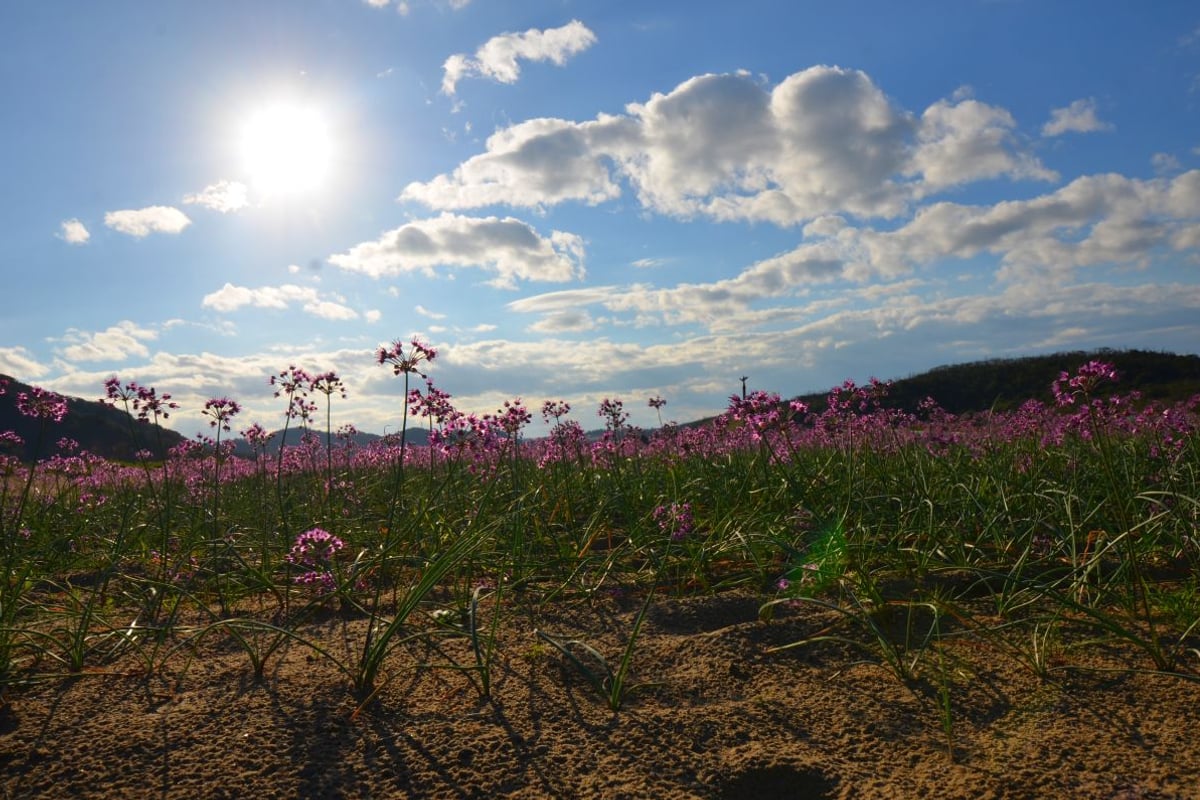
Image: Wikimedia Commons
Sakyu rakkyo refers both to the rakkyo (Japanese scallion) grown in the sand dune fields of Fukube Town, Tottori City, adjacent to the Tottori Sand Dunes, and to the pickles made from it. Rakkyo is a vegetable whose small bulb-like part is eaten, and it is commonly pickled in sweet vinegar. The sand dune fields have low soil fertility, and the thick layer of sand makes it hard for excess moisture and nutrients to accumulate, so the rakkyo grow firm and pale. Their crisp texture is highly valued in the market, and in March 2016 they were registered as a Geographical Indication (GI) under the names 'Tottori Sakyu Rakkyo' and 'Fukube Sakyu Rakkyo.' The harvest runs from late May to mid-June; besides being shipped with roots attached or as washed rakkyo, they are sold year-round as processed products such as sweet vinegar pickles. From late October to early November, pale purple flowers bloom all at once across about 120 hectares of fields, creating a seasonal autumn sight of the dunes.
Origin
Rakkyo in Tottori is said to have begun when an attendant on a sankin-kotai (alternate attendance) journey brought it back from Edo during the Edo period. It is also said to have been brought back from the medicinal herb garden in Koishikawa, Edo. The dune lands of Fukube were once hills planted with peaches and mulberries, but because of their poor ability to retain water, the fruit grew only small. Drought-tolerant rakkyo suited this land, and the hills were leveled to expand the fields.
History
Full-scale cultivation began in 1914 (Taisho 3), and an industrial cooperative was also formed to work on sales. Around 1965 (Showa 40), prompted by a collapse in market prices, the agricultural cooperative started a processing business, adjusting shipments by turning the rakkyo into salted and seasoned processed products. In 1977 (Showa 52), sprinkler facilities were completed. 'Sakyu Rakkyo' was registered as a trademark in 2005, and it was registered as a Geographical Indication (GI) in March 2016.
Features
Tottori Sakyu Rakkyo is of a variety called 'Rakuda' and has a somewhat elongated egg shape. Because its scales (rinpen) are of even thickness, it is said to be crisp from the first bite to the last. Planting is mainly done from late July to August, entirely by hand. In the sand in midsummer, the bulbs are planted one by one. 'Ni-nengo saibai' (two-year cultivation), in which the crop is harvested from late May to mid-June of the following year, has become the established practice.
Main Ingredients
Food Culture
During the flowering season, events have been held such as the 'Rakkyo Flower Marathon,' run along the roads through the blooming fields, and the 'Rakkyo Flower Fair,' where processed products are sold in the fields. The fields, which look like a purple carpet, are a familiar landscape to visitors to the Tottori Sand Dunes as well.
How It Differs from Home Cooking
The traditional 'hon-zuke' (full pickling) method involves salting the rakkyo for two weeks or more, desalting them, and then re-pickling them in sweet vinegar or a similar liquid. For home cooks, a 'kantan-zuke' (easy pickling) method that skips the salting step is also introduced; the rakkyo can be eaten from the same day, but must be kept refrigerated. Besides sweet vinegar, seasonings vary, including salt, shiso, and black vinegar.
Famous Shops
砂丘会館
鳥取県鳥取市福部町湯山2164
A facility with a souvenir shop and a restaurant near the entrance to the Tottori Sand Dunes. It carries a wide range of Tottori's famous confections and specialty products and is described as also handling processed products such as Sakyu rakkyo pickles. Business hours are said to be 9:00 to 17:00.
| 砂丘らっきょう(JA鳥取いなば) | Branded processed rakkyo products whose trademark is registered by JA鳥取いなば (JA Tottori Inaba). Besides sweet vinegar pickles, there are flavors such as salt and tamari. Sakyu rakkyo as a seasoned pickle was certified in 2011 under 'Honba no Honmono' (本場の本物), a regional food brand labeling system. |
|---|
FAQ
Q. Is Sakyu rakkyo grown inside the Tottori Sand Dunes?
A. It is cultivated not in the Tottori Sand Dunes tourist site itself but in the sand dune fields of adjacent Fukube Town. The production area under the Geographical Indication is also defined as 'sand dune fields adjacent to the Tottori Sand Dunes.' The Tottori Sand Dunes are a special protection zone of a national park, and the fields spread out to the east of the dunes.