Oiri (Colorful Rice Puffs)
Oiri (Pastel-Colored Rice Puffs Given at Weddings)
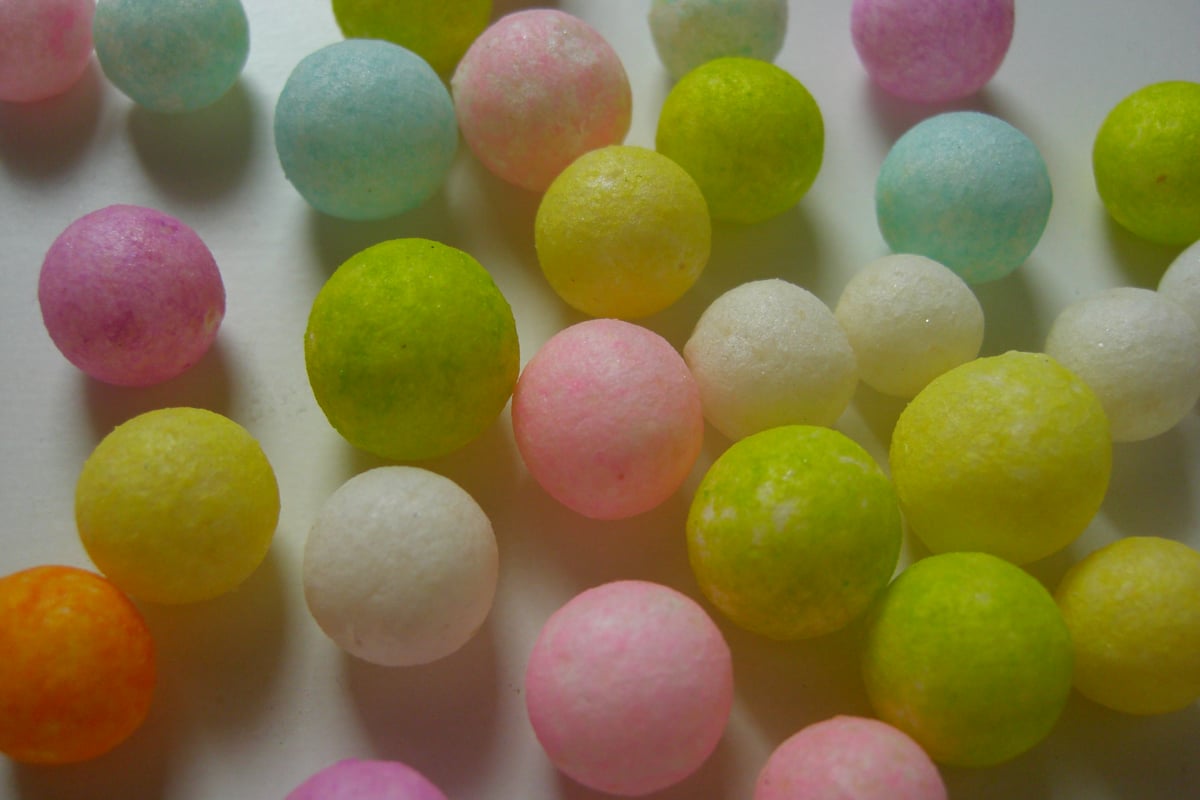
Image: Wikimedia Commons
Oiri are small, ball-shaped arare (rice crackers) made from glutinous rice, handed down mainly in the Seisan area in the western part of Kagawa Prefecture. They are round grains about 1 cm in diameter, in soft pastel colors such as pink, green, white and light blue. They are hollow inside and have a light texture that melts softly in the mouth, with restrained sweetness. In the Seisan area they have long been known as a wedding confection, handed out by brides to the neighbors of the family they married into or given as wedding favors (hikidemono). According to legend, they began when farmers presented arare in five colors at the wedding of a princess, the daughter of Ikoma Chikamasa, the lord of Sanuki. In recent years they have also been used as celebratory sweets for occasions such as childbirth and new homes, and they have grown popular as decorations for soft-serve ice cream and cakes.
Origin
According to legend, around 1587 (Tensho 15), when the princess of Ikoma Chikamasa, who had become lord of Sanuki, was to be married, farmers of the domain roasted arare in five colors and presented them to her. It is said that the custom spread because the princess was delighted with them. Ikoma Chikamasa built Marugame Castle, and oiri is sometimes described as a confection of Marugame. However, 山下おいり本舗 also introduces this as one theory, and no reliable records have been confirmed.
History
According to a feature by the Shikoku Shimbun, oiri were originally in two colors, red and white, but five colors are now the mainstream. It is said that brides brought oiri with them as a vow to work diligently with a gentle heart, and handed them out to neighbors and children. At their peak, many wagashi (Japanese confectionery) shops made them, but today 山下おいり本舗 is said to be the only specialty shop. From around 1990 they were featured in the media and became known outside the prefecture as well.
Features
Making them takes a great deal of effort. Glutinous rice is soaked in water overnight, steamed, and pounded with sugar. While still hot, it is spread thin and dried in the sun, then cut into small cubes and dried further. When these are roasted, they puff up into round balls. Each color is tinted and flavored separately, and finally they are mixed together to finish. It is said that if the heating and drying are not done just right they will not puff up neatly, and it is reported to take about a week to complete.
Main Ingredients
Food Culture
In the Seisan area it is an indispensable confection for weddings, handed out when making courtesy calls on the neighbors of the family the bride marries into, and also used as wedding favors. When they are handed out, several 'koban-gashi (oiri koban),' flattened versions of oiri, are often said to be included. Today they are also used for celebrations of childbirth, a baby's first seasonal festival (hatsuzekku) and new homes.
Famous Shops
山下おいり本舗
香川県三豊市高瀬町新名1018-20
Founded in the late Edo period, this shop has made confections for generations since the Meiji era and is now a specialty shop for oiri. It is said that the sixth-generation owner added two colors to the traditional five, creating seven-color oiri. Its official website lists small 30 g bags in the 400-yen range and 65 g bags in the 600-yen range.
View details →御菓子司 じょうと
香川県三豊市豊中町比地大845-1
A wagashi shop in Toyonaka Town, Mitoyo City, that sells oiri as a celebratory confection. Its website describes oiri as ball-shaped arare about 1 cm in diameter, made from the western part of Kagawa Prefecture to the area east of Saijo City in Ehime Prefecture.
View details →FAQ
Q. What does the name 'oiri' mean?
A. It is said to have come to be called 'oiri' as a play on 'iru' (煎る), meaning to roast the arare over a fire, and 'iru' (入る), meaning to enter a family as a bride (yome-iri). The name expresses both the method of roasting the glutinous rice dough to puff it up and its role as a wedding confection.
Q. Is oiri handed out at weddings throughout Kagawa Prefecture?
A. The custom of using oiri for weddings has been handed down mainly in the Seisan area in the western part of Kagawa Prefecture. Kagawa Prefecture's materials also introduce it as a wedding confection long handed down in the Seisan area. A similar custom exists in the area east of Saijo City in Ehime Prefecture, where it is also called 'oiri-mame.'