Image: Wikimedia Commons
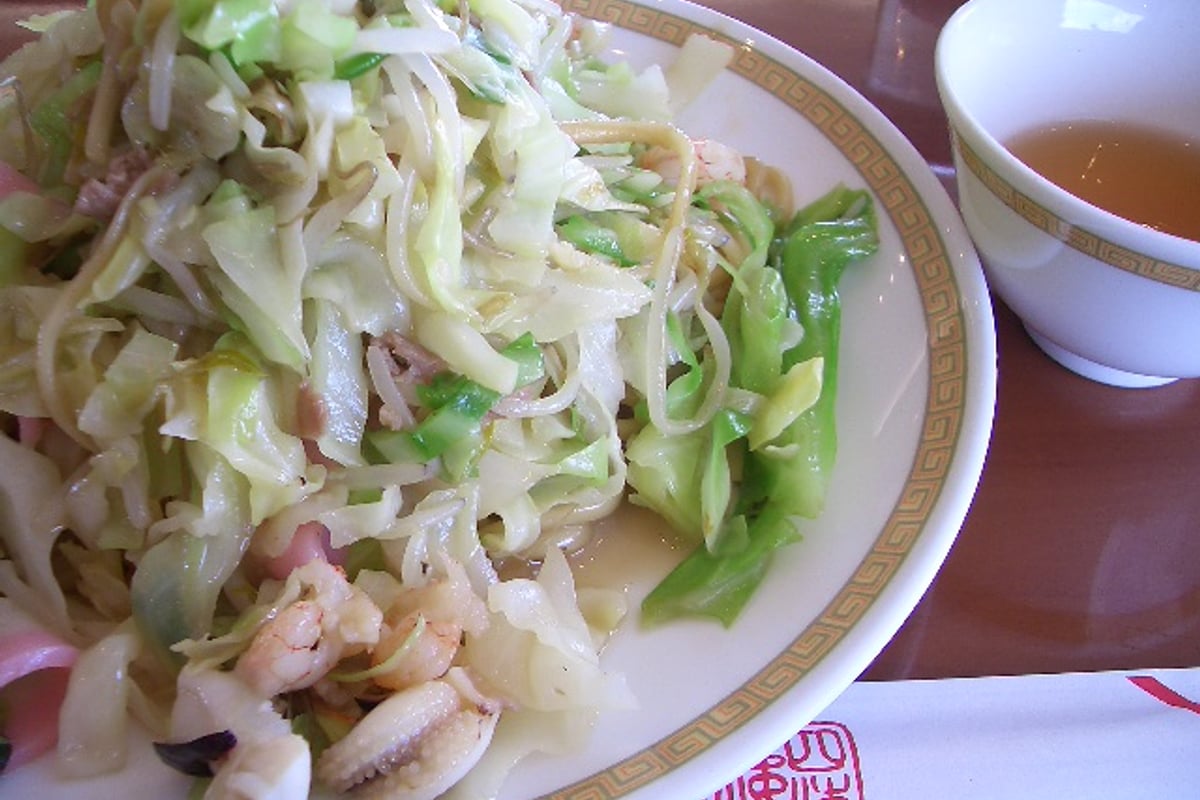
Sara udon is a soupless noodle dish born from Nagasaki champon. It is said to have been created as a variation of champon by Chin Heijun (陳平順), the founder of Shikairo (四海樓), who devised champon. The name ('sara' means plate) is said to come from the fact that it was served on a flat plate. There are two kinds of sara udon: 'futomen sara udon' (thick-noodle sara udon), in which the same thick noodles as champon are stir-fried with the toppings and made to absorb broth, and 'hosomen sara udon' (thin-noodle sara udon), in which thin noodles are deep-fried until crispy and topped with a thick sauce full of ingredients. People in Nagasaki clearly distinguish between the two. The toppings, such as pork, seafood, cabbage and kamaboko (fish cake), are almost the same as for champon. In Nagasaki, there is a custom of eating it with locally made Worcester sauce. It is a familiar dish on home tables, in school lunches and as a delivery order when guests visit.
Origin
According to Shikairo's official website, Chin Heijun devised sara udon as a variation of champon. It was a dish in which champon noodles were first pan-fried, stir-fried with the toppings, and then a small amount of broth was added and soaked into the noodles. It is said to have been named 'sara udon' because the soupless noodles were served on a flat plate. The Ministry of Agriculture, Forestry and Fisheries notes that at the time, when it was common sense to serve noodles in a bowl, serving them on a plate surprised people.
History
Stir-frying thick noodles and having them absorb broth takes time and effort. It is said that, to simplify cooking, the thin-noodle sara udon was born, in which the noodles are made thin, deep-fried and topped with a thick sauce. Because it was easy to make, it spread to homes in Nagasaki and eventually became known throughout Japan. Today, many Chinese restaurants in Nagasaki offer both thick and thin noodles on the menu so customers can choose as they like. It is also often included in school lunch menus.
Features
The toppings, such as pork, shrimp, squid, cabbage, bean sprouts and kamaboko, are almost the same as for champon. With thick noodles, the noodles and toppings are stir-simmered until the broth is gone. With thin noodles, a thickened sauce is poured over fried noodles to finish. People in Nagasaki call the thin noodles 'paripari' (crispy). In the city, noodles are available in roughly three thicknesses: extra-thin, thin, and slightly thicker thin. Because each restaurant chooses noodles that suit its sauce, the thinness of the noodles has become a mark of each restaurant's individuality.
Main Ingredients
Food Culture
In Nagasaki, there is a custom of ordering a large platter of sara udon for delivery from a nearby Chinese restaurant to entertain guests during Obon, New Year and when visitors come. Some people prefer 'second-day sara udon', in which leftover sara udon is stir-fried again in a frying pan the next day. Pouring Worcester sauce over it partway through to enjoy a change of flavor is introduced as the Nagasaki way of eating it.
How It Differs from Home Cooking
At home, a method of buying fresh thin noodles from a noodle factory, frying them and shaping them on the plate has been introduced. Store-bought sets combining fried noodles with seasoned soup are also well established in homes. Restaurants choose noodles of different thicknesses to suit their own sauce.
Famous Shops
中華料理 四海樓
長崎県長崎市松が枝町4-5
The restaurant said to have devised sara udon. Its official website explains the original method of soaking pan-fried noodles with toppings and broth, as well as the origin of the later thin fried-noodle sara udon. A travel guide lists sara udon at 1,430 yen. Prices are subject to change.
View details →ちゃんぽん 蘇州林
長崎県長崎市尾上町1-67 長崎街道かもめ市場内
Known for its extra-thin-noodle sara udon, advertised as 'the thinnest in Nagasaki'. Because the noodles are thin, they are fried through to the core and are characteristically fragrant. A 2026 travel guide lists the jo (premium) sara udon (thin noodles) at 1,540 yen. It also sells sara udon noodles for home use. Prices are subject to change.
View details →中国名菜 京華園
長崎県長崎市新地町9-7
A restaurant for thick-noodle sara udon, said to use the thickest noodles in Shinchi Chinatown. A travel guide lists sara udon (thick noodles) at 1,100 yen. It also cooperated in showing how the dish is made for a champon and sara udon feature in Nagazine, an information magazine of Nagasaki City. Prices are subject to change.
| Kincho Worcester Sauce (金蝶ソース) | A Nagasaki-born sauce said to be indispensable for sara udon. It is told that in the early Showa period, the founder of a soy sauce shop in Oura-machi created it aiming for a sauce that would suit Chinese cuisine, also seeking advice from Chin Heijun of Shikairo. It is characterized by sourness and spiciness from plenty of vinegar and spices. At the online shop of the seller, Choko Shoyu, a 260ml bottle is 340 yen. Prices are subject to change.Where to buy →PR |
|---|---|
| Nagasaki Sara Udon by みろくや | Sara udon from Mirokuya, a souvenir noodle shop in 'Nagasaki Kaido Kamome Ichiba' in front of Nagasaki Station. It comes with fried noodles that need no frying at home and soup for the sauce. An assortment of champon and sara udon is also offered as a return gift for the furusato nozei (hometown tax donation) program. A confection of sara udon noodles coated in chocolate has also attracted attention.Where to buy →PR |
FAQ
Q. Which came first, thick noodles or thin noodles?
A. Thick noodles are the original. According to Shikairo's explanation, it was originally a dish in which champon noodles were pan-fried, stir-fried with the toppings and made to absorb broth. The sara udon with thin fried noodles topped with sauce was born later to simplify cooking. Today, the thin-noodle version is better known.
Q. Are sara udon and 'kata yakisoba' (crispy fried noodles) the same thing?
A. They look similar but are considered different dishes. According to Nagazine, kata yakisoba is a dish called 什錦炸麺 (suchin tsumien) in China, and its noodles, toppings and seasoning differ from those of sara udon. Sara udon is a Nagasaki-born dish that uses the toppings and broth of champon.
Q. Is it all right to put vinegar on sara udon?
A. That is up to your taste, but in Nagasaki, Worcester sauce is the standard. According to Nagazine, it is said that restaurants began keeping vinegar on hand as they responded to requests from tourists, and the practice took hold. This is because in the Kanto and Kansai regions there is a custom of eating gomoku yakisoba (stir-fried noodles with mixed toppings) with vinegar.