Image: Wikimedia Commons
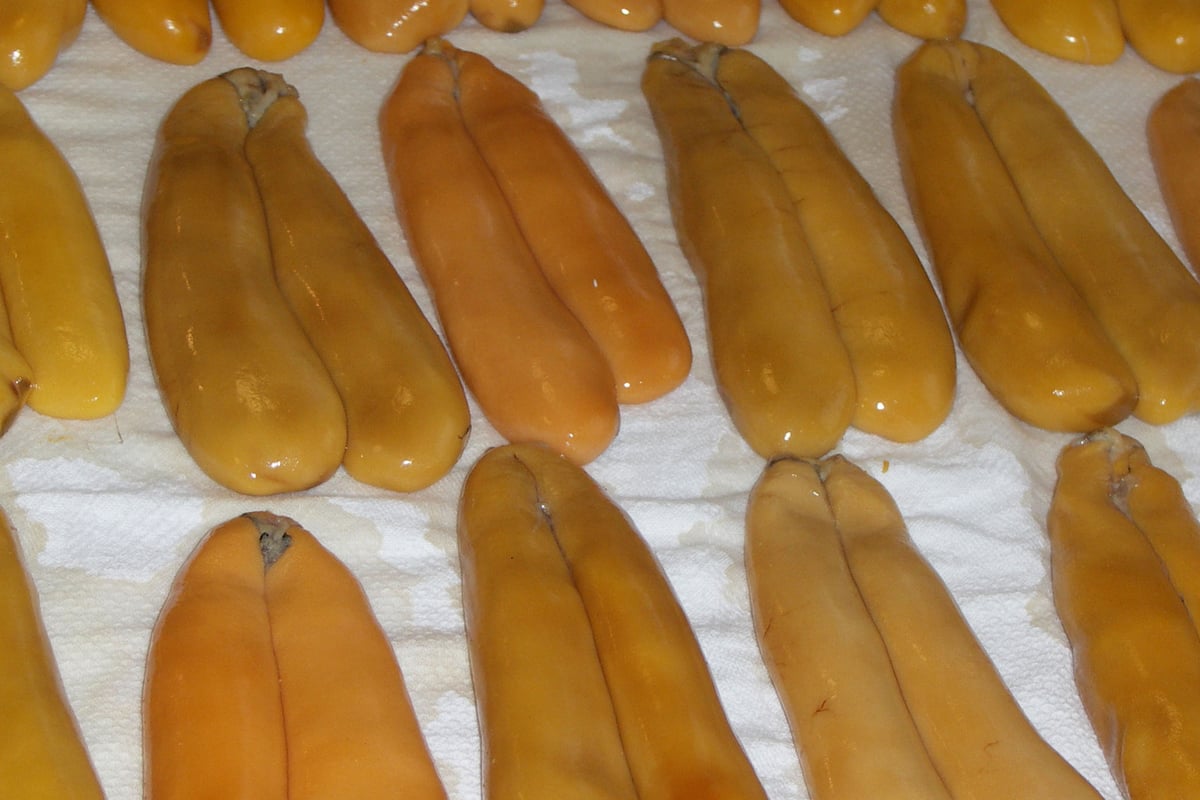
Karasumi is a Nagasaki delicacy made by salting the ovaries of grey mullet and drying them in the sun. It has a glossy amber color, also described as tortoiseshell-colored or candy-colored. It is characterized by a dense, sticky texture and the rich savory flavor typical of fish roe. In the Edo period, it is said to have been counted among the three great delicacies, along with uni (sea urchin) from Echizen and konowata from Mikawa. The name is said to come from its resemblance in shape to karasumi (唐墨), an ink stick introduced from China. The food itself originally came from China, and the method of using mullet ovaries is said to have been devised in Nagasaki. Karasumi produced in Nagasaki Prefecture was registered with the national Geographical Indication (GI) system as 'Nagasaki Karasumi' in 2023. Besides being sliced thinly as an accompaniment to sake, it is also served as one of the dishes of Shippoku cuisine. As a rare and expensive item, it is valued as a gift and a high-end souvenir.
Origin
Karasumi is said to have been introduced to Nagasaki from China (Ming) in the Azuchi-Momoyama period. It is said to have initially been made from the ovaries of Spanish mackerel (sawara). Later, according to tradition, Takano Yusuke, who ran a fish shop in Nagasaki, devised a method using the ovaries of mullet, which were caught in large numbers around Nomozaki. Materials from the Ministry of Agriculture, Forestry and Fisheries date the invention of karasumi to the Enpo era (1673–1681) and describe Nagasaki as the birthplace of karasumi made from mullet.
History
Nagasaki karasumi is said to have been presented to the shogun's family for about 150 years, from 1712 (Shotoku 2) until the return of political power to the emperor (Taisei Hokan). In the Edo period, it was renowned as one of the 'Three Delicacies of the Realm' (tenka sanchin), and from the Meiji period onward it continued to be used as an essential ingredient in Shippoku cuisine. In Nomozaki and Kabashima, mullet karasumi is still made today. In July 2023 (Reiwa 5), 'Nagasaki Karasumi' was registered as a Geographical Indication (GI).
Features
The raw material is mullet ovaries, and only salt is used for seasoning. The ovaries are taken out carefully so as not to break the membrane, drained of blood, salted, desalted and then dried in the sun, with the process repeated. The drying period varies by shop and season, and some shops take about a month. The finished product is said to be about half to two-thirds the size of the raw material. Because high-quality mullet is hard to obtain in Japan, some shops use ovaries from overseas.
Main Ingredients
Food Culture
The classic way to eat karasumi is to slice it thinly and serve it as is as an accompaniment to sake. In Nagasaki, it has also been served as one of the dishes of Shippoku cuisine. Mullet, the raw material, is an autumn fish, and karasumi is also a seasonal word (kigo) in haiku. In recent years, long-established shops have also released products that are easy to use at home, such as flaked karasumi and ochazuke (rice with tea).
Famous Shops
高野屋
長崎県長崎市築町1-16
A long-established karasumi shop described as having been founded in 1675 (Enpo 3). It is said to have devoted itself solely to karasumi since its founding and to preserve the traditional method. Travel guides list a single lobe (katahara) of 20g from 1,080 yen. It also sells flaked karasumi and karasumi chazuke. Prices are subject to change.
View details →小野原本店
長崎県長崎市築町3-23
A long-established shop founded in 1859 (Ansei 6). Its prewar shop building escaped damage from the atomic bombing and is a Registered Tangible Cultural Property of Japan. Its karasumi is said to be characterized by low salt and thorough drying, all done by hand. As of the end of April 2025, karasumi slices were listed at 540 yen. Prices are subject to change.
View details →| Processed karasumi products by Onohara Honten | Whole karasumi is expensive, but Onohara Honten (小野原本店) also makes processed products that are easier to buy. As of the end of April 2025, karasumi chirimen (with dried baby sardines) was listed at 1,620 yen and karasumi pasta oil at 1,836 yen. There is also karasumi for home use, priced by weight. Prices are subject to change.Where to buy →PR |
|---|
FAQ
Q. Where does the name 'karasumi' come from?
A. It is said to come from its resemblance in shape to karasumi (唐墨), an ink stick introduced from China. There is also an anecdote that when Toyotomi Hideyoshi asked its name, someone answered 'karasumi,' but nothing is known for certain. There are various theories about the origin of the name.
Q. Is karasumi a food found only in Japan?
A. Foods made by salting and drying fish ovaries also exist overseas. In Taiwan, the version made from mullet is called 'wuyuzi' (烏魚子); it is grilled, sliced thinly and eaten with daikon radish and other accompaniments. On the Italian island of Sardinia there is 'bottarga,' which is used in pasta.
Q. What are Japan's three great delicacies?
A. Since the Edo period, karasumi from Hizen (present-day Nagasaki and Saga Prefectures), uni from Echizen (Fukui Prefecture) and konowata from Mikawa (Aichi Prefecture) have been called the three great delicacies. Konowata is shiokara (salted fermented seafood) made from sea cucumber intestines. Materials from the Ministry of Agriculture, Forestry and Fisheries introduce them as the 'Three Delicacies of the Realm' (tenka sanchin).