Image: Wikimedia Commons
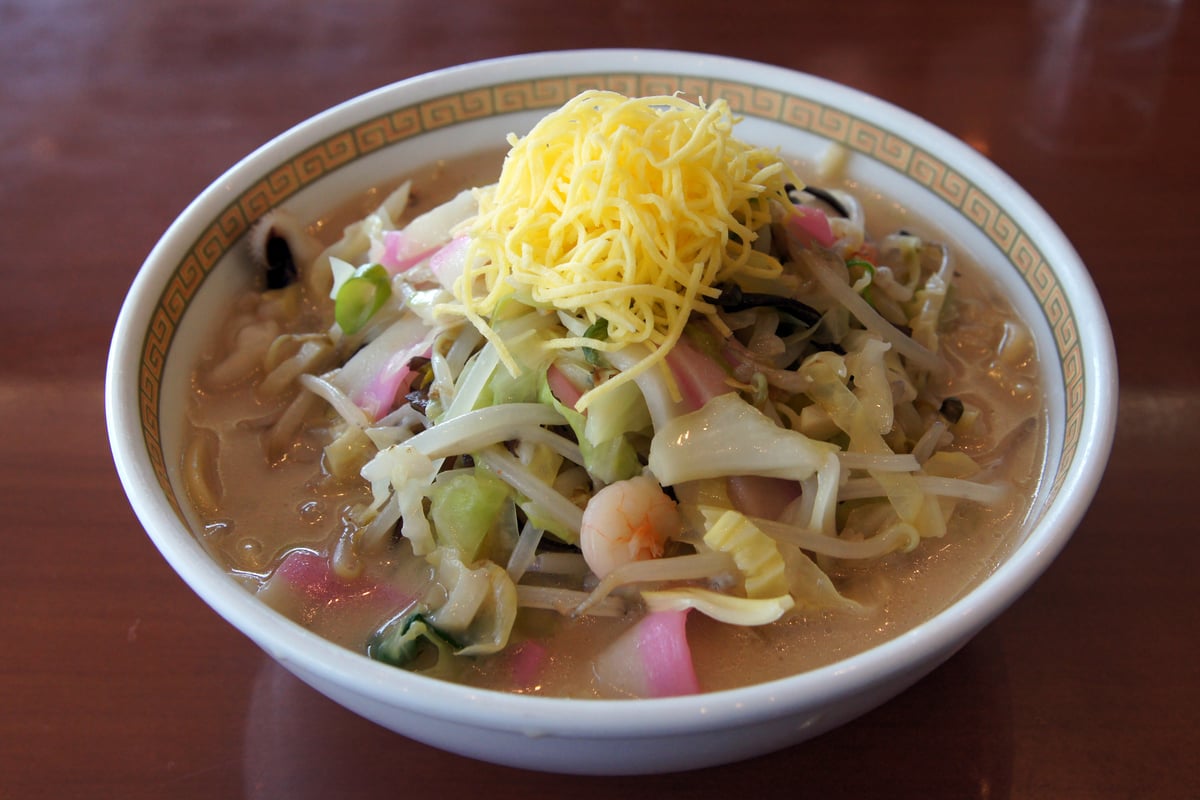
Nagasaki champon is a noodle dish of Nagasaki Prefecture in which pork, seafood, cabbage, bean sprouts and other ingredients are stir-fried in lard, then simmered together with the noodles after broth is poured in. It is said to have begun in 1899 (Meiji 32), when Chin Heijun (陳平順), the founder of the Chinese restaurant Shikairo (四海樓) in Nagasaki, created it for Chinese students studying in Japan and others. It is said that he aimed for a dish that was cheap, nutritious and filling. The mainstream broth combines pork bones and chicken bones. The noodles are champon noodles unique to Nagasaki, kneaded with toaku (a type of kansui alkaline water). Unlike ramen, in which broth is poured over boiled noodles, the noodles are simmered in the same pot as the other ingredients, so it can be made in a single wok. Another characteristic is the red-and-white kamaboko (fish cake) called 'hanpen' in Nagasaki. It is eaten every day at home, in school lunches and at casual eateries, and is known throughout Japan as the representative local taste of Nagasaki.
Origin
According to Shikairo's official website, Chin Heijun, a native of Fujian Province, opened his restaurant in 1899 (Meiji 32) in Hirobabamachi, on the former site of the Tojin Yashiki (Chinese quarter). Champon is said to have been devised as a cheap, nutritious dish for the Chinese students and overseas Chinese who had come to Nagasaki. The Ministry of Agriculture, Forestry and Fisheries introduces the Fujian dish tonniishiimen (湯肉絲麺) as its root. It is a light noodle dish with pork, shiitake mushrooms and bamboo shoots, which was arranged in Japanese style with a richer broth and plenty of toppings.
History
According to Shikairo, it was at first a dish not on the menu and was called 'Shina udon' (Chinese udon). Nagazine, an information magazine of Nagasaki City, notes that it seems to have come to be called 'champon' around the late Meiji period. Because it was easy to make and nutritious, it spread to homes and restaurants in Nagasaki. It eventually spread to other parts of the prefecture as well, and a distinctive champon developed in Obama Onsen in Unzen City. Shikairo moved to Matsugaemachi in 1973 (Showa 48).
Features
Common ingredients include pork, squid, shrimp, red-and-white kamaboko, cabbage, green onions and bean sprouts. Some restaurants change the shellfish by season, using clams in summer and oysters in winter. To make it, lard is heated in a wok, the meat and vegetables are stir-fried, broth is added and then the noodles go in. Its appeal is that the savory flavor from the ingredients dissolves into the broth, and the noodles soak up that broth. Some people eat it topped with a raw egg or sprinkled with white pepper to taste.
Main Ingredients
Food Culture
In Nagasaki, champon is eaten not only at Chinese restaurants but also in school lunches, company cafeterias and casual eateries. According to Nagazine, it is most often eaten at lunch. Many people are said to pair champon with fried rice (yakimeshi). The Ministry of Agriculture, Forestry and Fisheries also notes that since its creation it has become a home-style dish eaten daily in Nagasaki.
How It Differs from Home Cooking
Nagazine introduces examples of restaurants using broth made by simmering pork bones and chicken bones for about five to six hours. The skill of finishing each order in a wok in about two minutes is also key to the restaurant flavor. At home, an easy way is to make it with store-bought champon noodles and chicken-bone soup base or similar, and the recipe from the Ministry of Agriculture, Forestry and Fisheries also uses this method.
Famous Shops
中華料理 四海樓
長崎県長崎市松が枝町4-5
Founded in 1899, it is said to be the birthplace of champon and sara udon. On the second floor is the 'Champon Museum', which introduces the history of the restaurant and of champon and can be visited free of charge. A travel guide lists champon at 1,430 yen. The restaurant does not accept reservations. Prices are subject to change.
View details →中国菜館 江山楼 中華街本店
長崎県長崎市新地町12-2
It began as a restaurant opened in Shinchi Chinatown in 1946 (Showa 21) by the couple 王玉官 and 梅瑛. Its signature tokujo (premium) champon is a luxurious version with many toppings such as shark fin and scallops. A 2025 article introducing the nearby Chinatown annex lists the tokujo champon at 2,750 yen. Prices are subject to change.
View details →| Nagasaki Champon by みろくや | A shop of local souvenir noodles located in 'Nagasaki Kaido Kamome Ichiba' in front of Nagasaki Station, which makes and sells its own champon and sara udon. An assortment of champon and sara udon with soup is also offered as a return gift for the furusato nozei (hometown tax donation) program.Where to buy →PR |
|---|
FAQ
Q. Where does the name 'champon' come from?
A. There are various theories. Shikairo says it comes from 'shapon' or 'seppon' (meaning 'to eat a meal'), a greeting in the Fujian dialect used by overseas Chinese in Nagasaki. Other theories have also been introduced, such as one combining the 'chan' of a Chinese gong (kane) with the 'pon' of a Japanese tsuzumi hand drum, and one tracing it to Portuguese.
Q. What is toaku?
A. It is a type of kansui (alkaline water) consisting of sodium carbonate and potassium carbonate. According to Nagazine, it came to Nagasaki from Shanghai in the early Showa period. A permit is required to produce it, and it is said to be made only in Nagasaki within Japan. It is also used in chimaki (rice dumplings) particular to Nagasaki, and it is the source of the distinctive flavor of champon noodles.
Q. What is the difference between Nagasaki champon and Obama champon?
A. The Ministry of Agriculture, Forestry and Fisheries introduces Nagasaki champon, with a rich broth based mainly on pork bones, and Obama champon, with a light broth based mainly on chicken bones, as the two major champon of the prefecture. Obama champon is said to have come to Obama Onsen in the Taisho period, and it is also being used for regional revitalization, with the local ryokan association holding events and more.