Image: Wikimedia Commons
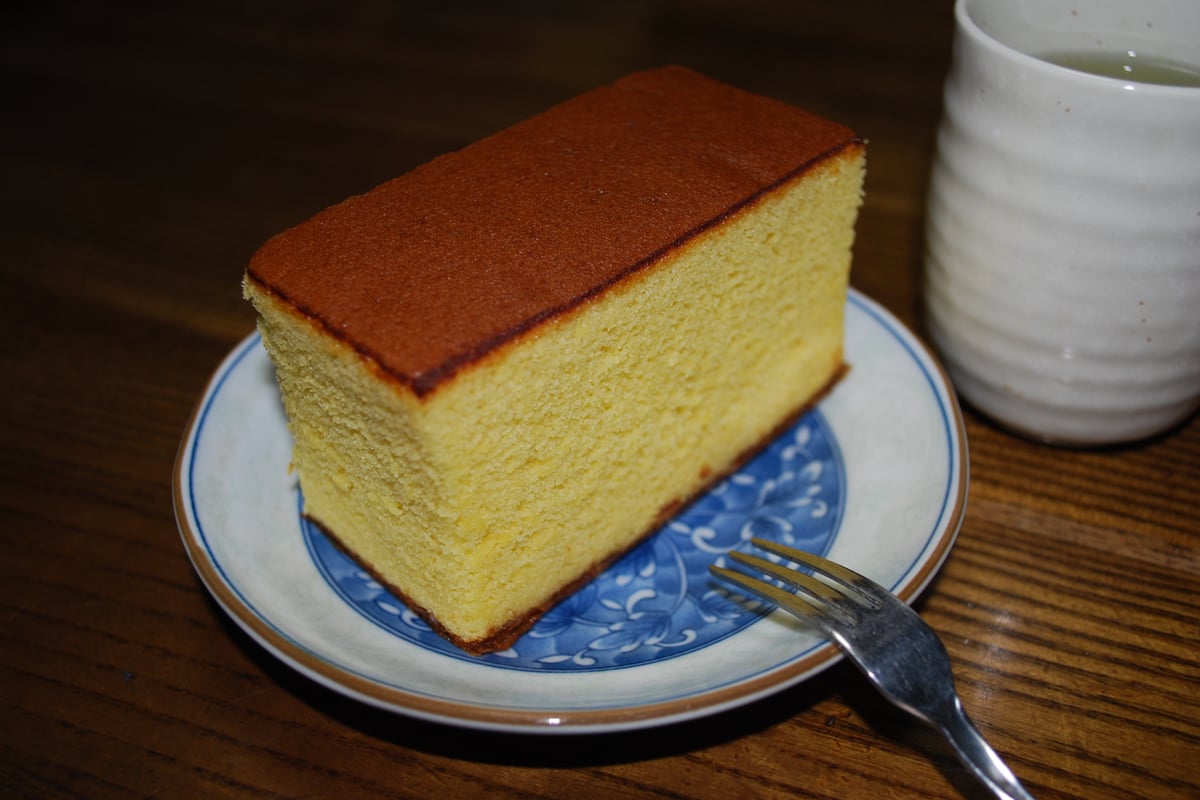
Castella is a representative Nagasaki confection baked mainly from eggs, sugar, wheat flour and starch syrup (mizuame). It developed in its own way in Japan from a Nanban confection introduced by the Portuguese in the 16th century. It is said to have become a local specialty because it continued to be made in Nagasaki, which remained open as a trading port even during the period of national seclusion (sakoku) and where sugar was gathered. It is characterized by its moist texture and a sweetness rich in egg flavor. Much of Nagasaki's castella also offers the crunchy texture of zarame (coarse sugar) left at the bottom. The most widely accepted theory is that the name comes from the Kingdom of Castile, which existed in Spain, but there are other theories as well. Nagasaki City is home to long-established shops such as Fukusaya (福砂屋), said to have been founded in 1624, as well as Shooken (松翁軒) and Bunmeido Sohonten (文明堂総本店). It is loved throughout Japan as a gift for visits and as a formal present.
Origin
Castella is said to have originated from a Nanban confection brought to Nagasaki by the Portuguese in the 16th century. According to Nagasaki City, the name is said to have come about when Japanese people of the time asked the name of the confection and the Portuguese replied that it was 'a confection of the Kingdom of Castile.' Another explanation is that it is a shortened form of the Portuguese 'bolo de Castela,' meaning 'cake of Castile.' There is no clear record of who first baked it.
History
Even during the period of national seclusion, Nagasaki remained open as a port for foreign trade, and sugar was unloaded at Dejima. The easy availability of sugar is said to be the background to castella-making taking root in Nagasaki. Castella in the Edo period is said to have used roughly equal amounts of eggs, flour and sugar, and was not as moist as it is today. The method of using starch syrup spread from the modern era onward. In 2006, 'Nagasaki Castella' is said to have been registered as a Regional Collective Trademark.
Features
Nagasaki castella is generally made by baking batter poured into a large mold and cutting it into bars (sao). No oil or fat is used; the cake is made by binding the air bubbles of whipped eggs together with a relatively small amount of flour. Zarame remaining on the bottom is said to be a hallmark of Nagasaki castella, and Fukusaya explains that it is zarame that did not fully dissolve during the mixing process. Because the zarame dissolves over time, storage in a cool place is recommended in summer.
Main Ingredients
Food Culture
According to the Ministry of Agriculture, Forestry and Fisheries, sugar and confections unloaded at Dejima were carried to various regions along the Nagasaki Kaido highway and are said to have transformed Japan's confectionery culture. This route is also called the 'Sugar Road.' In Nagasaki, castella is a standard gift for visits and for celebrations. At long-established shops such as Fukusaya and Shooken, methods relying on the handwork of craftsmen have been handed down.
Famous Shops
カステラ本家 福砂屋 長崎本店
長崎県長崎市船大工町3-1
A long-established shop founded in 1624 (Kan'ei 1). Because it handled sugar shipped from Fuzhou in China, it is thought to have used the characters '福' (fuku) and '砂' (sa, sand) in its shop name. Its bat trademark derives from the bat being regarded as a symbol of good fortune in China. On a department store's online shop, Castella Kogire No. 1 (small-cut castella) is 2,268 yen. Prices are subject to change.
View details →松翁軒 本店
長崎県長崎市魚の町3-19
It is said to have begun in 1681 (Tenna 1), when its founder, Yamaguchiya Sadasuke, started making sugar-preserved foods and castella in Motodaiku-machi. Each craftsman is described as taking charge of a single oven and baking one sheet at a time. 'Chocolate' (チョコラーテ), which combines castella with chocolate, was devised by the eighth-generation owner. The main shop also has a café.
View details →文明堂総本店
長崎県長崎市江戸町1-1
It began as 'Bunmeido,' opened in 1900 (Meiji 33) by Nakagawa Yasugoro in Maruyama-machi, Nagasaki City. The shops opened before the war in Tokyo, Kobe and elsewhere became separate companies after the war. As they are different companies from Bunmeido Sohonten in Nagasaki, care is needed when making a purchase.
View details →FAQ
Q. Where does the name 'castella' come from?
A. The most widely accepted theory is that it comes from the Kingdom of Castile in Spain. Other theories say that it is a corruption of 'kasutoruboru,' which appears in the 1704 book 長崎名物尋考 (Nagasaki Meibutsu Jinko), or that it comes from a call given while whipping egg whites. The call theory is regarded as doubtful because the time periods do not match.
Q. Is castella a Japanese or a Western confection?
A. It is a confection that developed in Japan from a Nanban confection of Portuguese origin, and it is often classified as wagashi (Japanese confectionery). Bunmeido describes it as a confection that combines the best of Japanese and Western sweets, saying it is 'both wagashi and yogashi (Western confectionery).'
Q. What is 'gosanyaki castella'?
A. It is a rich-tasting castella baked with more egg yolk and less flour than ordinary castella. A well-known theory holds that the name comes from a 5:3 ratio of egg yolk to egg white, but there are other theories as well. Judging the baking is difficult, and it is said to be baked by skilled craftsmen.