Kinzanji Miso (Chunky Miso with Summer Vegetables)
Kinzanji Miso (Chunky Miso with Summer Vegetables)
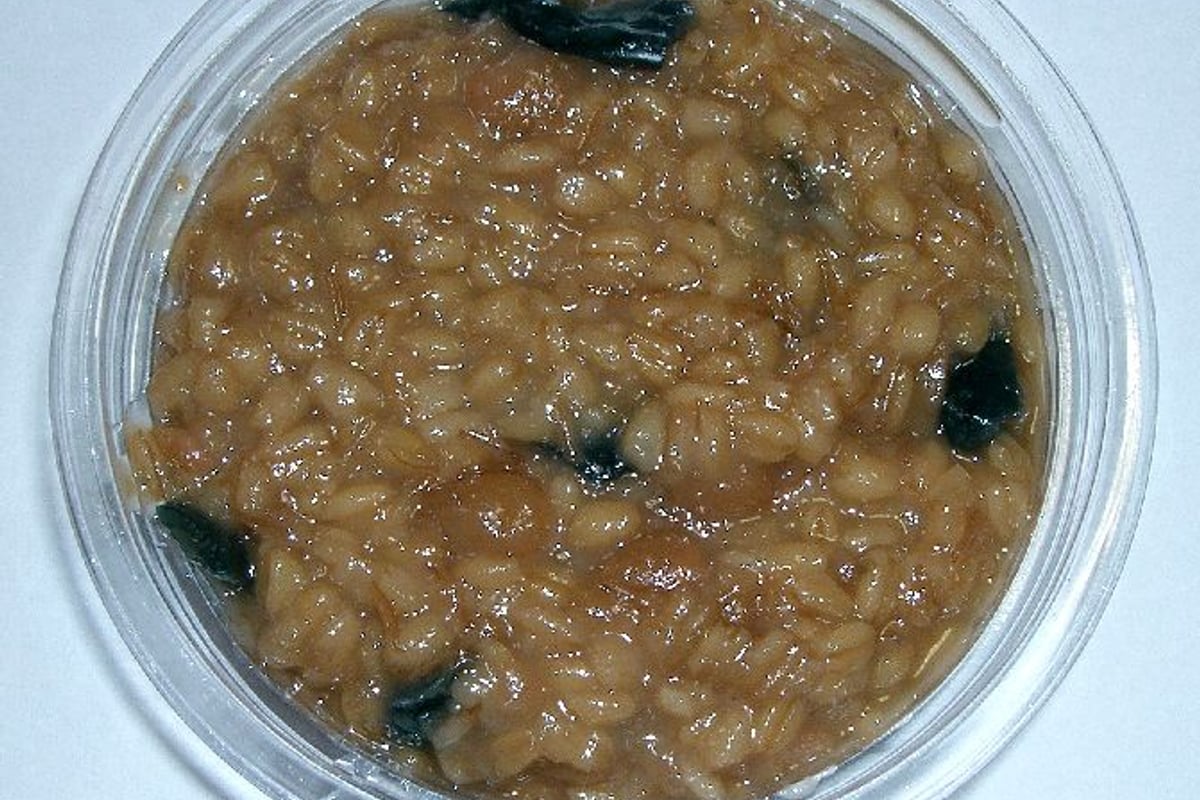
Image: Wikimedia Commons
Kinzanji miso is a traditional miso of Wakayama Prefecture, made by mixing koji (malted grain) of soybeans, barley, and rice with chopped vegetables such as uri melon, eggplant, ginger, and shiso, and then letting it mature. Rather than a seasoning dissolved into dishes, it is a type of name-miso (miso eaten as a side dish), also called okazu miso, eaten as is alongside rice or as a snack with sake. The leading theory holds that in the Kamakura period, the Zen monk Kakushin (Hotto Kokushi), who traveled to Song China, learned how to make it at Jingshan Temple (Kinzan-ji) and brought the method to Kishu after returning to Japan. Yuasa Town is known as a production area of Kinzanji miso, and it is also said that the liquid that collected in the miso barrels became the beginning of Yuasa soy sauce. In 2017, 'Kishu Kinzanji Miso' became the first product of Wakayama Prefecture to be registered as a Geographical Indication (GI). In Yuasa Town, there are still storehouses that make Kinzanji miso.
Origin
Kakushin (Hotto Kokushi) is said to have traveled to Song China in 1249 (Kencho 1) and trained at Jingshan Temple (Jingshan Xingsheng Wanshou Chan Temple). Kakushin returned to Japan in 1254 and founded 興国寺 (then called 西方寺) in what is now Yura Town. Kinzanji miso is said to have begun when Kakushin taught people in the vicinity the miso-making method the monk had learned in between religious training. On the other hand, there are also other theories, such as that Kukai brought it back from Tang China, and there are several theories about its origin.
History
The method is said to have spread to the area around 興国寺, in what are now the Yuasa and Gobo areas, and became popular among ordinary people as a preserved food. In the Edo period, it came to be made in large quantities in Yuasa, which had abundant water and convenient sea transport. Under the protection of the Kishu Tokugawa family, it became, along with soy sauce, an important industry of the Kishu Domain, and it was sold in Edo as a Kishu specialty. The Kishu Miso Industry Cooperative (紀州味噌工業協同組合) was established in 1951, and in 2017 'Kishu Kinzanji Miso' was registered as a GI.
Features
Kishu Kinzanji miso is characterized by turning all three of domestically grown soybeans, naked barley, and rice into koji, and by using uri melon, eggplant, ginger, and shiso as its vegetables. Ordinary Kinzanji miso is made by combining koji of soybeans and wheat with uri melon, eggplant, and ginger. The koji and chopped vegetables are prepared together with salt and sugar and then fermented and matured. Even with grains of soybean and barley still intact, it is soft, with a mellow flavor in which the umami of the koji and the taste of the vegetables blend together.
Main Ingredients
Food Culture
Kinzanji miso is basically eaten as is, alongside warm rice or as a snack with sake. It is also eaten with raw vegetables or spread on rice balls and grilled. It was originally also a preserved food for making vegetables last a long time.
How It Differs from Home Cooking
Kinzanji miso is made with soybeans, koji, chopped eggplant and uri melon, shiso, and so on, and the flavor is said to differ from household to household. Breweries in Yuasa and elsewhere each preserve their own methods, such as using koji of three grains (soybeans, naked barley, and rice) and making the miso in a traditional environment that makes use of the yeasts living in the storehouse.
Famous Shops
太田久助吟製
和歌山県有田郡湯浅町湯浅15
A storehouse dating back to the late Edo period. It was originally a soy sauce brewery, but is said to have switched to making miso exclusively after the war. Chopped white uri melon, round eggplant, ginger, and shiso are added to koji of steamed rice, soybeans, and naked barley and left to mature. Without mechanization, the miso is made in the same environment as in the past, and a wooden box (270 g) is about 1,080 yen.
丸新本家
和歌山県有田郡湯浅町湯浅1466-1
A long-established Yuasa business founded in 1881 (Meiji 14) that makes and sells Kinzanji miso and soy sauce. It is a storehouse that has traditionally made Kinzanji miso, and in 2002 湯浅醤油有限会社 was established to handle soy sauce brewing. It is one of the storehouses that pass on the history of Yuasa's Kinzanji miso and soy sauce to the present day.
| 湯浅醤油 'Gudakusan (Chunky) Kinzanji Miso' | Kinzanji miso available at 九曜蔵, the storehouse of the Yuasa Town soy sauce brewery 湯浅醤油. It is Kinzanji miso made by a soy sauce brewery, and 270 g is about 810 yen. At 九曜蔵 you can also tour the soy sauce storehouse, where large cedar barrels stand in rows, and buy the miso at the same time. |
|---|
FAQ
Q. Why is it written with the characters '金山寺' (Kinzanji)?
A. It is said to come from Jingshan Temple (径山寺, read 'Kinzanji' in Japanese) in China, where Kakushin trained. It is said that the miso was sold under the name '径山寺' in the early Edo period and became popular, and the characters '金山寺,' which have the same reading, spread. Wakayama Prefecture's public relations magazines and other publications still also use the spelling '径山寺味噌.'