Kawara Soba (Green Tea Soba Served on a Hot Roof Tile)
Kawara Soba (Green Tea Soba Served on a Hot Roof Tile)
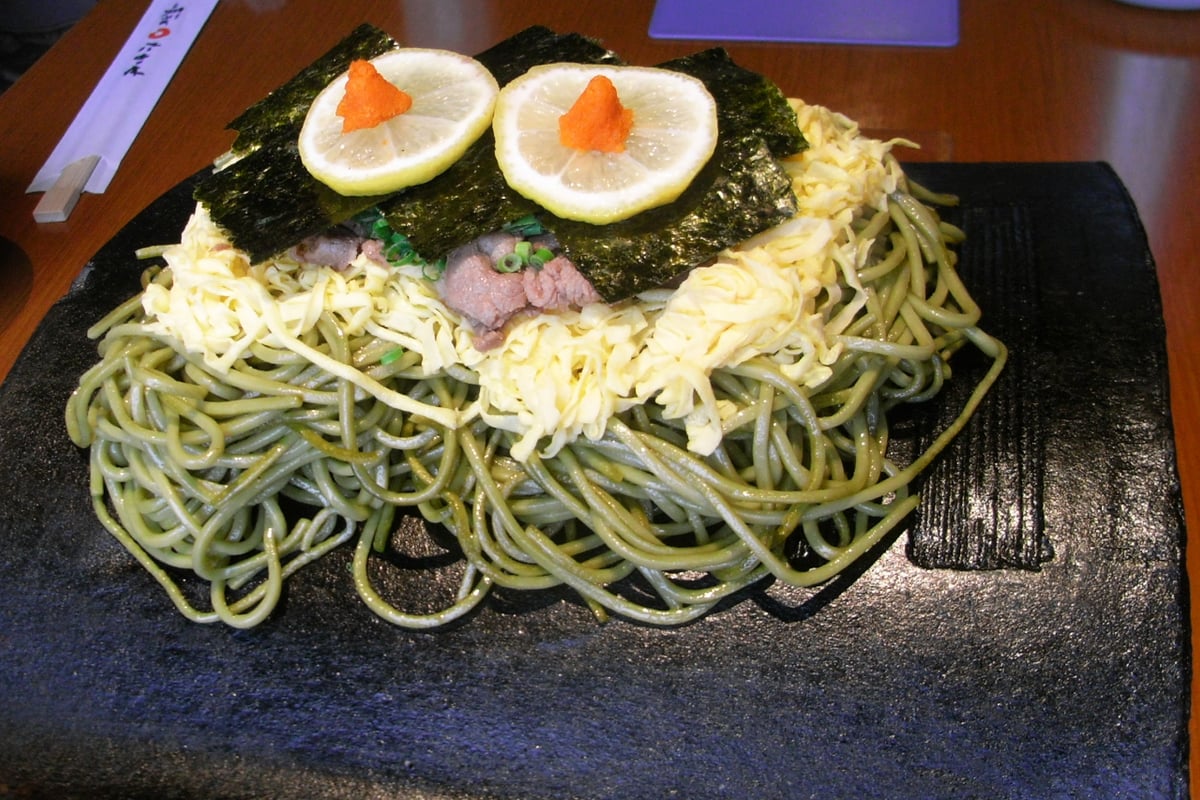
Image: Wikimedia Commons
Kawara Soba (soba served on a hot roof tile) is a dish in which green tea soba (cha-soba) is placed on a heated roof tile (kawara), colorfully topped with beef, kinshi tamago (thin strips of egg crepe) and more, and eaten by dipping it in warm mentsuyu (noodle dipping sauce). Kawatana Onsen in Toyoura Town, Shimonoseki City, Yamaguchi Prefecture, is regarded as its birthplace. Around 1961 (Showa 36), 高瀬慎一, who ran a ryokan (Japanese inn) at the hot spring, created it as a dish that would become a specialty of Kawatana Onsen. It is said to have been inspired by an elder's story that, during the Satsuma Rebellion (Seinan War), soldiers of the Satsuma army besieging Kumamoto Castle grilled wild plants and meat on roof tiles and ate them. The cha-soba that touches the tile becomes crisp and toasty, and diners can also enjoy the contrast with the softer noodles on top. Today it has spread across Yamaguchi Prefecture as a local specialty dish. At home it is easily made on a hot plate or in a frying pan, and it is sometimes served in school lunches at elementary and junior high schools in the prefecture.
Origin
The inspiration was a story connected with the Satsuma Rebellion of 1877 (Meiji 10). 高瀬慎一 is said to have heard from a local elder that soldiers of the Satsuma army besieging Kumamoto Castle used roof tiles to grill wild plants and meat to eat. The Ministry of Agriculture, Forestry and Fisheries' introduction also cites the background that, when Kawatana Onsen flourished as a hot-spring health resort (toji-ba) in the Edo period, common people were specially permitted to use roof tiles.
History
According to the Ministry of Agriculture, Forestry and Fisheries' introduction, Kawara Soba was created in 1961 (Showa 36) by a ryokan at Kawatana Onsen as a specialty for the hot spring. The official website of the creator's restaurant says it was born in 1962, so sources differ by one year. When the ryokan where it originated closed, the dish once disappeared, but in response to customers saying they wanted to eat it again, a specialty restaurant was opened. After that, other ryokan and restaurants began to serve it as well, and it spread throughout the prefecture.
Features
The roof tile is coated with oil and heated over an open flame, and boiled cha-soba is grilled and placed on it. On top go beef simmered in a sweet and savory sauce, kinshi tamago and thinly sliced green onions, with shredded nori scattered over. A slice of lemon is added together with momiji-oroshi (grated daikon with red chili), and the noodles are dipped in warm mentsuyu. Because the tile retains heat well, the dish stays hot to the very end. The noodles touching the tile become crisp like okoge (scorched rice), adding a toasty aroma.
Main Ingredients
Food Culture
Because it is easy to make on a hot plate and looks attractive, Kawara Soba is often made in Yamaguchi homes when people get together. Kawara Soba sets for home use are also sold. At elementary and junior high schools in the prefecture it sometimes appears on the school lunch menu, making it a dish familiar to children as well.
How It Differs from Home Cooking
At restaurants, a real roof tile is heated over an open flame, the cha-soba and toppings are arranged on it, and it is brought to the table piping hot. At home, a hot plate or frying pan is used instead of a tile; the cha-soba is grilled first and the toppings are then placed on top.
Famous Shops
元祖瓦そば たかせ 川棚本館
山口県下関市豊浦町大字川棚5437
The restaurant founded by 高瀬慎一, who created Kawara Soba. Besides the main building, a renovated structure about 100 years old, there is also the Minami Honkan (south main building) nearby. The official website lists the original Kawara Soba at 1,485 yen (tax included) per serving. The cha-soba is kneaded with Uji matcha, and the dipping sauce has a slightly sweet flavor accented by bonito and kombu dashi.
View details →| Kawara Soba Set for Home Use (元祖瓦そば たかせ) | A set sold by 元祖瓦そば たかせ (Ganso Kawara Soba Takase) for enjoying the restaurant's Kawara Soba at home. The restaurant's online shop lists it at 1,404 yen for 2 servings and 2,376 yen for 4 servings (both tax included). It is also reported to have been sold at the shop of the Kawatana Minami Honkan.Where to buy →PR |
|---|
FAQ
Q. Is the tile in Kawara Soba a real roof tile?
A. Real roof tiles are used for the Kawara Soba served at restaurants. The official website of the creator's restaurant explains that it uses Japanese roof tiles that have been in use for decades and developed them with its own original method. The tiles retain heat well, so the dish stays hot even as time passes. At home, a hot plate or similar is used as a substitute.