Fuku-sashi (Shimonoseki Thinly Sliced Pufferfish Sashimi)
Fuku-sashi (Shimonoseki Thinly Sliced Pufferfish Sashimi)
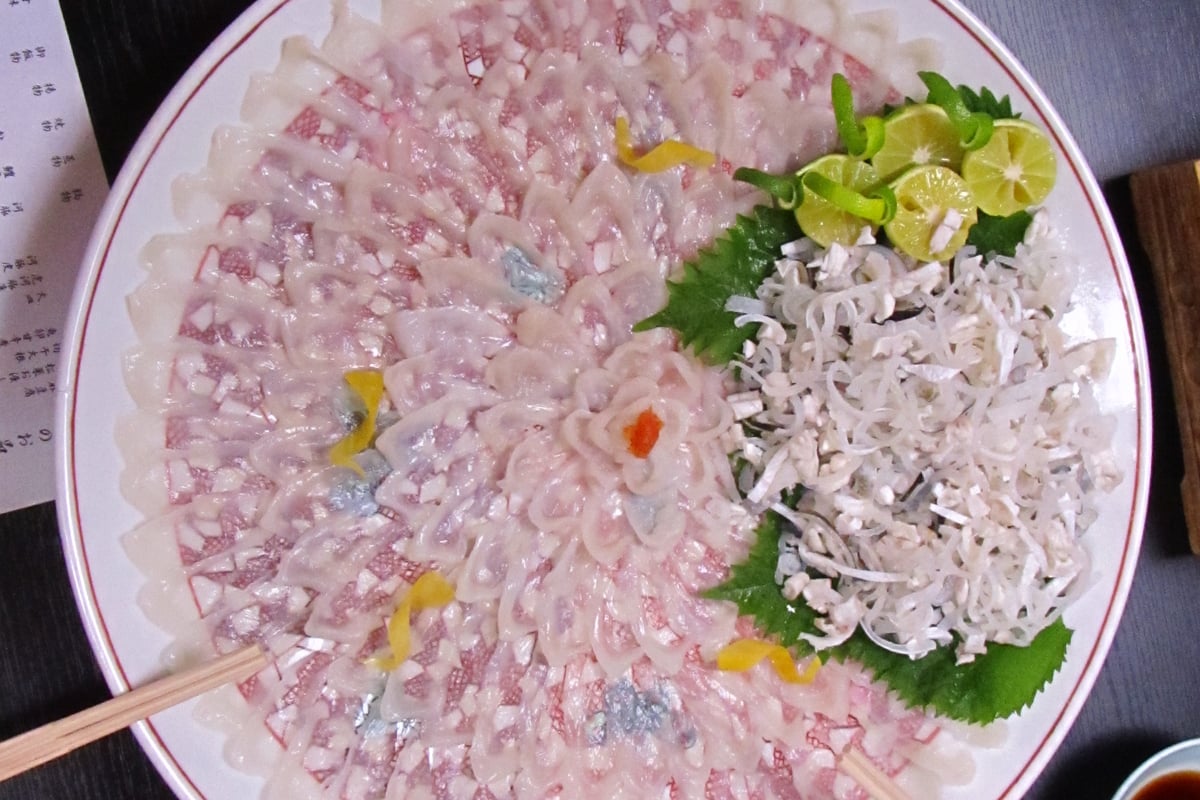
Image: Wikimedia Commons
Fuku-sashi (pufferfish sashimi) is a signature dish of Shimonoseki City, Yamaguchi Prefecture, in which the flesh of tiger puffer (torafugu) is sliced so thin it is almost translucent and arranged on a large platter. In Shimonoseki, fugu (pufferfish) is called 'fuku,' without the voiced sound, and its sashimi is called 'fuku-sashi.' Because 'fuku' sounds like the word for good fortune (福), the name is also said to be auspicious. Yamaguchi Prefecture's official prefectural fish is the fugu, and Shimonoseki, with its long history of fugu cuisine and many processing plants and restaurants, is known as 'the home of fuku.' In 1888 (Meiji 21), at the urging of Ito Hirobumi, Yamaguchi Prefecture lifted its ban on eating fugu, and the Shimonoseki ryotei (traditional Japanese restaurant) 春帆楼 (Shunpanro) became the first restaurant officially licensed to serve fugu. Kiku-mori (chrysanthemum arrangement), in which the thin slices are laid out in a circle like flower petals, is a showcase of the chef's skill. It is eaten with ponzu accompanied by momiji-oroshi (grated daikon with red chili) and green onions. Because it is expensive, it is regarded as a special delicacy served at celebrations and other occasions. The fishing season for wild tiger puffer is limited to roughly September through March, and fuku-sashi is enjoyed as a taste of winter.
Origin
There are tiger puffer spawning grounds in the waters near Shimonoseki, and the Kanmon Straits, which link the Sea of Japan and the Seto Inland Sea, are also a migration route for tiger puffer. Because of this environment, Shimonoseki is said to have developed a fugu-eating culture from early times. On the other hand, fugu was banned for a long time because of the danger of poisoning. It is said that during Toyotomi Hideyoshi's invasions of Korea, fugu poisoning deaths occurred one after another among the soldiers gathered in Kyushu, and eating fugu was prohibited.
History
The rules prohibiting the eating of fugu continued into the Meiji era. According to 春帆楼's chronology, at the end of 1887 (Meiji 20), when rough seas meant no fish could be caught, the proprietress, Michi, served the forbidden fugu at Ito Hirobumi's meal. Ito liked the taste so much that the following year, 1888, he had the Governor of Yamaguchi Prefecture (kenrei, the equivalent of today's governor) lift the ban, and 春帆楼 became the first officially licensed fugu restaurant. In 1974 (Showa 49), Haedomari Market (南風泊市場), a market specializing in fugu, opened on Hikoshima Island.
Features
Fugu flesh is fibrous and very springy, so it is cut by usuzukuri (paper-thin slicing) into translucent slices with a dedicated fugu-hiki bocho (fugu slicing knife). The dark red meat (chiai) and thin membrane are removed from the filleted flesh, which is then cut on a slant with a shaving motion and arranged on the platter. The best-known arrangement is kiku-mori, which resembles a large chrysanthemum blossom. Blanched skin is sometimes served alongside. It is eaten with ponzu, made by combining soy sauce with the juice of citrus such as daidai (bitter orange), accompanied by momiji-oroshi and finely chopped green onions.
Main Ingredients
Food Culture
In Shimonoseki, fuku-sashi arranged in kiku-mori style is sold even at fish shops and supermarkets, and it is eaten at home as well. Every year on April 29, the Shimonoseki Fuku Memorial Service (下関ふく供養祭) is held to console the spirits of fugu. In 2016, tiger puffer processed in Shimonoseki was registered as a Geographical Indication (GI) under the name 'Shimonoseki Fuku.'
How It Differs from Home Cooking
Because fugu has poisonous parts, only people with a fugu processor (fugu shorishi) license may prepare it. At restaurants, chefs slice the flesh thinly and finish the kiku-mori arrangement on the spot. At home, people do not fillet fugu themselves; instead, they buy ready-arranged fuku-sashi from fish shops or supermarkets.
Famous Shops
春帆楼 下関本店
山口県下関市阿弥陀寺町4-2
A ryotei associated with Ito Hirobumi and the first restaurant officially licensed to serve fugu. In 1895 (Meiji 28), it was also the venue for the signing of the Sino-Japanese peace treaty (the Treaty of Shimonoseki). The official website lists a 'Fugu Kaiseki' including tiger puffer sashimi from 8,800 yen including tax, and full courses from 24,200 yen including tax (service charge not included).
View details →下関ふく百花 関とら本店
山口県下関市みもすそ川町6-20
A fuku restaurant about a 4-minute drive from Karato Market. Its hallmark is fuku-sashi sliced carefully one piece at a time by its chefs and arranged to resemble a large chrysanthemum. Reservation sites introduce courses starting from about 12,000 yen per person. The restaurant's tiger puffer sashimi sets are also sold through department store mail order.
唐戸市場
山口県下関市唐戸町5-50
A market facing the Kanmon Straits, where fugu is sold at the fresh fish stalls and served at the eateries. On Fridays, Saturdays, Sundays and public holidays, 'Iki-iki Bakangai' (活きいき馬関街) is held on the first floor, where you can buy fugu nigiri and other sushi from a single piece and compare them. It is also said that fuku-jiru (fugu miso soup) can be enjoyed at shops in the market from about 400 yen.
| Grilled Tiger Puffer Fins (春帆楼) | A product of grilled tiger puffer fins sold at the shop of 春帆楼's Shimonoseki main restaurant. Fugu fins dried and toasted, then placed in hot sake, make what is called 'hirezake' (fin sake), which offers a fragrant, toasty flavor. The official website lists it at 756 yen (tax included).Where to buy →PR |
|---|---|
| Daidai Ponzu (春帆楼) | A ponzu sold at the shop of 春帆楼's Shimonoseki main restaurant. Fuku-sashi is classically eaten with ponzu made by combining citrus juice with soy sauce, and daidai is a representative citrus for it. The official website lists it at 1,026 yen (tax included).Where to buy →PR |
FAQ
Q. Why is fugu called 'fuku' in Shimonoseki?
A. A well-known theory is that the voiced 'fugu' evokes the word 'fugu' meaning misfortune (不遇), while 'fuku' connects to good fortune (福), making it auspicious. 春帆楼 also introduces theories that it is an old name derived from the way the fish puffs up its belly (fukuramu) when angry, or from its habit of blowing (fuku) water. Which theory is correct is not clear.
Q. Is it all right to prepare fugu at home?
A. Please avoid it. Fugu has poison in parts such as the liver and ovaries, and only people with a fugu processing license may prepare it. In Yamaguchi Prefecture, you must have at least three years of practical experience in fugu processing and then pass an examination. The name and requirements of the license differ by prefecture, and it is not a national qualification.