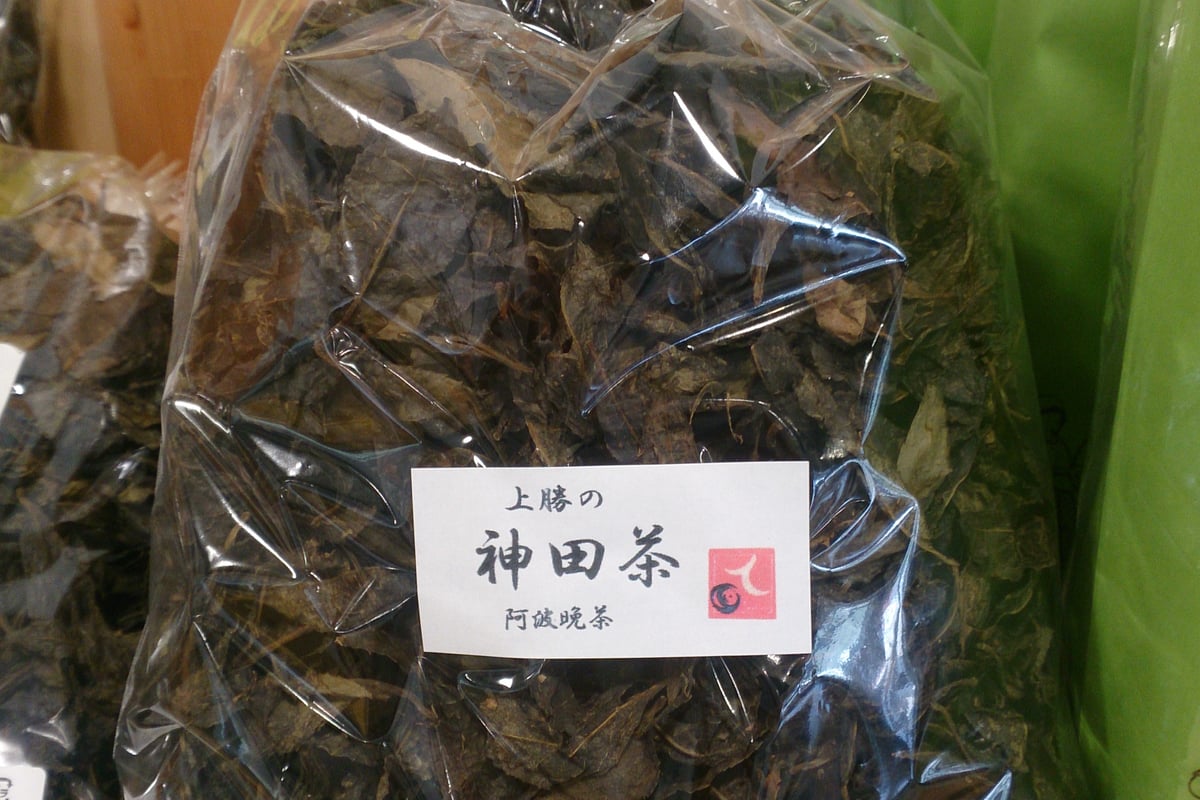
Image: Wikimedia Commons
Awa Bancha (fermented tea) is a post-fermented tea made with the help of lactic acid bacteria, produced in the mountainous areas of Tokushima Prefecture. The main production areas are Kamikatsu Town in Katsuura District and the area of the former Aioi Town in Naka Town, Naka District. It is also made in places such as Minami Town in Kaifu District. Large tea leaves that have grown through the summer are picked and boiled in a big cauldron, then rubbed to bruise them, packed into tubs and left to ferment. Finally, they are dried in the sun. It is characterized by a faint sourness from lactic acid fermentation and a soft, gentle mouthfeel. It was originally made by each household for its own consumption, so the method and flavor differ slightly from family to family. In 2018 (Heisei 30), it was selected by the national government as an 'Intangible Folk Cultural Property Requiring Measures Such as Making Records' under the title 'Production Techniques of Fermented Tea in the Shikoku Mountains.' In 2021 (Reiwa 3), the 'Production Techniques of Awa Bancha' were designated a national Important Intangible Folk Cultural Property.
Origin
There are two traditions about its origin: one says it was introduced by Kobo Daishi (Kukai), and the other says it was introduced by Yokoo Gon-no-kami, a fugitive warrior of the Heike (Taira clan). However, neither is supported by historical documents dating back before the Edo period, and both are regarded as no more than legend. The character 晩 used in its name (instead of the 番 of ordinary 'bancha') is explained as a spelling producers use to show that it is a post-fermented tea, distinct from ordinary bancha, which differs in its leaves and production method.
History
Awa Bancha has been passed down in mountain villages several hundred meters above sea level in the Shikoku Mountains, made by each household mainly for its own use. In March 2018, together with Goishi-cha from Kochi Prefecture and Ishizuchi Kurocha from Ehime Prefecture, it was selected by the national government as 'Production Techniques of Fermented Tea in the Shikoku Mountains.' This was the first such selection in the field of food culture. In March 2021, it was designated an Important Intangible Folk Cultural Property. In Kamikatsu Town, 'Kamikatsu Awa Bancha' is registered as a regional collective trademark.
Features
Production takes place in the summer months of July and August and consists of tea picking, boiling, rubbing, pickling in tubs, drying and sorting. The picked leaves are boiled in a large cauldron to stop oxidative fermentation, then rubbed to bruise the surface of the leaves. They are then packed into tubs with the air pressed out and fermented by lactic acid bacteria. The pickling stage is considered the most important step, and it generally lasts about one to two weeks in Naka Town and about two to three weeks in Kamikatsu Town. Its distinguishing feature is that it relies on fermentation by lactic acid bacteria rather than on oxidation of the tea leaves themselves.
Main Ingredients
Food Culture
Awa Bancha has been drunk as an everyday tea in mountain households. Because it can be made only during the hot summer season, each year's tea starts to appear around September. Some producers take reservations and ship the tea in order as it is finished.
Famous Shops
Kamikatsu-TeaMate
徳島県勝浦郡上勝町大字正木字平間155-1
A business in Kamikatsu Town that produces and sells Awa Bancha. It makes Kamikatsu Awa Bancha with a faint sourness, slowly fermented with lactic acid bacteria. Its official website lists 100g of tea leaves at 1,620 yen, and there are also 500g packs and small sampler sets for comparing flavors. It also accepts participants for seasonal farm experiences such as tea picking.
View details →まえばら農園
徳島県勝浦郡上勝町
A farm in Kamikatsu Town that handles everything itself, from growing the tea to making Awa Bancha and shipping it. No pesticides or chemical fertilizers are used during cultivation, and the tea is fermented in wooden tubs. Production starts around July, and sales usually begin around September each year, ending once the prepared stock runs out. Tea bag products are also available.
View details →| 'Awa Bancha' (阿波番茶) 100g (立石園) | Awa Bancha tea leaves sold on the online shop of the Tokushima Prefecture Products Center, with the product name written as '阿波番茶.' A 100g pack is listed at 1,980 yen (tax included). Because supplies are limited, purchase quantities may be restricted or it may sell out.Where to buy →PR |
|---|
FAQ
Q. Are 晩茶 and 番茶 (both read 'bancha') different things?
A. Awa Bancha is sometimes also written 阿波番茶 or 阿波ばん茶. However, ordinary bancha is a type of unfermented green tea, whereas Awa Bancha is a post-fermented tea made through lactic acid fermentation. Because the leaves and production method differ, producers are said to use the character 晩 to distinguish it.