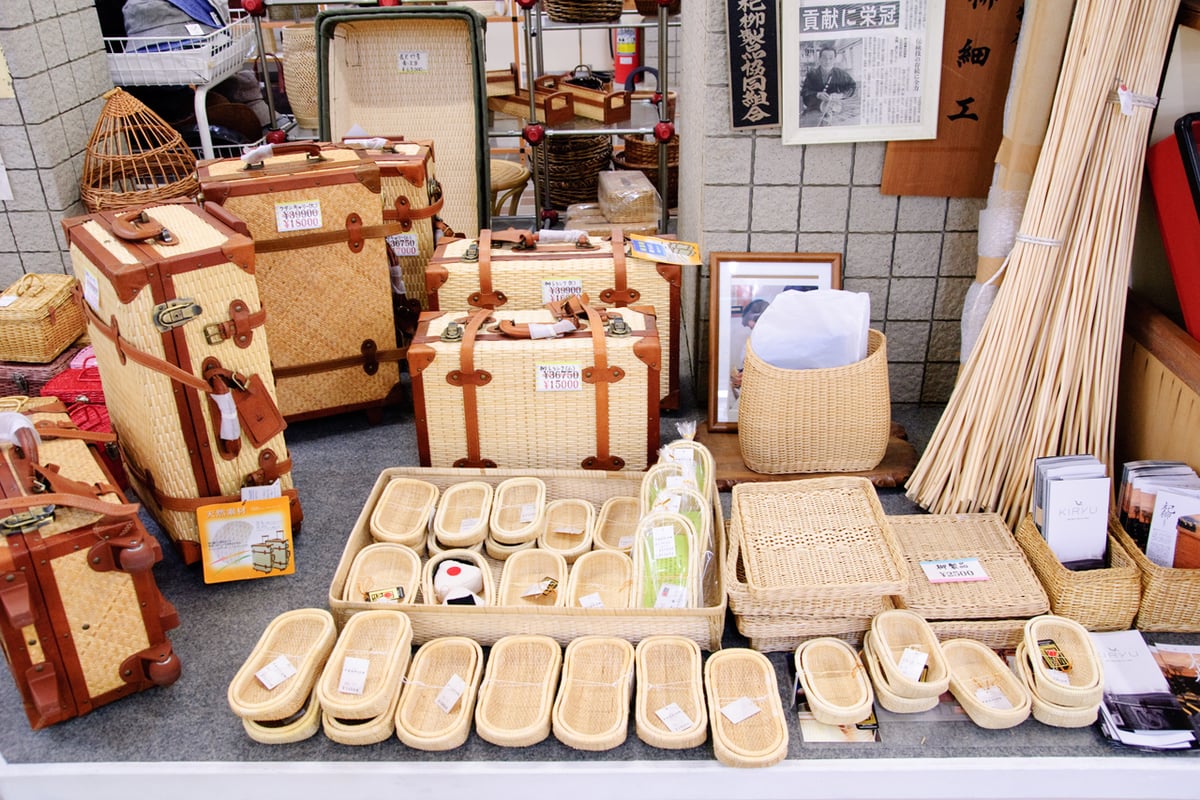
Image: Wikimedia Commons
Toyooka Kiryu Zaiku is wickerwork made in Toyooka City, Hyogo Prefecture, by weaving the branches of the koriyanagi willow (kiryu). Koriyanagi is a shrub of the willow family that once grew wild in the wetlands along the Maruyama River (Maruyamagawa). According to Hyogo Prefecture, the craft began in the Nara period, and willow boxes made in Tajima Province at that time survive in the Shosoin repository. In the Edo period, under the patronage of the Kyogoku family, lords of the Toyooka Domain, Toyooka became known throughout Japan as a production center of yanagi-gori (willow wicker trunks) used to store clothing and other items. In the Meiji era, the wicker-trunk bag (kori kaban), a trunk fitted with handles and locks, was created, and it became the starting point of today's Toyooka, 'the town of bags.' A characteristic of the craft is that each piece is woven by hand, combining techniques such as bottom weaving, rope weaving, rim weaving and lid weaving. Products are divided into three categories: yanagi-gori, small trunks, and baskets of willow or rattan. It was designated a Traditional Craft designated by the Minister of Economy, Trade and Industry in 1992 (Heisei 4).
Origin
Toyooka's kiryu wickerwork is said to have begun with the use of the koriyanagi willow that grew wild on the banks of the Maruyama River. Hyogo Prefecture describes the craft as beginning in the Nara period, and willow boxes made in Tajima Province at that time still exist in the Shosoin. Materials from the Hyogo Prefecture Kiryu Products Cooperative (兵庫県杞柳製品協同組合) also introduce a legend that the techniques were passed on by Amenohiboko no Mikoto, a prince of Silla who is said to have opened up Tajima and who is the enshrined deity of Izushi Shrine. The same materials state that the craft is also mentioned in the Shoku Nihongi (Chronicles of Japan Continued).
History
According to Hyogo Prefecture, kiryu wickerwork took shape as an industry in the Toyotomi period and came under the patronage of the Kyogoku family, lords of the Toyooka Domain, in the early Edo period. The domain established a monopoly system under which it bought up all the products and sold them itself, and yanagi-gori became known nationwide as a Toyooka specialty. In the Meiji era the wicker-trunk bag (kori kaban) was devised, and at the 2nd National Industrial Exhibition (Naikoku Kangyo Hakurankai) in 1881, a kiryu basket case fastened with three leather straps was exhibited. Baskets reached their heyday in the Taisho era. After the war, items such as shopping baskets were also made, but from 1973 (Showa 48) onward production declined under pressure from foreign products.
Features
The raw material, koriyanagi, is strong and supple, with both softness and resilience. Woven products are said to be well ventilated, to absorb a moderate amount of moisture and to be resistant to water. There are 7 bottom-weaving techniques, 6 rope-weaving techniques, 18 rim-weaving techniques and 10 lid-weaving techniques, and these are combined to make a wide variety of forms, from trunks to handbaskets. As a traditional craft, it has three categories: yanagi-gori, small trunks, and baskets of willow or rattan. It has been reported that, as of 2021, only one person was certified as a certified traditional craftsperson in the yanagi-gori category.
Techniques
Bottom, Rope, Rim and Lid Weaving
The weaving methods of kiryu wickerwork are systematized by part. According to the Hyogo Prefecture Kiryu Products Cooperative, there are 7 types of bottom weaving, 6 types of rope weaving, 18 types of rim weaving and 10 types of lid weaving. These are combined to weave various forms, such as trunks and stylish handbaskets.
Weaving Yanagi-gori
Willow rods of uniform length and thickness are used for the warp, and hemp thread for the weft. Crouching on a board, the weaver repeatedly lifts every other willow rod and passes the hemp thread between them, weaving the piece into a flat panel. Shaping the corners and evening out the weave are difficult techniques that also require strength.
Materials Used
| Main Production Areas |
|
|---|
Artisans & Workshops
たくみ工芸(寺内卓己)
A workshop in 魚屋, Izushi-cho, Toyooka City, whose family business is making willow and rattan baskets. 寺内卓己 joined the family business in 1978 and has honed the techniques of yanagi-gori making. The Kobe Shimbun (2021) reported that 寺内卓己 was the only certified traditional craftsperson in the yanagi-gori category. The koriyanagi is grown in fields in 清冷寺, Toyooka City.
兵庫県杞柳製品協同組合
A production-area cooperative at 1362 赤石, Toyooka City (tel. 0796-23-3821). It is responsible for promoting the traditional craft Toyooka Kiryu Zaiku and has run a successor training program since 1990 (Heisei 2). It also works to spread the techniques, for example through kiryu classes held at local high schools by its chairperson and others.
How to Buy
- 伝統工芸館 杞柳 (Izushi-cho, Toyooka City)
- A facility for exhibiting and selling kiryu products, opened in March 2021 near the Izushi Castle ruins in the castle town of Izushi. It was reported that members of the Community Revitalization Cooperation Corps (chiiki okoshi kyoryokutai) who are learning under a yanagi-gori craftsperson also serve customers. It is best to check business days and available items in advance.
- Shops in Izushi, Kinosaki Onsen and Toyooka City
- According to the multilingual tourism commentary of the Ministry of Land, Infrastructure, Transport and Tourism, small handbags and baskets of kiryu wickerwork can be purchased at shops in various places in Izushi, Kinosaki Onsen and Toyooka. For large items such as yanagi-gori, it is best to contact the workshops or the cooperative.Where to buy →PR
FAQ
Q. How is kiryu wickerwork related to Toyooka bags?
A. In the Meiji era, the wicker-trunk bag (kori kaban) was made by reinforcing the corners of a yanagi-gori with leather and adding handles and locks. This is considered the origin of Toyooka bags. Later, the material shifted from kiryu to leather and synthetic fibers, and Toyooka is described as having become a production area that accounts for about 80% of Japan's bag production.
Q. What is 'kiryu'?
A. It refers to koriyanagi, a shrub of the willow family. It has long, slender, supple branches that are strong and resilient, making them well suited to woven crafts. In Toyooka, willows that grew wild in the wetlands of the Maruyama River basin were used, and today they are also grown in fields.