Taikodai Embroidered Curtains
Taikodai Shishu Kazarimaku (Embroidered Curtains for Festival Drum Floats)
 1 / 2
Image: Wikimedia Commons
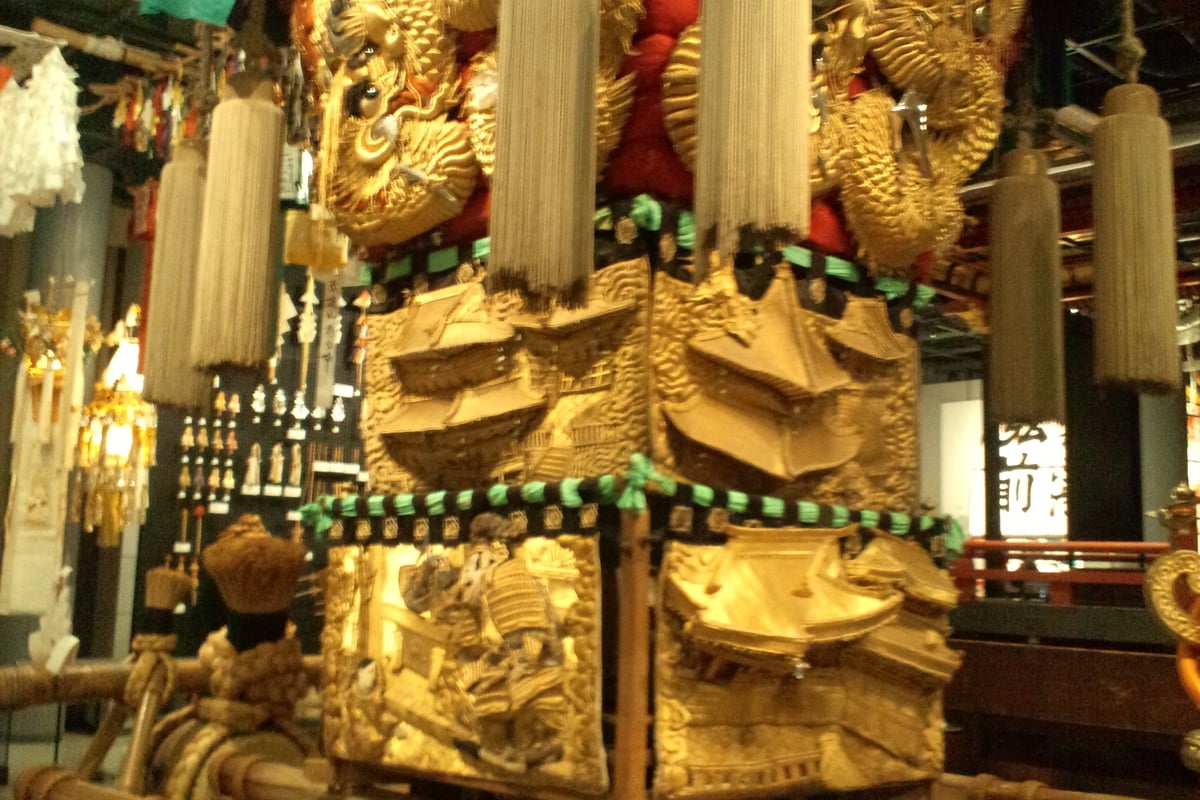
Taikodai Embroidered Curtains (Taikodai Shishu Kazarimaku) are embroidered curtains that decorate the taikodai (festival drum floats) carried at autumn festivals in the Toyo (eastern Ehime) region of Ehime Prefecture. A taikodai is a festival float with a drum installed inside a tower-like frame (yagura), and it is known from the Niihama Taiko Festival and the autumn festivals of Shikokuchuo City. On the curtains hanging on all four sides, and on the futon-jime that bind the futon roof (a roof of stacked cushion-like layers), dragons, hawks, lions (shishi), warriors and other motifs are rendered in three-dimensional embroidery using gold thread. Taikodai from the Toyo region of Ehime to Kagawa and Hyogo prefectures are said to be characterized by such lavish three-dimensional embroidery. A single craftsperson handles almost every step of making the curtains, and each one is made to order. They are designated a Traditional Specialty Product (designated by Ehime Prefecture), and the listed contact is a nuishi (embroidery craftsperson) in Shikokuchuo City. In 2024 (Reiwa 6), the technique of 'nuihaku production' used for the curtains was designated an Intangible Cultural Property of Shikokuchuo City.
Origin
A taikodai is a type of festival float with futon roofs stacked on top of four pillars, and it is also called 'futon-daiko,' among other names. It is said to have originated in the Kamigata (Kyoto-Osaka) area in the Edo period, and its present form spread to various parts of western Japan in the first half of the 19th century. In Ehime Prefecture, it is called 'taikodai' in the areas east of Saijo City. Taikodai are distributed with Mie Prefecture as their eastern limit; they are numerous in the Kinki, San'yo and Shikoku regions and are also found scattered in Kyushu.
History
According to Niihama City materials, taikodai in the early Meiji era were about 3 meters tall, about the size of today's children's taikodai. As the region grew prosperous with the development of the Besshi Copper Mine, each district began to compete in splendor and size. From the mid-Meiji era to the early Showa era they reached almost the size they are today, and the curtains also became more lavish as embroidery techniques developed. Niihama's taikodai are said to have originally been called 'mikoshi-daiko.'
Features
On Niihama's taikodai, a total of eight dragon futon-jime, in pairs of two, are attached to the four sides of the futon roof, and below them a total of eight uwamaku (upper curtains) and koranmaku (balustrade curtains) are attached on the four sides. The designs include birds and beasts (kinju) such as dragons, hawks and lions, palaces, and warrior pictures based on stories and plays. The designs carry the wishes of the district that owns the taikodai.
Techniques
Three-Dimensional Embroidery (Takanui)
An embroidery in which the base is built up before gold thread is laid over it, so that the design stands out in three dimensions. It is said to be a traditional technique called 'takanui embroidery.' The conventional method is to make the dragon's scales with cotton, and there is also a technique called 'sashi-uroko' (inserted scales), in which each scale is sewn separately and then attached.
Nuihaku Production
A traditional technique used for the decorative curtains of taikodai, designated an Intangible Cultural Property of Shikokuchuo City in 2024. 山下八郎, a nuishi from the former Iyomishima City, is said to have developed the curtains of Niihama's taikodai with a three-dimensionality and power that overturned previous conventions.
Combining the Canopy, Tassels and Curtains
On Niihama's taikodai, the tenmaku (canopy) at the top is said to represent the universe, the black 'kukuri' the clouds, and the tassels the rain. The four pillars represent east, west, south and north, and the embroidered uwamaku and koranmaku adorn the spaces between them. A taikodai can reach about 5.5 meters in height and weigh about 3 tons.
Materials Used
| Main Production Areas |
|
|---|
Artisans & Workshops
縫師 高橋直孝
A nuishi in Kawanoe-cho, Shikokuchuo City. He was certified as an Ehime Traditional Craftsperson in 2005 (Heisei 17) and as a 'Contemporary Master Craftsman' in 2020 (Reiwa 2), and received the Medal with Yellow Ribbon in 2023. In 2024, he was recognized as the holder of the technique of 'nuihaku production,' a city-designated Intangible Cultural Property.
株式会社金鱗(きんりん)
A nuiya (embroidery workshop) headquartered in Ojoin, Niihama City, established in 2000. The company relates that its representative, 合田武史, has worked on three-dimensional embroidery, self-taught, since childhood. It makes and repairs decorative curtains for taikodai, as well as mizuhiki-maku (valance curtains) for danjiri and futon-daiko.
Official site →How to Buy
- Ordering from a nuishi or nuiya
- Decorative curtains are made to order, one piece at a time. 金鱗 gives a delivery time of 2 to 3 years for taikodai curtains. It introduces decorative curtains for personal home use as starting from around 500,000 yen per piece, and miniature tassels from around 15,000 yen each.Where to buy →PR
Hands-on Experiences
あかがねミュージアム(太鼓台ミュージアム)
愛媛県新居浜市坂井町2-8-1
Taikodai actually operated in various parts of the city are displayed in rotation. Real taikodai and their decorative curtains can be seen up close almost all year round. Photos of the floats in procession and happi coats are also on display. Closed on Mondays.
FAQ
Q. When and where can I see taikodai?
A. The Niihama Taiko Festival is usually held from October 16 to 18, and there are more than 50 taikodai in the city. In Shikokuchuo City, the autumn festival of the Kawanoe district is usually held from October 13 to 15. Outside the festival season, you can see the real thing at あかがねミュージアム in Niihama City.
Q. How long does it take to make one decorative curtain?
A. The nuiya 金鱗 gives a delivery time of 2 to 3 years for taikodai curtains and 1 to 3 years for mizuhiki-maku. Because one craftsperson handles almost every step, it takes a long time. Even a decorative curtain for personal home use is said to take about one to one and a half years.
Q. Do any old decorative curtains survive?
A. 愛媛県歴史文化博物館 holds eight futon-jime from a taikodai of the late Meiji era. They were used at a festival in Sakaide City, Kagawa Prefecture, and are said to have been purchased from the Niihama area around 1921 (Taisho 10). They are smaller than today's Niihama taikodai and are regarded as materials for understanding how taikodai have changed over time.