 1 / 2
Image: Wikimedia Commons
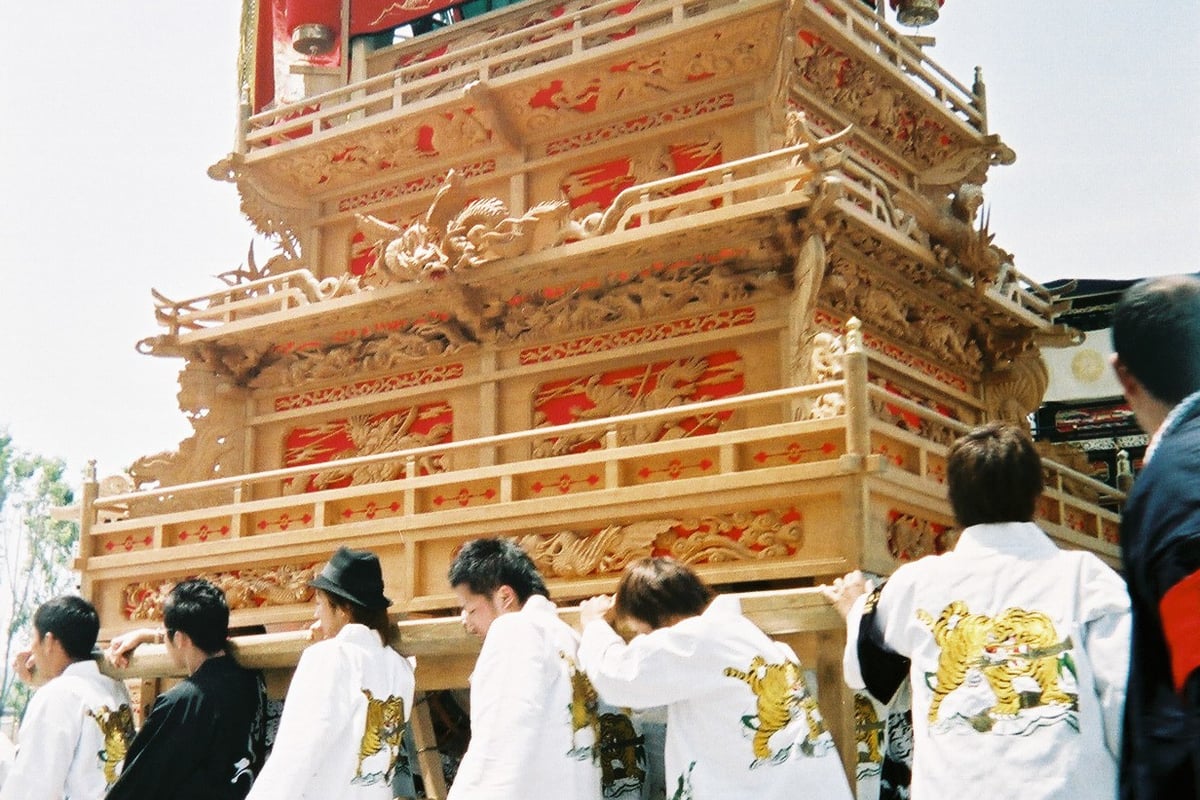
Saijo Danjiri Carvings are the wood carvings that decorate the danjiri (festival floats), also called yatai, carried at the Saijo Festival, the autumn festival of Saijo City, Ehime Prefecture. The Saijo Festival is the collective name for the festivals of four shrines in the city, and every October more than 150 floats, including danjiri, mikoshi (portable shrines) and taikodai (festival drum floats), are dedicated. Among them, the festival of Isono Shrine is especially large, and 77 danjiri and 4 mikoshi are said to be dedicated. A danjiri is a float about 5 meters tall made of hinoki (Japanese cypress), on which myths, ancient Chinese tales, warrior pictures, and flowers and birds are depicted in openwork carving. Another feature is that it is assembled without nails, using komisen (wooden pegs) and wedges. This carving technique was designated a Traditional Specialty Product (designated by Ehime Prefecture) in 2002 (Heisei 14). In the city, craftspeople from a family that has built danjiri since the Edo period still continue to build new danjiri today.
Origin
The festival of Isono Shrine has continued since the mid-Edo period and is said to have a history of about 300 years. A float thought to be today's 'Otomo Danjiri Honmachi' first appears in a document from 1761 (Horeki 11). After that, the number of danjiri and mikoshi gradually increased. The danjiri parade through the town as attendants accompanying the shrine's sacred palanquin (goshinyo).
History
Surviving old danjiri include the Toko danjiri, built in 1853 (Kaei 6), and the former Uoyamachi danjiri of 1862 (Bunkyu 2). Both are said to have been made by the master builder (toryo) Uoyamachi Mankichi. From around the Showa 50s (roughly 1975 to 1984), a 'new-build boom' arose in which each neighborhood built a new danjiri. In this way, the skills of danjiri making have been passed down. The festival dates were fixed at the current October 15 and 16 in 1941 (Showa 16), when the former Saijo City was established.
Features
Danjiri have two or three stories, and there are three types: plain wood (shiraki), black-lacquered and vermilion-lacquered. They weigh about 500 to 800 kilograms. Openwork carvings known as ranma carvings depict scenes from stories in three dimensions, and glass is sometimes set into the eyes of animals. Danjiri making is divided among the master builder, the painter, the carver and the lacquerer (nushi), and the carvings are said to be the part where the wishes of the neighborhood and the individuality of the makers come through.
Techniques
Openwork Carving (Sukashibori)
A technique in which the board is carved all the way through to the back so that the design stands out in three dimensions. On Saijo danjiri, myths, tales from China's Spring and Autumn and Warring States periods, warrior pictures, and flowers and birds are depicted. Carvers are said to acquire the skill by repeating tasks from their apprentice days, such as 'arabori' (rough carving) to shape the forms and carving dragon scales.
Assembly Without Nails
No nails or other metal fittings are used to assemble a danjiri. The wood is joined and tightened with komisen (wooden pegs) and wedges. After the festival, the danjiri is taken apart, and each neighborhood or preservation society stores it in dedicated storage boxes. It is reassembled and used again before the festival every year.
Materials Used
Production Process
- 1
Consultation and Contract
Building a new danjiri proceeds as a two-year plan from the time the commission is received. In the first year, repeated discussions are held with neighborhood representatives to decide the form and the themes of the carvings. A contract is drawn up while checking against the budget.
- 2
Construction
Based on the design, carpenters build the framework and carvers carve the carvings for each part. Edo-period design drawings are said to have been of two kinds: a view from directly above and a view from directly beside. The 石水 family still holds design drawings and preliminary sketches of Edo-period danjiri.
- 3
Trial Assembly and Unveiling
From spring to summer of the second year, a 'trial assembly' (karigumi) is carried out, and defects and fine details are checked with the people of the neighborhood. Curtains and lanterns are attached for the final adjustments, and an 'unveiling' (ohirome) ceremony is held in early October, before the festival.
| Main Production Areas |
|
|---|
Artisans & Workshops
石水彫刻所(石水信至)
A carving studio in Tsuitachiichi, Saijo City. 石水信至 is a danjiri carver and an Ehime Traditional Craftsperson. Of the more than 130 danjiri in the city, he has worked on over 30. He received the Regional Traditional Performing Arts Award in 1997 and an Ehime Prefecture Governor's commendation in 2021.
Official site →六代目 石水綱一
The sixth generation of the 石水 family, he began working as a carver in 2004 (Heisei 16) at the age of 23. He gained experience starting from 'arabori' (rough carving) under his master, who is his uncle. In 2010, he was entrusted for the first time with the carvings for the Kitagawa danjiri, themed on the Three Kingdoms (Sangokushi).
石水家(魚屋町萬吉の家系)
A family line whose first generation is 'Uoyamachi Mankichi,' master builder of the Yamamoto family, shrine and temple carpenters (miyadaiku) in Saijo since the Genroku era. Since building the float of Kamiyokomachi in 1853 (Kaei 6), the family is said to have repaired and built danjiri. Design drawings and preliminary sketches of Edo-period danjiri have been handed down in the family.
FAQ
Q. Where can I see danjiri carvings?
A. You can see them on the danjiri that parade through various parts of the city during the Saijo Festival. The Isono Shrine festival is usually held on October 15 and 16. At the 'Kawairi' (river entry) in the Kamo River on the evening of the 16th, the sight of about 80 danjiri lined up on the riverbank with their lanterns lit is said to be a highlight.
Q. How many danjiri are there at the Saijo Festival?
A. Across the Saijo Festival as a whole, more than 150 danjiri, mikoshi and taikodai combined are dedicated. The Isono Shrine festival alone is said to see 77 danjiri and 4 mikoshi dedicated, a scale said to be unparalleled in Japan for the number dedicated to a single shrine.