 1 / 2
Image: Wikimedia Commons
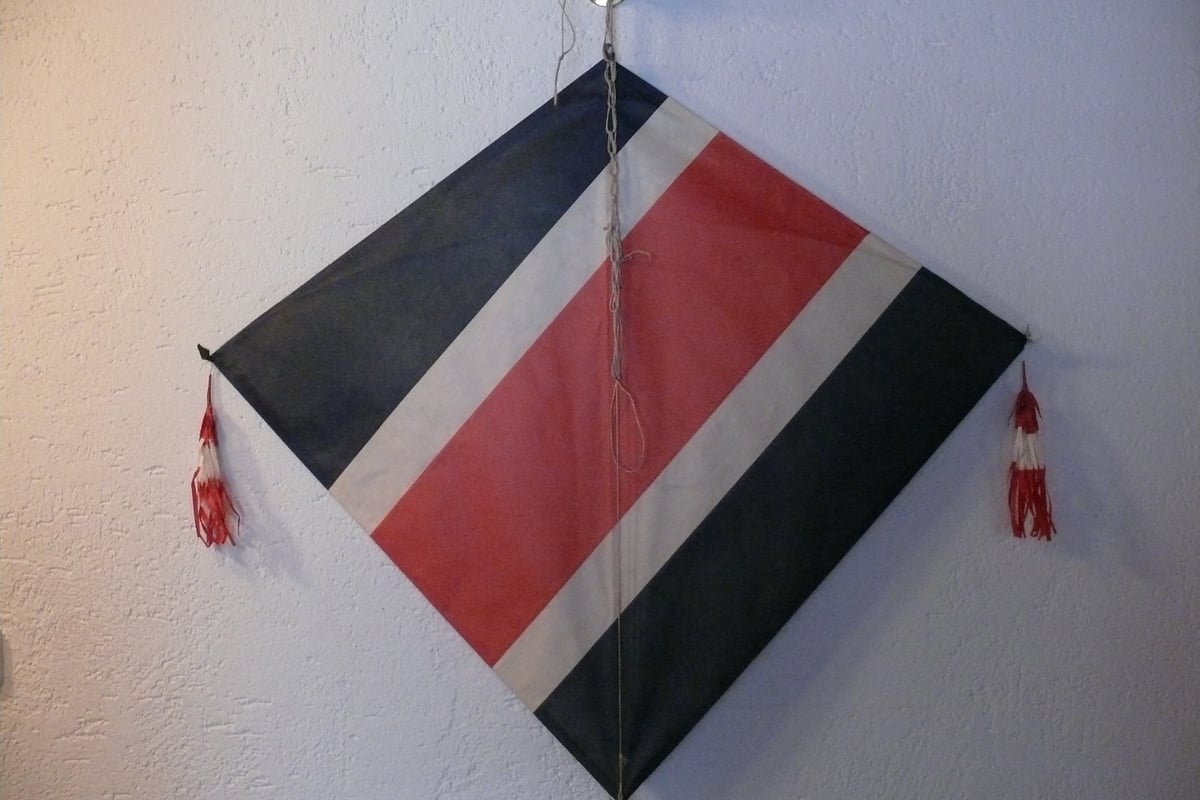
Nagasaki hata are kites handed down in Nagasaki City. In Nagasaki, kites are called 'hata,' and kite flying is called 'hata-age.' They are diamond-shaped, with washi (Japanese paper) pasted onto two bamboo spars, one vertical and one horizontal, and because they have no tail, they can be maneuvered freely in the air. They are characterized by simple, exotic designs made by cutting and pasting red and blue washi onto a white ground. Rather than competing for height, people enjoy 'hata kite fights,' in which they try to cut each other's lines using 'bidoro yoma' (glass-coated kite line), a line coated with powdered glass. For this reason they are also called 'kenka-bata' (fighting kites). The accepted theory is that they were introduced by Indonesians who came to the Dutch trading post on Dejima. Hata-age has long been cherished as one of Nagasaki's three great events, along with Nagasaki Kunchi and Shoro Nagashi. Nagasaki hata (written 長崎凧) and bidoro yoma are described as having been designated Nagasaki Prefecture Traditional Crafts in 1993 (Heisei 5). Every April, the Nagasaki Hata-age Festival is held at Tohakkei Park.
Origin
The accepted theory is that the present form of the hata was introduced by Indonesians who came as attendants of the Dutch trading post on Dejima. There is also a theory that attendants serving the Portuguese had already brought it before Dejima was built. As for the origin of the word 'hata,' it is said that there are two theories: one that it comes from the flags (hata) of Dutch ships, and another that it comes from 'patang,' a word for kite in India and elsewhere.
History
Southern-style hata are already described in sources such as the 'Nagasaki Saijiki' of 1797 (Kansei 9). Hata kite fights appear to have reached their peak from the mid-Edo period to the Meiji era. Because people trampled fields while scrambling for fallen hata and fights broke out, the Nagasaki Magistrate's Office issued prohibitions many times. In 1816 (Bunka 13), even flying and owning hata in the town were banned, but the practice is said to have soon revived.
Features
The hata is diamond-shaped and light, with only two spars, one vertical and one horizontal, and no tail at the lower tip. As a result it sways unsteadily in the air, but its direction can be changed freely by how the line is handled. The designs are not painted; they are made by cutting and pasting dyed washi. A representative design is 'Tango-jima,' with a color scheme resembling the Dutch flag, and there are many others such as 'Nami ni Chidori' (plovers over waves) and 'Hinomaru' (rising sun). Size is expressed as the number of one-mon coins lined up, and the '24-mon' size is often used for fights.
Techniques
Bidoro yoma
A hemp line coated with powdered glass; 'yoma' is a Nagasaki word for thread. At 小川凧店 (Ogawa Kite Shop), hemp line is stretched between bamboo posts, coated with a 'glass dumpling' made by mixing glass powder ground in a mortar with rice paste, and left to dry, a process said to be repeated three times.
Cut-and-paste designs
Washi dyed with a brush is cut with stencils and a paper-cutting knife and pasted together with paste to create the design. The basic scheme combines red and blue on a white ground, with the white separating the colors and giving a light look. Humorous design names such as 'Kirimochi' (cut rice cakes), 'Ishidatami' (paving stones) and 'Kujirankawa' (whale skin) are also part of the appeal.
Hata kite fights
A one-on-one contest in which bidoro yoma lines are entangled to cut the opponent's line. If the line is slackened once and then pulled quickly, the hata moves in the direction its head is pointing. When a match is decided, people shout 'Yoiya!', and a hata that was cut and fell is said to have belonged to whoever picked it up.
Materials Used
Production Process
- 1
Cutting bamboo
In November, bamboo with long spaces between the nodes, suited to hata, is selected and cut. Bamboo left to rest for more than a year to remove oil and moisture is said to become hard yet flexible, and strong. 小川凧店 is said to cut about 20 stalks each year for use two years later.
- 2
Framing
The bamboo is split to the dimensions of the vertical and horizontal spars, then roughly shaved, de-oiled and dried, and finish-shaved. The top tip, called the 'tsunbi,' is bent over a flame, the vertical and horizontal spars are assembled, and a tension line is run around the edge. Every step is said to affect how well the hata flies and how it fights.
- 3
Dyeing the washi
Because the colors change easily with humidity and temperature, dyeing is done from the end of August to September. 小川凧店 is said to dye 500 to 600 sheets of washi red and blue itself each year. The dyes are purchased in Kyoto, but the formula is not disclosed.
- 4
Pasting and finishing
The spars are pasted to the washi bearing the design, and the paste margins are folded back along the tension line and left to dry. Tassel ornaments called 'hyu' are hung on the left and right. Hyu are made by cutting slits into thin washi, and when a hata tilts, some are trimmed away to adjust the balance.
| Main Production Areas |
|
|---|
Artisans & Workshops
小川凧店(小川ハタ店)
A hata shop near Kazagashira Park, founded in 1907 (Meiji 40). The owner, 小川暁博, has been making hata for more than 50 years and is said to dye the washi himself. His motto is 'I don't make hata that won't fly.'
Official site →How to Buy
- 小川凧店 shop
- Hata can be purchased at the shop in Kazagashira-machi, Nagasaki City. A tourism information site lists the small 'issen-dako' from about 300 yen. About 20 designs are said to be sold at the hata-age venue, so if you want a particular design, checking or ordering in advance is recommended.Where to buy →PR
- Ordering decorative hata
- Auspicious 'kazari-bata' (decorative hata) are also made, such as 'Koi no Takinobori' (carp climbing a waterfall) for the Boys' Festival (Tango no Sekku), zodiac animals and designs celebrating a birth. For Koi no Takinobori, the gold-paper scales are cut and pasted one by one. Custom orders with names are also possible, and orders are said to come from all over Japan.Where to buy →PR
Hands-on Experiences
小川凧店(長崎凧資料館)
長崎県長崎市風頭町11-2
Visitors can watch a craftsman demonstrate hata making, and with a reservation can also try making a hata and receive instruction in flying one. The workshop is listed from about 1,800 yen. Fees may change, so please confirm by phone (095-823-1928) in advance.
View details →長崎ハタ揚げ大会(唐八景公園)
長崎県長崎市田上3丁目287
An annual spring event usually held on a Sunday in early April. In 2025 it was held on April 6 from 10:00 to 15:00, and visitors were told they could enjoy hata kite fights and free kite flying. Inquiries go to 長崎ハタ揚げ振興会 (Nagasaki Hata-age Promotion Association, 095-823-7423).
View details →FAQ
Q. Why are kites called 'hata'?
A. It is said that there are two theories about the origin of the word: one that it comes from the 'hata' (flags), such as the flags and signal flags of Dutch ships, and another that it comes from 'patang,' meaning kite in India and elsewhere. It is also said that in Nagasaki, only diamond-shaped hata-type kites are called hata, while other kites are distinguished as 'tako.'
Q. Where can I see hata-age?
A. Hata have traditionally been flown mainly on Sundays and holidays from the end of March to early May at places such as Mt. Kazagashira, Tohakkei, Mt. Konpira and Mt. Inasa. The venue of the Nagasaki Hata-age Festival is Tohakkei Park. 小川凧店, which makes hata, is located near Kazagashira Park.
Q. Can bidoro yoma be handled with bare hands?
A. Line coated with glass powder is sharp, and handling it with bare hands is said to be dangerous. It is safer to protect your fingers with work gloves, leather gloves or finger cots. Once the hata is flying high, it is controlled by holding the 'ne-yoma,' the part of the line without glass powder.