Image: Wikimedia Commons
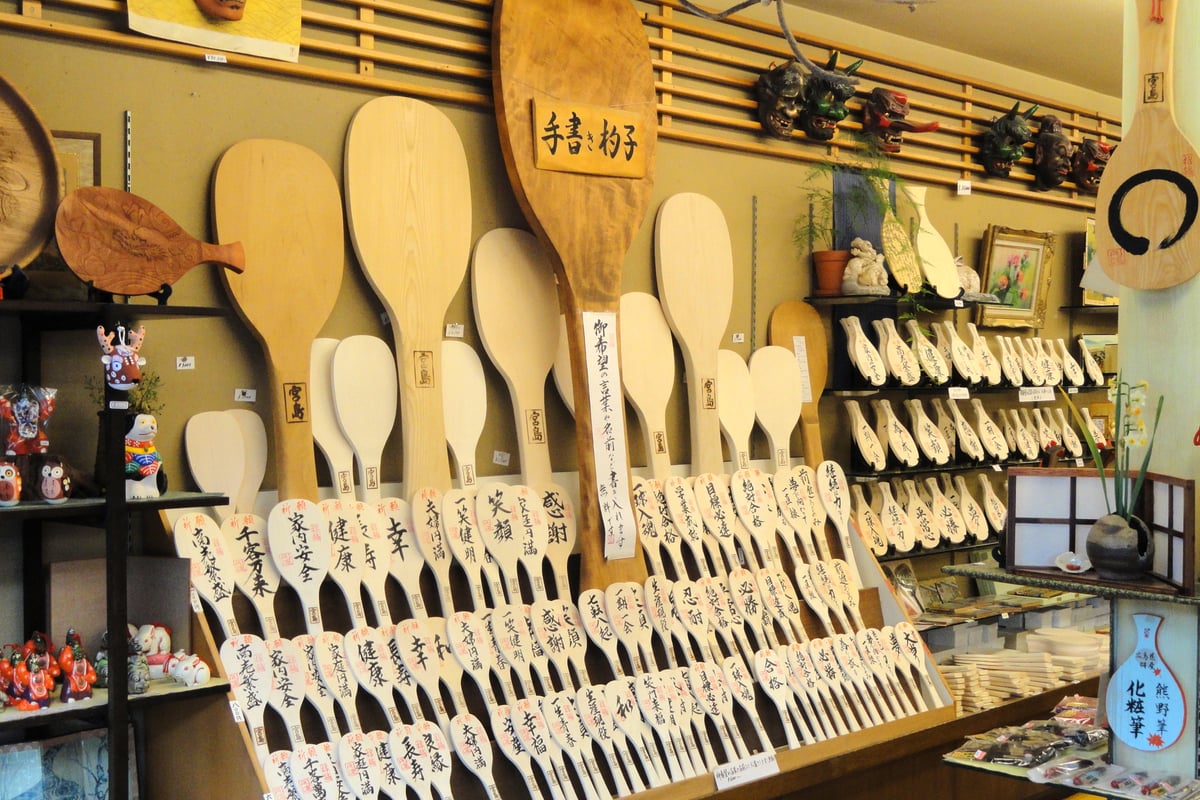
Miyajima-zaiku is a general term for the woodcrafts that have been made on Miyajima (Itsukushima) in Hatsukaichi City, Hiroshima Prefecture. It includes the shakushi (rice paddle) used to serve rice, lathe-turned woodwork in which wood is turned on a lathe to shape it, kurimono (hollowed-out woodwork), and Miyajima-bori carving, in which trays and confectionery vessels are decorated with carving. Most products have a plain wood finish with little lacquer or coloring, making the most of the color and feel of the wood grain. Another characteristic is that many are items for everyday use. Because farming and weaving were forbidden on Miyajima as an island of the gods, the islanders engaged in forestry work and developed crafts that made use of the abundant timber. In particular, the shakushi spread throughout Japan as Miyajima's representative souvenir, and its production volume is said to be the largest in Japan. In 1982 (Showa 57), Miyajima-zaiku was designated a Traditional Craft by the Minister of Economy, Trade and Industry (a national Traditional Craft). At the 宮島伝統産業会館 (Miyajima Dento Sangyo Kaikan) near Miyajima Pier, visitors can try making a shakushi and Miyajima-bori carving.
Origin
The roots of Miyajima-zaiku are said to lie in the techniques of carpenters and sashimono-shi (joinery cabinetmakers) who were invited to the island in the early Kamakura period to build shrines and temples, including Itsukushima Shrine. The first crafted items are said to have been goshiki-bashi (five-colored chopsticks) and iro-yoji (colored toothpicks), auspicious items associated with Shinto rituals. The shakushi is said to have been devised in the Kansei era (around 1790) by 誓真 (Seishin), a monk living on the island, based on the shape of the biwa lute held by the goddess Benzaiten, and he taught the islanders how to make it.
History
Miyajima-bori carving is said to have been introduced in the late Edo period by 波木井昇斎 (Hakii Shosai), a native of Koshu (Yamanashi Prefecture). The technique of lathe-turned woodwork is also said to have reached the island in the Kaei era at the end of the Edo period. When the railway opened in the Meiji era, the number of worshippers increased. At the time of the Sino-Japanese and Russo-Japanese Wars, Miyajima-zaiku became known throughout Japan as souvenirs for the soldiers gathered in Hiroshima. From around the middle of the Meiji era, shakushi were also shipped to the Kansai region as daily necessities, and Miyajima-zaiku was exported overseas as well. Many of today's businesses are small sole proprietorships, and securing successors is considered a challenge.
Features
Most products have a plain wood finish, and in addition to Miyajima-bori carving, decoration methods include urushi-buki (wiping with natural lacquer) and sabiiro-zome (rust-colored staining). The shakushi has a gentle shape modeled on the biwa, and it is said to have no odor and to keep rice grains from sticking. Miyajima-bori carving makes the most of the grain of woods such as tochi (Japanese horse chestnut), keyaki (zelkova) and cherry. The carving is applied to wooden bases such as trays and confectionery vessels shaped on a lathe and square trays made by the hollowing technique.
Techniques
Lathe-turned woodwork
A technique in which logs are selected and sawn, and the naturally dried wood is turned on a lathe while a cutting tool (kanna) is applied to carve out the shape. No showy coating such as lacquer or coloring is applied, so the natural character of the wood itself is brought out. The more it is used, the more subdued and mellow it becomes, and its character changes over time.
Miyajima-bori carving
A carving technique in which designs are carved into wooden bases such as trays and confectionery vessels to decorate them. Woods with beautiful grain, such as tochi, keyaki and cherry, are used, and patterns are brought out by the shading of the carving. In the hands-on experience at the 宮島伝統産業会館, participants color and finish a round tray carved with a maple-leaf design.
Materials Used
Production Process
- 1
Kidori (cutting the wood)
Logs are sawn, dried naturally and cut to suit the product.
- 2
Making the wooden base
The shape is made by turning on a lathe, hollowing, shaving and other methods.
- 3
Finishing
The surface is polished, and the wood grain and texture are refined.
- 4
Decoration
The piece is decorated with Miyajima-bori carving, urushi-buki, sabiiro-zome and other methods.
| Main Production Areas |
|
|---|
Artisans & Workshops
小林一松堂
A lathe-turned woodwork shop on Miyajima's Omotesando shopping street, where 小林松斎 makes Miyajima lathe-turned woodwork. He handles everything from selecting materials to sawing and natural drying, then turns and finishes the pieces on the lathe. This 'Miyajima no Rokuro Zaiku' (宮島のロクロ細工) has been certified as part of Hiroshima City's 'The Hiroshima Brand' (ザ・広島ブランド).
Official site →How to Buy
- 宮島伝統産業会館 (1st floor)
- A facility right next to Miyajima Pier. On the first floor, Miyajima-zaiku such as shakushi, lathe-turned woodwork, Miyajima-bori trays and Miyajima clay bells (dorei) are displayed and sold. Admission is free.Where to buy →PR
- 杓子の家
- A shop at 488 Miyajima-cho, Hatsukaichi City, that makes and sells Miyajima shakushi, about a 10-minute walk from Miyajima Pier. It carries mini spoons made of kaede (maple) and shakushi-shaped straps (about 500 to 800 yen each), and names can be inscribed on the back of the straps. Closed on Wednesdays.Where to buy →PR
- 小林一松堂
- Located at 470-2 Omotesando Shopping Street, Miyajima-cho, Hatsukaichi City. Hiroshima City's introduction page lists items such as a lathe-turned sushi tub (30 cm in diameter) at 32,000 yen including tax.Where to buy →PR
Hands-on Experiences
宮島伝統産業会館(みやじまん工房)
広島県廿日市市宮島町1165-9
On the third floor, you can try shakushi making (550 yen per person) and Miyajima-bori carving (2,200 yen per person). In shakushi making, you brand designs such as a torii gate, maple leaves or deer onto the paddle, and in Miyajima-bori carving, you carve a maple leaf into a round tray 15 cm in diameter and color it. It takes 45 minutes to 1 hour, and advance reservations are required. Fees are payable in cash.
View details →FAQ
Q. What is the giant shakushi on Miyajima?
A. It is a giant shakushi made in 1983 (Showa 58) to pass on the tradition of Miyajima-zaiku and as a symbol of the island. It is 7.7 m long, up to 2.7 m wide and weighs 2.5 t; it was made from a 270-year-old keyaki tree and took 2 years and 10 months to complete. To commemorate the registration of Itsukushima Shrine as a World Heritage Site in 1996, it was put on display on the Omotesando shopping street.