Image: Wikimedia Commons
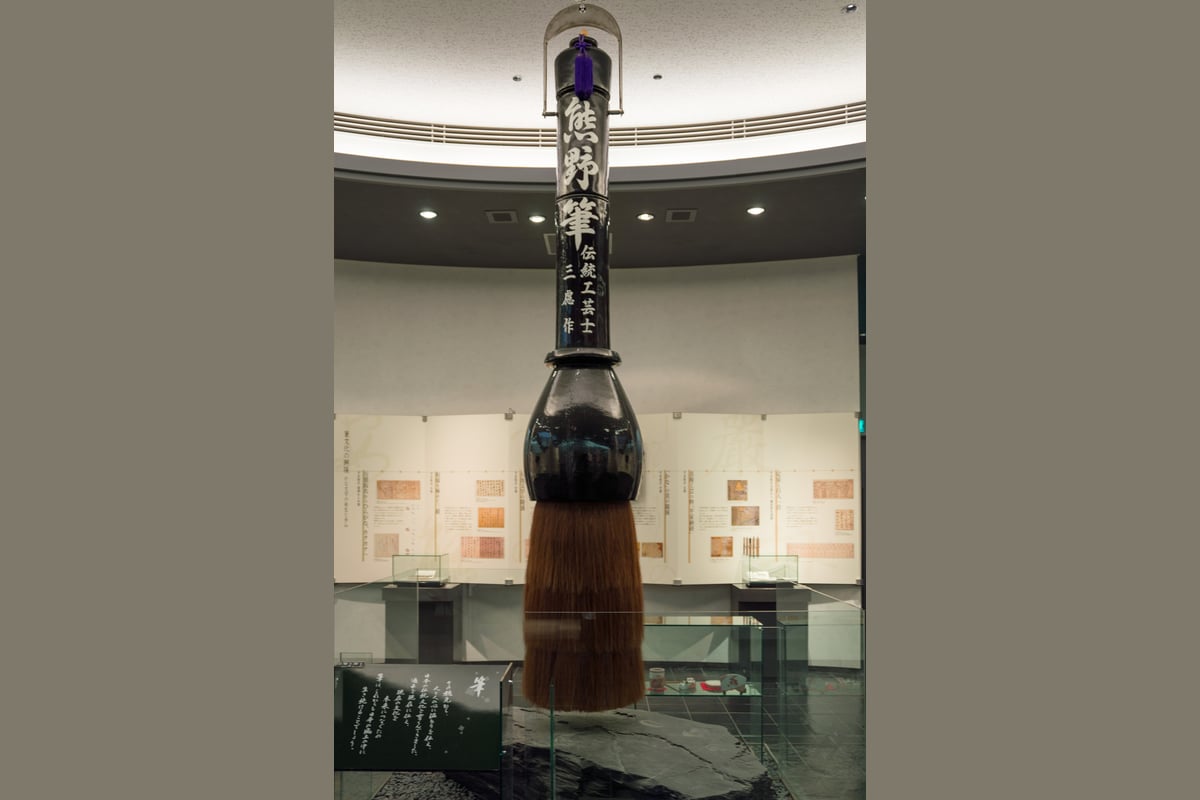
Kumano-fude is a general term for the brushes made in Kumano Town, Aki District, Hiroshima Prefecture. In addition to writing brushes used for calligraphy (shohitsu), a wide range of brushes is made, from painting brushes for Nihonga (Japanese-style painting) and watercolor to makeup brushes and hake (flat brushes). Brush making in Kumano Town began in the late Edo period. In 1975 (Showa 50), Kumano-fude became the first craft in the prefecture to be designated a Traditional Craft by the Minister of Economy, Trade and Industry (a national Traditional Craft). About 2,000 people, roughly 10 percent of the town's population, are said to work in brush-related jobs, and the town is called 'the Capital of Brushes' (Fude no Miyako). According to the Kumano Brush Cooperative (熊野筆事業協同組合), its members' production in fiscal 2022 (Reiwa 4) amounted to about 24 million brushes, worth about 9.6 billion yen. Makeup brushes, which spread after World War II, account for the largest share, and they are also used by cosmetics makers in Japan and abroad. The town has a brush museum, Fude no Sato Kobo (筆の里工房), where visitors can watch demonstrations by certified traditional craftspeople and try making a brush.
Origin
Kumano Town has little farmland, and in the Edo period its farmers went to work away from home during the agricultural off-season, in places such as Kishu (Wakayama Prefecture) and Yamato (Nara Prefecture). On their way back, they bought brushes and ink sticks in Nara and elsewhere and peddled them, and this is said to be the beginning of Kumano's connection with brushes. In time, people from the village learned brush making and brought the techniques home. The Kumano Brush Cooperative explains that they were taught by craftsmen in Nara, while 伝統工芸 青山スクエア (Aoyama Square) states that a person who had studied under an official brush maker of the Hiroshima Domain passed on the techniques. Some sources also say that there was a person who trained in Arima (Hyogo Prefecture).
History
Partly because the Hiroshima Domain encouraged crafts, brush making in Kumano flourished. When the school system spread in the Meiji era, demand for brushes used in calligraphy practice (shuji) grew greatly, and Kumano grew into a major brush-producing area. After World War II, demand for calligraphy brushes declined, and the makers found a new path in producing painting brushes and makeup brushes. Kumano-fude was designated a national Traditional Craft in 1975, and in 2004 the cooperative obtained a collective trademark. Every year on Autumnal Equinox Day, the Fude Matsuri (Brush Festival) is held at venues including Sakakiyama Shrine (榊山神社), and in 2026 it was held for the 92nd time.
Features
Animal hair such as goat, horse, deer, raccoon dog (tanuki), weasel and cat is used for Kumano-fude. Some brushes also use synthetic fibers, feathers, or a baby's first hair (taimo). Its wide variety, from brushes for schoolchildren to brushes for professional calligraphers and special brushes made to order, is a hallmark. Kumano-fude has long been said to be made through 73 processes, and the sorting and blending of hair and the making of the brush head (hokubi) are done by hand by skilled craftspeople. Makeup brushes make use of the brush-head-making skills cultivated in calligraphy brushes.
Techniques
Hinoshi and kemomi (heat-straightening and rubbing the hair)
A process in which rice-husk ash is sprinkled on the raw hair and a heated iron is applied to straighten its kinks and let the ash absorb the oil. The hair is then wrapped in deerskin and rubbed to straighten the strands. This preparation of rubbing the hair with ash to remove the oil is the first key step in making Kumano-fude.
Nerimaze (wet blending of hair)
A process in which hair trimmed to the same length is spread thin, coated with a thin paste and folded over many times to blend it evenly. By mixing hairs of different qualities without unevenness, the brush head is formed. Any remaining poor-quality hairs are also removed at this stage while blending.
Removing sakage and surege (reversed and worn hairs)
The work of pulling out, from a bundle of hair with its tips aligned, hairs growing in the opposite direction and hairs with frayed tips, using a small knife called a hansashi. Each hair is judged one by one, relying on the feel of the fingertips. If such hairs remain, the brush tip will not come together to a point.
Materials Used
Production Process
- 1
Selecting and combining hair
Hair is chosen to suit the type of brush, and the amounts are decided and combined.
- 2
Hinoshi and kemomi
Ash is sprinkled on the hair and an iron is applied to remove kinks and oil, and the hair is rubbed in deerskin.
- 3
Combing and aligning the hair
Downy hair is removed with a comb, and the bundle is tapped to align the hair tips.
- 4
Removing sakage and surege
Reversed hairs and hairs with damaged tips are pulled out with a small knife.
- 5
Sungiri (cutting to length)
Using a ruler called a sungi, the hair is cut to the required lengths.
- 6
Nerimaze (wet blending of hair)
Hair coated with a thin paste is folded over repeatedly and blended evenly.
- 7
Shintate (forming the core)
The thickness is adjusted with a tube called a koma, and the hair is dried to form the core of the brush head.
- 8
Wrapping the outer hair (uwage-maki)
High-quality outer hair (koromoge) is spread thin, wrapped around the core and dried.
- 9
Tying with thread
The base is bound tightly with hemp thread and seared with a hot iron to finish the brush head.
- 10
Kurikomi (fitting the head)
The hole in the handle is shaped with a small knife, and the brush head is glued in place.
- 11
Finishing
The brush head is soaked with paste, shaped and dried.
- 12
Engraving the name
The name of the brush is carved into the handle and filled with pigment to complete it.
| Main Production Areas |
|
|---|
Artisans & Workshops
白鳳堂
A brush maker headquartered in Jonohori, Kumano Town, founded in 1974. Applying the techniques of traditional Japanese brushes, it built a system for mass-producing a wide variety of high-quality makeup brushes. In 2005, it received the Prime Minister's Award at the first Monozukuri Nippon Grand Award. In addition to makeup brushes, it also makes calligraphy brushes, Nihonga painting brushes and brushes for professional use.
Official site →竹宝堂
A makeup brush maker in Kumano Town. Its chairman, 竹森鉄舟, is introduced as a brush maker who started out making the tips of menso-fude (fine-line brushes), and in 2022 he received the Medal with Yellow Ribbon for making makeup brushes. The company offers many series, such as Kiwami (極), Takumi (匠) and Z, and also sells face-washing brushes and brush cases.
Official site →晃祐堂
A makeup brush maker headquartered in Kumano Town, with a makeup brush workshop and a directly managed store in Hiratani, Kumano Town. It adds its own innovations to the traditional techniques of Kumano-fude, and many of its products have registered designs. At the fiscal 2023 public exhibition of traditional crafts (伝統的工芸品公募展), its set of five Kumano-fude dyed with persimmon tannin (kakishibu) received the Buyer's Award.
Official site →How to Buy
- 熊野筆セレクトショップ (inside Fude no Sato Kobo)
- A shop attached to Fude no Sato Kobo, introduced as carrying about 1,500 kinds of brushes, including calligraphy brushes, painting brushes and makeup brushes. You can compare brushes from many makers in the production area all at once. There is also a museum shop inside the facility.Where to buy →PR
- 熊野筆セレクトショップ Ginza store
- A specialty store for Kumano makeup brushes on the second floor of the Hiroshima brand shop TAU (ひろしまブランドショップTAU) in Ginza, Tokyo. It stocks more than 400 kinds, combining products from seven makeup brush makers with the store's own original items, and also carries calligraphy and painting brushes. You can also get advice on how to use and care for the brushes.Where to buy →PR
- 熊野筆事業協同組合
- The production-area cooperative at 3-13-19 Nakamizo, Kumano Town (tel. 082-854-0074). Its official website explains how Kumano-fude are made and how to care for them, and it also runs an official shop.Where to buy →PR
Hands-on Experiences
筆の里工房 筆づくり実演&体験
広島県安芸郡熊野町中溝5-17-1
You can watch a brush-making demonstration by a certified traditional craftsperson and try the 'finishing' process. The fee is 3,500 yen (admission charged separately), it takes about 60 minutes, and reservations are given priority. If you book at least two weeks in advance, your name can be engraved on the brush handle. The museum is closed on Mondays (or the following weekday if Monday is a national holiday).
View details →晃祐堂 化粧筆工房
広島県安芸郡熊野町平谷4丁目4-7
The workshop and directly managed store of the makeup brush maker 晃祐堂. According to its official website, workshop tours and brush-making experiences are available if you book by the previous day. Please confirm fees and details when booking.
View details →FAQ
Q. How can I tell genuine Kumano-fude?
A. The Kumano Brush Cooperative has established a certificate label bearing its unified brand mark, the 'K Mark'. For brushes with the K Mark, you can use the serial number to ask the cooperative which manufacturer made them. The cooperative warns that fake certificate labels are circulating on some online shops and flea-market apps.
Q. How should I start using a calligraphy brush I've just bought?
A. New brushes often have their hair stiffened with paste. The cooperative advises gently loosening the hair tips and removing the paste before use. After use, wash out the ink, reshape the brush and dry it in a well-ventilated, shady place.