Image: Wikimedia Commons
Kawajiri-fude are writing brushes made in Kawajiri Town, Kure City, Hiroshima Prefecture. In 2004 (Heisei 16), they were designated a Traditional Craft by the Minister of Economy, Trade and Industry (a national Traditional Craft). Kawajiri's connection with brushes began in the late Edo period, when brushes from other production areas were bought and sold there, and in time brush making took root in the village. Animal hair is used for the brush heads, and they are generally made with the technique of nerimaze (wet blending of hair), in which the hair is moistened and blended together. Because it takes much time and effort, it is not suited to mass production, but in return it produces high-quality brushes. Hiroshima Prefecture introduces the supple tips of Kawajiri-fude, which descend from the tradition of Kyoto brushes (Kyo-fude), as well suited to cursive script, kana calligraphy and the precise depiction of Nihonga (Japanese-style painting). The workshops maintain a system in which a single craftsperson makes each brush from start to finish, and the process is said to involve more than 70 steps.
Origin
Kawajiri's connection with brushes is said to have begun in Tenpo 9 (1838), when 菊谷三蔵 of Kawajiri bought brushes from Arima in Settsu Province (Hyogo Prefecture) and sold them by placing them at terakoya (temple schools) and elsewhere. He also encouraged the villagers to make brushes, but it is said that the practice did not spread right away. In the mid-19th century, 上野八重吉 spread brush making as a side job for the agricultural off-season. He is said to have learned brush making in Arima and begun production by inviting craftsmen from Izumo (Shimane Prefecture), and he is regarded as the founder of Kawajiri-fude.
History
When school education spread in the Meiji era, demand for brushes used in calligraphy practice increased, and brush making in Kawajiri developed greatly. It is said to have reached its peak from the end of the Meiji era to the early Showa period. During the war, production fell due to shortages of materials and craftsmen being sent to the front, but it recovered after the war. In 1967, the Kawajiri Brush Cooperative (川尻毛筆事業協同組合) was organized, and on August 31, 2004, Kawajiri-fude was designated a national Traditional Craft. In 2014, it also received a Good Design Award. According to Hiroshima Prefecture's materials, the number of craftspeople has fallen to about one-tenth of what it was 60 years ago.
Features
The main material for the brush heads is animal hair, and bamboo or wood is used for the handles. A characteristic of Kawajiri-fude is that the nerimaze technique of moistening and blending the hair is commonly used. The process is broadly divided into making the brush head, making the handle and finishing, and at every stage the brushes are made one by one by hand using time-honored techniques. On Mount Noro (野呂山) there is the 川尻筆づくり資料館 (Kawajiri brush-making museum), which introduces the processes and history of brush making in Kawajiri through documents and models.
Techniques
Nerimaze (wet blending of hair)
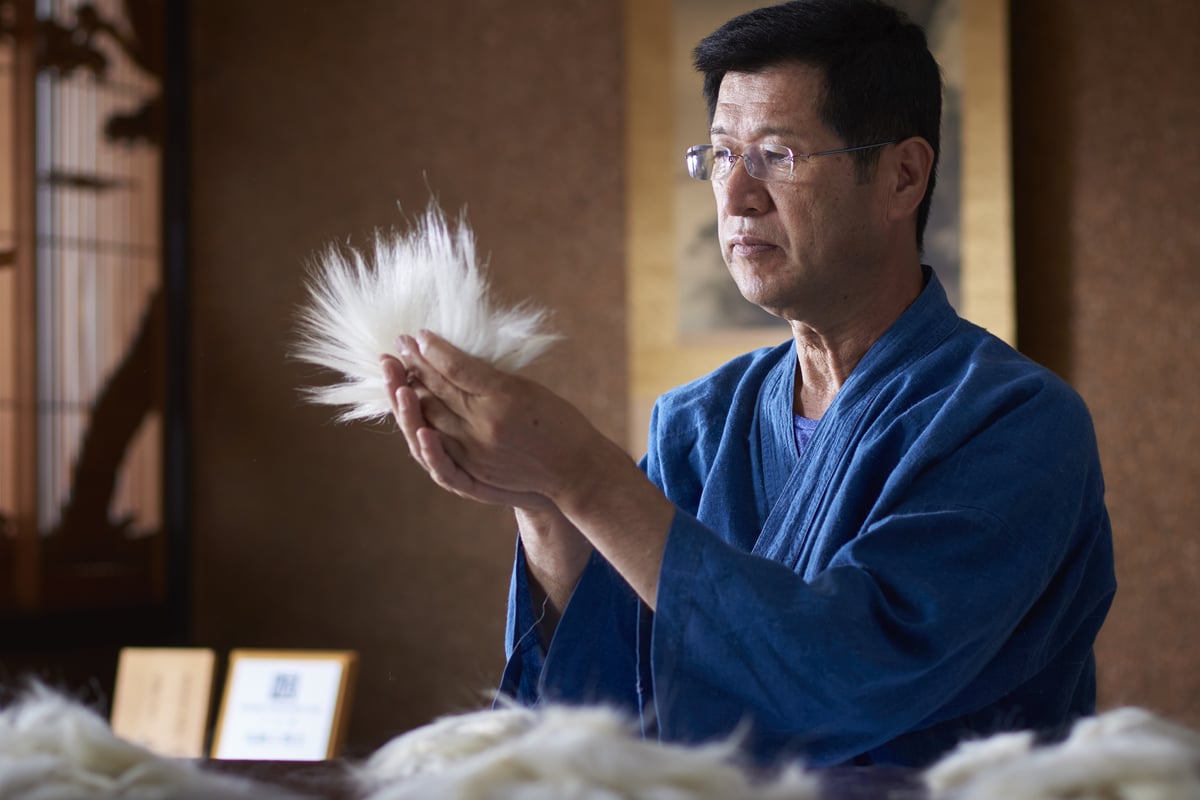
A technique in which raw hair is moistened with water and spread thin, and the work of folding it over and layering it is repeated to blend hairs of different qualities evenly. It is time-consuming and unsuited to mass production, but because it requires great skill, it produces high-quality brush heads. In Kawajiri, brushes are still made with this technique today.
Integrated production by one craftsperson
In Kawajiri workshops, a single craftsperson takes charge of everything from sorting the raw hair to making the brush head, attaching it to the handle and finishing. Because each brush is made one at a time without relying on machines, they cannot be made in large numbers, but the workshops can respond to the detailed requests of calligraphers and Nihonga painters. The process is said to involve more than 70 steps.
Materials Used
Production Process
- 1
Making the brush head
Raw hair is sorted and blended by nerimaze to form the brush head.
- 2
Making the handle
Handles are made from bamboo or wood, and the part where the brush head fits is shaped.
- 3
Finishing
The brush head is attached to the handle and shaped to complete the brush.
| Main Production Areas |
|
|---|
Artisans & Workshops
文進堂 畑製筆所
A brush workshop in Harayama, Kawajiri Town, Kure City, introduced as founded in 1930. The third-generation head, 畑義幸, is a certified traditional craftsperson of Kawajiri-fude who learned brush making from his father from the age of eight, and he handles more than 70 processes by himself using techniques handed down to a single heir in each generation. The fourth generation, 畑幸壯, is carrying on these skills. In addition to goat-hair and weasel-hair brushes, the workshop also makes baby-hair brushes (akachan-fude) and makeup brushes.
Official site →How to Buy
- Online store of 文進堂 畑製筆所
- 文進堂 sells brushes through the online store on its official website. Hiroshima City's introduction page lists the calligraphy brush 'Giko' (義巧), which uses hair from male goats selected near the Yangtze River in China around 1970, from 38,500 yen including tax. Its brushes are also carried by calligraphy supply shops outside the prefecture.Where to buy →PR
- 川尻毛筆事業協同組合
- The Kawajiri-fude production-area cooperative at 1-2-2-401 Nishi, Kawajiri Town, Kure City (tel. 0823-87-2395). It also holds the regional collective trademark for 'Kawajiri-fude' and serves as a point of contact for questions about brushes and makers in the production area.Where to buy →PR
Hands-on Experiences
文進堂 筆づくり体験
広島県呉市川尻町原山1-5-35
Under the guidance of a certified traditional craftsperson, you can learn about the tools and processes of brush making and experience the differences in finish between new and old materials. Hiroshima Prefecture's official tourism site 'Dive! Hiroshima' states that the fee is 26,800 yen (English guide charged separately), it takes about 80 minutes, and bookings are for groups of two to four people. Reservations are made through an experience booking site. It is about a 15-minute walk from JR Aki-Kawajiri Station.
View details →FAQ
Q. How do Kumano-fude and Kawajiri-fude differ?
A. Both are brushes made in Hiroshima Prefecture and designated as national Traditional Crafts. Kumano-fude, designated in 1975, comes from a large production area that makes not only calligraphy brushes but also painting brushes and makeup brushes in large quantities. Kawajiri-fude was designated in 2004, and its production area is supported by small workshops where a single craftsperson makes writing brushes from start to finish using the nerimaze technique.