Image: Wikimedia Commons
Izumo Menou Zaiku is a precious-stone craft made in Tamayu Town, Matsue City, Shimane Prefecture (around Tamatsukuri Onsen). A single craftsperson works stones such as the blue agate mined on Mt. Kasen in the town entirely by hand, from cutting the rough stone through polishing and finishing. The agate of Mt. Kasen differs in color, blue, red or clear, depending on the part of the rough stone, and from the latter half of the early Kofun period (around the 4th century) it was distributed throughout Japan as colorful beads. At the foot of Mt. Kasen, large-scale bead-making took place from the early Kofun period to the Heian period, and the workshop sites are preserved as the national historic site 'Izumo Tamatsukuri Site'. Bead-making, which once died out in the Heian period, began again at the end of the Edo period as 'Izumo Menou Zaiku'. Tamayu Town is also said to be the birthplace of the Yasakani no Magatama, one of the Three Sacred Treasures of Japan, and the magatama (comma-shaped bead) serves as the town's symbol mark. Today pendants, necklaces, cufflinks, ornaments and other items are made, and it is designated a Shimane Prefecture Furusato Traditional Craft.
Origin
Izumo Menou Zaiku has its roots in ancient bead-making. Mt. Kasen (199 m above sea level) in Tamayu Town is known as a mountain that produces jasper, agate and other raw materials for beads. At the Izumo Tamatsukuri Site at the southwestern foot of Mt. Kasen, excavations in Showa 44 and 46 uncovered the remains of about 30 bead-making workshops. Along with beads such as magatama, kudatama (cylindrical beads), marudama (round beads) and kirikodama (faceted beads), tools such as whetstones and iron drills were also unearthed.
History
From the middle of the Kofun period onward, Izumo became one of the leading bead-producing areas in Japan. Bead-making, which had died out in the Heian period, was revived at the end of the Edo period. In Meiji 34 (1901), 新宮福次郎 opened 'しんぐうめのう店' in the Tamatsukuri Onsen area. 株式会社めのや, which carries on that lineage, still makes magatama today. In March 1982, Izumo Menou Zaiku was designated a Shimane Prefecture Furusato Traditional Craft.
Features
Agate is a hard natural stone, and once polished it keeps its luster for a long time. Izumo Menou Zaiku values handwork in which the stone is polished so thoroughly that it heats up. Another feature is that there is no division of labor: a single craftsperson handles everything from cutting the rough stone to finishing. Besides magatama, which have been made since ancient times, pendants and necklaces are now the mainstay of production, and cufflinks and ornaments are also made.
Techniques
Grinding and polishing
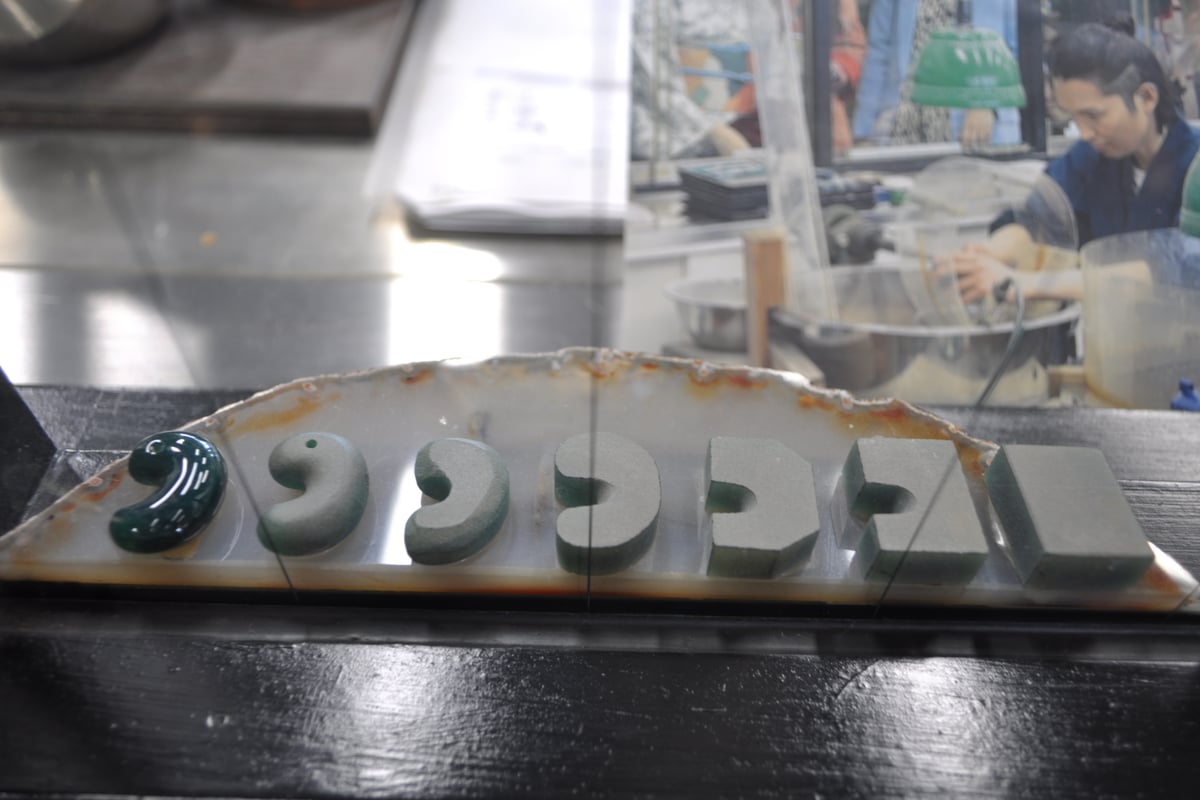
A technique in which the roughly shaped stone is ground in stages, from the first grinding to the fourth grinding, to refine its shape and surfaces. Finally, board polishing and finish polishing are carried out, polishing the stone until it heats up to bring out the luster unique to agate.
Consistent handwork
A single craftsperson carries out everything by hand, from hikiwari (cutting the rough stone into pieces) through rough shaping, grinding and polishing. Shimane Prefecture materials cite this consistent handwork as a feature of Izumo Menou Zaiku.
Materials Used
Production Process
- 1
Hikiwari (cutting)
The rough stone is cut.
- 2
Rough shaping
The stone is ground into a rough shape.
- 3
First to fourth grinding
The stone is ground in four stages to refine its shape and surface.
- 4
Board polishing
The stone is polished using a board to smooth its surfaces.
- 5
Finish polishing
The stone is polished until it heats up, bringing out its luster to finish.
| Main Production Areas |
|
|---|
Artisans & Workshops
株式会社めのや
A company whose origins lie in 'しんぐうめのう店', opened by 新宮福次郎 in the Tamatsukuri Onsen area in 1901. Shimane Prefecture materials list it as a designated business for Izumo Menou Zaiku. It makes Izumo-style magatama and agate products and sells them at めのうやしんぐう in the Tamatsukuri Onsen area as well as at stores around Japan.
Official site →How to Buy
- めのうやしんぐう
- A long-established agate craft shop at 325 Tamatsukuri, Tamayu Town, Matsue City, in the Tamatsukuri Onsen area. It also displays tools and processes used to work agate. A travel information site introduces pendants from 2,000 yen, bracelets from 2,000 yen and magatama straps from 1,000 yen. Closed on Sundays.Where to buy →PR
Hands-on Experiences
松江市出雲玉作資料館
島根県松江市玉湯町玉造99-3
A museum of beads that exhibits items excavated from the Izumo Tamatsukuri Site, opened in 1977. The second floor introduces the history, tools and works of Izumo Menou Zaiku, which was revived at the end of the Edo period. Admission is 300 yen for adults (free for high school students and younger), and it is closed on Mondays and on the day after holidays.
出雲玉作史跡公園
島根県松江市玉湯町玉造
A park laid out on the hillside where the bead-making workshop sites were found, where you can see facilities preserving the workshop remains and reconstructed buildings. There is a free parking lot, and together with 出雲玉作資料館 you can trace ancient bead-making.
View details →FAQ
Q. Can I try magatama-making at いずもまがたまの里伝承館?
A. No. 'いずもまがたまの里伝承館', which was in Tamayu Town, closed on January 31, 2022, following a decline in visitors due to the effects of COVID-19. Please note that some travel sites may still carry information about magatama-making experiences.
Q. How does it differ from Wakasa Meno Zaiku (Wakasa Agate Craft)?
A. Wakasa Meno Zaiku is a craft of Obama City, Fukui Prefecture, characterized by drawing out a vivid red color through 'yakiire', a process of heating the rough stone. Izumo Menou Zaiku uses stones such as blue agate from Mt. Kasen and is rooted in the tradition of magatama-making that has continued since ancient times.