Image: Wikimedia Commons
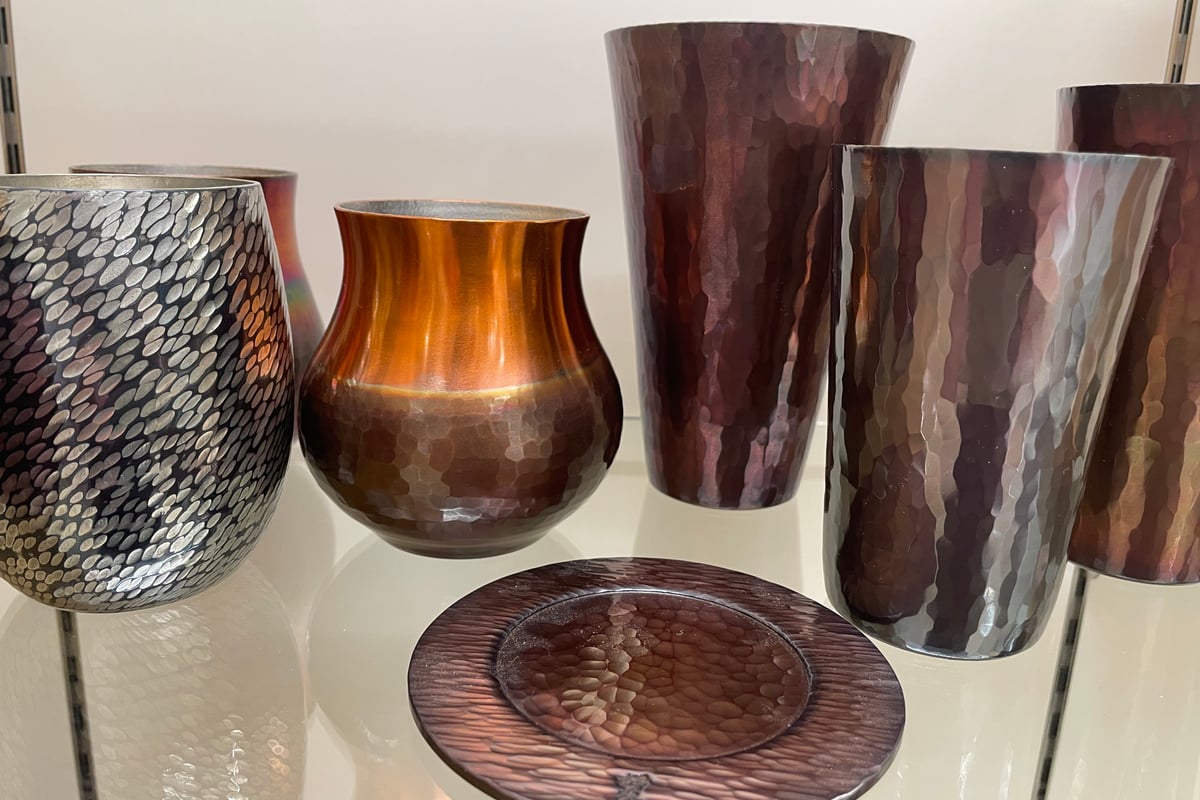
Dochu is a copper craft that has been made in Hiroshima since the Edo period. A single copper sheet is hammered again and again into the shape of a vessel, and the surface is given a pattern of fine irregularities called tsuchime (hammer-mark texture). Because the pieces are finally smoked with rice straw and then polished, the surface takes on a subdued black or amber tone. Its appeal is that the color deepens and a quiet luster grows the more it is used and the more years pass. It is said to have begun with a coppersmith who served the Asano family, lords of the Hiroshima Domain, at the beginning of the Edo period, and as a specialty of the domain it was also used as gifts to other daimyo families. The main products are vases, decorative plates, tea utensils, stationery and the like, and in recent years everyday items such as beer cups have also been made. In 1991 (Heisei 3), it was designated a Hiroshima Prefecture-designated Traditional Craft.
Origin
The name comes from a coppersmith retained by the Asano family who was so devoted to his work that he was called 'the bug of copper' (do no mushi). Hiroshima Prefecture gives this person's name as 佐々木伝兵衛, while a local newspaper and a manufacturer give it as 佐々木清, so the name differs depending on the source. According to the local newspaper, he is said to have been one of the craftsmen brought along when Asano Nagaakira moved from Kishu (Wakayama) to Hiroshima in Genna 5 (1619). There is also an explanation that Nagaakira, the lord of the domain, praised his enthusiasm and gave him the title 'Dochu.'
History
According to reports in the local newspaper, the Hiroshima Domain presented a Dochu chozubachi (water basin) to the Maeda family, lords of the Kanazawa Domain, in 1778, and a candlestick to the Uesugi family, lords of the Yonezawa Domain, in 1831. In the late Edo period the craftsmen died out, and the technique is said to have been lost for a time. In the late Meiji era, 伊藤琢郎 studied and revived it, and his shop later led to 伊藤久芳堂. There was demand for Dochu as commemorative gifts for government offices and companies, but 伊藤久芳堂 stopped production in 2008. Today, companies such as 株式会社光, which the prefecture designated as a manufacturer in 2009, continue to make it.
Features
Dochu is made from copper sheets about 1 millimeter thick, and despite its heavy appearance, it is characterized by being thin and light. The tsuchime, hammered in by hand one by one, gives each piece an expression unique to handwork. The finished color, such as black or amber, varies with how long the piece is smoked in straw. Some pieces are decorated with motifs such as carp or autumn leaves through inlay (zogan), plating, or hammering out from the reverse side. Because copper conducts heat well, it is said that putting ice in a beer cup quickly chills the whole vessel.
Techniques
Tankin (metal raising) and tsuchime
A technique in which a single copper sheet is hammered, stretched and compressed to raise it into a three-dimensional form. After forming, the surface is hammered to give it a pattern of fine irregularities called tsuchime. Tsuchime is the element that defines the appearance of Dochu.
Straw smoking (wara-ibushi)
A process in which the formed vessel is smoked with rice straw to color its surface. It also serves to prevent rust, and depending on the smoking time, the piece takes on tones such as black or amber. Polishing after smoking produces a subdued luster.
Materials Used
Production Process
- 1
Forming
The copper sheet is hammered into the shape of a vessel.
- 2
Applying tsuchime
The surface is hammered to give it a tsuchime pattern.
- 3
Smoking
The piece is smoked with rice straw to color it.
- 4
Polishing
The surface is polished to finish the piece.
| Main Production Areas |
|
|---|
Artisans & Workshops
株式会社光
A company in 幟町, Naka Ward, Hiroshima City, designated by Hiroshima Prefecture in 2009 as a manufacturer of Dochu. It runs a website dedicated to Dochu that introduces its products and the origin of Dochu. In June 2025, the site noted that many items were in short supply, so it is advisable to inquire when ordering.
Official site →株式会社西井製作所
A machining company in Kaita Town, Aki District, founded in 1918 (Taisho 7). According to Kaita Town's public-relations magazine, it revived the Dochu technique, which was on the verge of dying out as craftsmen declined, and turned it into products. At the G7 Hiroshima Summit in 2023, the company's beer cup was chosen as a gift for the advance teams of each country.
How to Buy
- Dochu 伊久馬 Beer Cup (The Hiroshima Brand)
- 西井製作所's beer cup is certified as part of Hiroshima City's 'Hiroshima Brand' (ひろしまブランド). The inside is coated with tin, which is said to make the beer foam finer. According to Hiroshima City's introduction, it costs 16,500 yen (tax included) each and is packaged in a paulownia box tied with sanada-himo (flat braided cord).Where to buy →PR
- Retailers of the beer cup
- Hiroshima City's introduction page lists the in-house sales booth at 西井製作所 as a main retailer. It is also sold at ひろしまブランドショップTAU (Hiroshima Brand Shop TAU), ひろしまIPPIN, 平和公園レストハウス (the Rest House in Peace Memorial Park) and elsewhere. Stock varies by store.Where to buy →PR
FAQ
Q. What does '蟲' mean?
A. 蟲 is the old form of the character 虫 (mushi, bug), and the name is sometimes written 銅虫. Here, mushi does not mean an insect but refers to a person absorbed in one thing, as in the expression 'shigoto no mushi' (a work bug, or workaholic). The nickname of a craftsman devoted to copperwork became the name of the craft itself.