Image: Wikimedia Commons
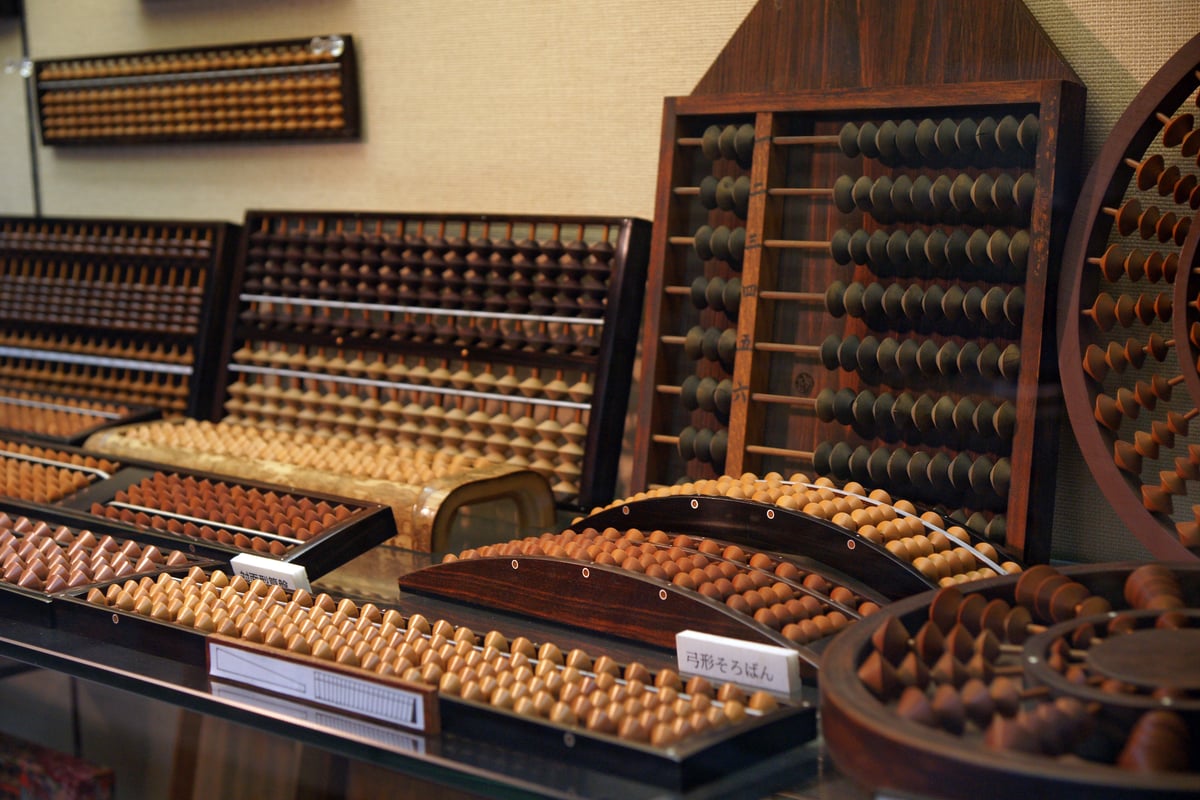
Banshu Soroban are soroban (abacuses) made mainly in Ono City, Hyogo Prefecture. The soroban is said to have been brought from China to Nagasaki at the end of the Muromachi period. Soroban making in Banshu is said to have been triggered by Toyotomi Hideyoshi's attack on Miki Castle in the Tensho era (1573–1592). Residents who fled the fighting to Otsu in Omi are said to have learned how to make Otsu soroban there and, after returning home, to have begun making them around Miki and Ono. The craft spread as handwork during the agricultural off-season, and developed greatly in the Edo period as reading, writing and the soroban became widespread through terakoya (temple schools). Production is divided among those who carve the beads, those who finish the beads, those who make the bamboo rods (higo) for the axes, and those who assemble the soroban, with more than 100 steps. Ono City is Japan's largest production area, accounting for about 70% of the country's soroban production. In 1976 (Showa 51) Banshu Soroban were designated a Traditional Craft by the Minister of Economy, Trade and Industry.
Origin
The soroban is said to have been brought from China to Nagasaki at the end of the Muromachi period and to have come into use in Japan from around the Bunroku era (1592–1595). Soroban making in Banshu is said to have originated when, during Toyotomi Hideyoshi's attack on Miki Castle in the Tensho era, residents who fled toward Otsu acquired the techniques of making Otsu soroban, returned to their hometown and began making them around Miki and Ono. In this area, with its mild climate and ample farmland, it took root as a side job during the agricultural off-season.
History
As terakoya spread in the Edo period and reading, writing and the soroban became widespread among ordinary people, production of Banshu Soroban also grew greatly. The Chinese-style form with 'two beads above and five below' was improved again and again, gradually changing into today's form. Production peaked around 1960 (Showa 35), after which demand declined with the spread of electronic calculators and computers and the falling birthrate. Banshu Soroban were designated a national Traditional Craft in June 1976, and the brightly colored 'Banshu Color Soroban' has also been developed.
Features
Banshu Soroban are distinguished by carefully selected natural materials and the good 'bead flicking' (tama-hajiki) achieved through handwork. The beads are made from ono-ore-kanba birch (樺), said to be so hard that it can break an axe, as well as boxwood (tsuge) and ebony. Hard, heavy woods such as ebony are used for the frame, and bamboo rods (higo) are used for the axes on which the beads are threaded. Specialized craftspeople divide the work for each part, and certified traditional craftspeople carry on the skills in each division. Ono City accounts for about 70% of national production.
Techniques
Division of labor
The work is divided among those who carve the beads, those who dye, drill and finish the beads, those who make the bamboo rods that serve as axes, and those who assemble the whole soroban. There are more than 100 steps, most of them done by hand. Soroban are made in batches of 200 to 300 at a time, and take about two to three weeks to complete.
Frame making and assembly
The process of shaping the frame pieces, threading the beads onto the bamboo rods, fitting them into the frame and finishing the back board. 宮本一廣, a certified traditional craftsperson, is said to place importance on getting the feel just right, so that the beads move smoothly and stop exactly in place when the finger is lifted. It is the key finishing stage that determines how easy a soroban is to use.
Materials Used
Production Process
- 1
Bead carving
Soroban beads are carved out of hard woods such as birch (ono-ore-kanba), boxwood and ebony. This is handled by craftspeople who specialize in bead carving.
- 2
Bead finishing
The carved beads are dyed, and holes for the axes are drilled through them to finish them. Bead finishing is also undertaken by specialized craftspeople.
- 3
Making bamboo rods
The bamboo 'higo' rods that serve as the axes on which the beads are threaded are made. This is the work of craftspeople who specialize in making bamboo rods.
- 4
Frame making and assembly
Frame pieces of ebony or other woods are shaped, and the beads are threaded onto the bamboo rods and fitted into the frame. Decoration of the back board and other finishing touches are applied, and the movement of the beads is checked to complete the soroban.
| Main Production Areas |
|
|---|
Artisans & Workshops
株式会社ダイイチ
A long-established maker of Banshu Soroban in Ono City, founded in 1909 (Meiji 42). Its representative is 宮永信秀. It drew attention for also producing replicas of the soroban used in 'Asa ga Kita', an NHK serial morning drama broadcast in 2015. It also makes educational toys that make use of soroban materials.
宮本一廣(伝統工芸士)
A certified traditional craftsperson in the frame-making and assembly division of Banshu Soroban, running a workshop in Ono City. 宮本一廣 handles multiple steps, from shaping the frame pieces to inserting the beads and decorating the back board. 宮本一廣's work is also introduced in moral education materials for junior high schools in Hyogo Prefecture.
How to Buy
- Ono City hometown tax donations (furusato nozei) (播州算盤工芸品協同組合 and others)
- The 播州算盤工芸品協同組合 (a soroban craft cooperative) at 東本町403-16, Ono City, and others offer return gifts. A 23-digit soroban with beads of top-grade birch and a frame of African ebony is available for donations from about 43,000 yen. Educational toys by Daiichi that make use of soroban materials are also offered.
- 株式会社ダイイチ (mail order)
- A soroban maker in Ono City founded in 1909 (Meiji 42). It runs a direct sales shop on Rakuten Ichiba and ships Banshu Soroban directly from Ono City. It also made replicas of the soroban used in the NHK serial morning drama 'Asa ga Kita'.
Hands-on Experiences
そろばんビレッジ
兵庫県小野市垂井町644-5
A facility where you can make an original soroban by choosing the colors of the frame and beads. Fees start from about 1,800 yen for 9 digits, with 12 digits about 2,300 yen and 15 digits about 2,800 yen. Making one takes about 30 to 45 minutes, and reservations are required by the previous day. About a 10-minute walk from Ono Station on the Kobe Electric Railway.
FAQ
Q. Why did soroban come to be made in Ono City?
A. It is said to have begun when residents who fled to Otsu during the attack on Miki Castle in the Tensho era learned how to make Otsu soroban and brought the techniques home. It spread as handwork during the agricultural off-season and developed along with the spread of terakoya in the Edo period.
Q. What is Banshu Soroban's share of domestic production?
A. Soroban from Ono City are said to account for about 70% of national production, making Ono Japan's largest production area. Banshu Soroban were designated a national Traditional Craft in 1976.
Q. Is there a facility where I can learn about the history of Banshu Soroban?
A. There is a soroban museum in the Ono City Traditional Industry Hall (小野市伝統産業会館) at 王子町806-1, Ono City. It displays works by master craftspeople through the ages, soroban from overseas, and a model of Himeji Castle made from soroban beads. It is open from 9:00 to 17:00.