Image: Wikimedia Commons
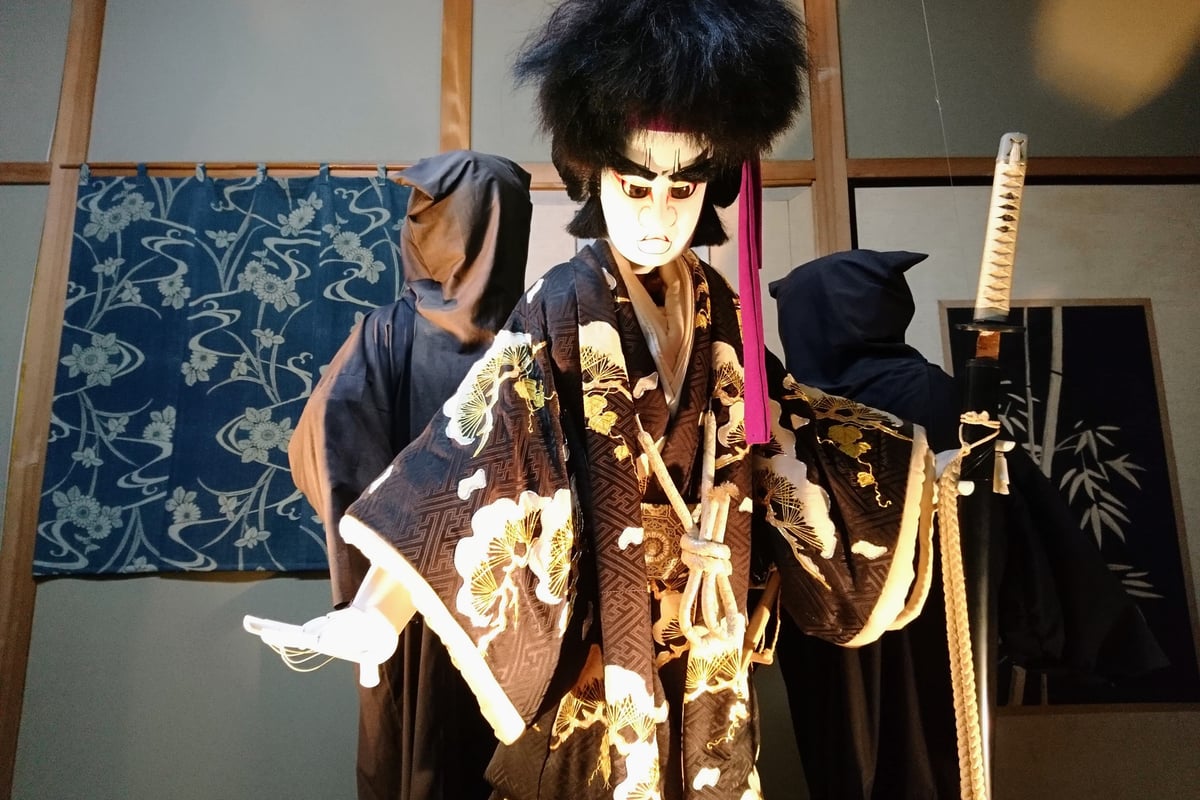
Awa Deko are the puppets used in Awa Ningyo Joruri, the puppet theater handed down in Tokushima Prefecture. 'Deko' means a doll made of wood. Awa Ningyo Joruri is a form of ningyo joruri (puppet theater) in which three puppeteers operate a single puppet to the accompaniment of gidayu-bushi (dramatic narrative chanting). It was designated a national Important Intangible Folk Cultural Property in 1999 (Heisei 11). In the past, it was performed during festivals on noson butai (rural stages) in places such as shrine grounds. In Awa, puppet heads (kashira) are basically of the six-sun type, a size larger than the four-sun type used in Bunraku (sun being a traditional unit of length). This is thought to have been devised by puppet makers from the early to mid-Meiji era so that the puppets would stand out even on outdoor stages. Mechanisms are built into the heads, and pulling a string changes the facial expression. The tools and works of three generations of the puppet maker Tenguhisa in Kokufu-cho, Tokushima City, are a national Important Tangible Folk Cultural Property. Works by puppet makers can be seen at the Awa Deko Ningyo Kaikan (Awa Puppet Hall) in Kawauchi-cho, Tokushima City.
Origin
Puppet theater in Awa is thought to have spread because the Hachisuka clan, which ruled Awa and Awaji in the early modern period, protected it. Puppet troupes from Awaji performed in places such as the castle town of Tokushima, and under their influence amateur puppet troupes sprang up across the region. Merchants who prospered from the indigo trade are also said to have supported puppet theater. Its origins are unclear, but activity seems to have begun by the first half of the 18th century. The puppets used in performances were called deko, and puppet makers carved their heads to order for troupes throughout the region.
History
Awa Ningyo Joruri reached its peak in the mid-Meiji era, and around 1887 (Meiji 20) there were more than 70 puppet troupes in the prefecture. This number is known from sources such as the order books of the first-generation Tenguhisa. Around the same time, heads grew larger, and around 1892 (Meiji 25) the first Tenguhisa devised glass eyes. In the Showa era, puppet theater declined rapidly due to the spread of cinema and the effects of war. After the war, it revived, spurred by events such as the founding of a promotion society in 1953 (Showa 28), and performances such as dedicatory performances at festivals continue today.
Features
Heads are said to be carved out of a single log of close-grained paulownia grown in cold regions. The faces are coated with layer upon layer of gofun, a white pigment made from powdered shells, and human hair is used for the hair. Compared with Bunraku puppets they are larger in size, and the glossy finish of the heads is another characteristic. To match the large heads, the puppets' movements and staging also became bolder. These Awa innovations influenced ningyo joruri in other regions such as Shikoku and Kyushu.
Techniques
Glass eyes
Around 1892 (Meiji 25), the first Tenguhisa devised garasu-me, glass inserted into the puppets' eyes. The sparkle of the eyes made the puppets look more lifelike, and together with the enlargement of the heads, this is said to have greatly influenced later Awa puppets.
Karakuri (mechanisms)
Mechanisms are built into the head, and pulling strings changes the expression. According to a puppet maker at the Awa Deko Ningyo Kaikan, an angry expression is produced by pulling three strings. For scenes in which a puppet is cut down, there is also a device that splits the head in half and rolls the eyes back to show the whites. To make the head easier to operate, its inside is carved down to a thickness of about 5 mm to make it lighter.
Wood carving and harinuki
The tools preserved at Tenguya are divided into those for deko carved from wood and those for harinuki puppets made by layering washi (Japanese paper). They are organized in the order of work, such as measuring tools for taking dimensions, cutting tools for shaping wood, and tools for crafting mechanisms.
Materials Used
Production Process
- 1
Carving the head
The head is carved out of a paulownia log. Carving the face alone takes about two weeks, and the expression is determined at this stage.
- 2
Installing the mechanisms
The inside of the head is carved thin to lighten it, and the mechanisms and strings for changing the expression are fitted.
- 3
Applying gofun
Gofun is applied to the face in many layers to finish it.
- 4
Attaching the hair
Human hair is glued together by hand to make the hair. Completing a single head is said to take more than three months.
| Main Production Areas |
|
|---|
Artisans & Workshops
天狗久(天狗屋)
A puppet-making house that, under the shop sign 'Tenguya' in Wada, Kokufu-cho, Tokushima City, was active over three generations from the Meiji to the Showa era. The first generation is known for devising glass eyes and enlarging heads, and is said to have made nearly 2,000 heads in his lifetime. The tools, works and order books of the three generations were designated a national Important Tangible Folk Cultural Property in 2002.
人形健(阿波木偶人形会館)
A puppet maker who makes deko at the Awa Deko Ningyo Kaikan in Kawauchi-cho, Tokushima City. 多田弘信, the second-generation Ningyo Ken, serves as director of the hall and has been named an 'Awa no Meiko' (Master Craftsman of Awa) by the prefecture. His teacher was his father, 多田健二, the first-generation Ningyo Ken and one of the 'Contemporary Master Craftsmen' (Gendai no Meiko). He works on the second floor of the hall, and media reports have cited prices of about 300,000 yen for a head and about 1 million yen for a complete puppet.
Official site →Hands-on Experiences
阿波木偶人形会館
徳島県徳島市川内町宮島本浦226-1
Displays about 100 works by Ningyo Ken and explains how the puppets are made, the mechanisms that change their expressions, and how they are operated. Admission is around 800 yen for adults, 700 yen for students and 600 yen for children. It is listed as open 9:00 to 16:00 and closed on Sundays and the first and third Mondays.
View details →徳島県立阿波十郎兵衛屋敷
徳島県徳島市川内町宮島本浦184
A facility on the site of the residence of Bando Jurobei, an Edo-period shoya (village headman), where Awa Ningyo Joruri is performed every day. Admission is around 410 yen for general visitors. However, it is scheduled to close for renovation from October 27, 2026 to early April 2027. Please check when it reopens before visiting.
View details →阿波木偶資料館(あわぎんホール)
徳島県徳島市藍場町2-14 あわぎんホール(徳島県郷土文化会館)5階
Displays deko heads, costumes and props by type, period and maker. A 2012 renovation redesigned the exhibits around the motif of a rural stage. The permanent exhibition is listed as free.
View details →阿波木偶制作教室(あわぎんホール)
徳島県徳島市藍場町2-14 あわぎんホール(徳島県郷土文化会館)4階
A class organized by the Tokushima Prefecture Culture Promotion Foundation, with instructors dispatched by the Awa Deko Sakka Kyokai (Awa Deko Artists' Association). Participants aim to make a deko with mechanisms over three years. In fiscal 2026 it ran for 12 sessions from July to December, with a tuition fee of 25,000 yen (materials and tools extra). Check each year's announcement for enrollment.
View details →天狗久資料館
徳島県徳島市国府町和田字居内172
Tenguhisa's former workshop, opened to the public by Tokushima City. The tools and works designated a national Important Tangible Folk Cultural Property were handed down here. Contact Tokushima City in advance about opening days and how to visit.
FAQ
Q. How do Awa Deko differ from Bunraku puppets?
A. Both are puppets operated by three people each, but Awa Deko are characterized by their large heads. While Bunraku heads are basically of the four-sun type, Awa heads are basically of the six-sun type. This was devised so the puppets would stand out even on outdoor rural stages, and their movements and staging are bolder as well.
Q. What kinds of plays are common in Awa Ningyo Joruri?
A. Many jidaimono (historical plays) suited to the large puppets and bold staging have been handed down. Among the most beloved is the Junrei Uta no Dan (Pilgrim's Song scene) from Keisei Awa no Naruto, which is often performed at the Awa Jurobei Yashiki as well.