 Image: Wikimedia Commons
Hyogo Prefecture
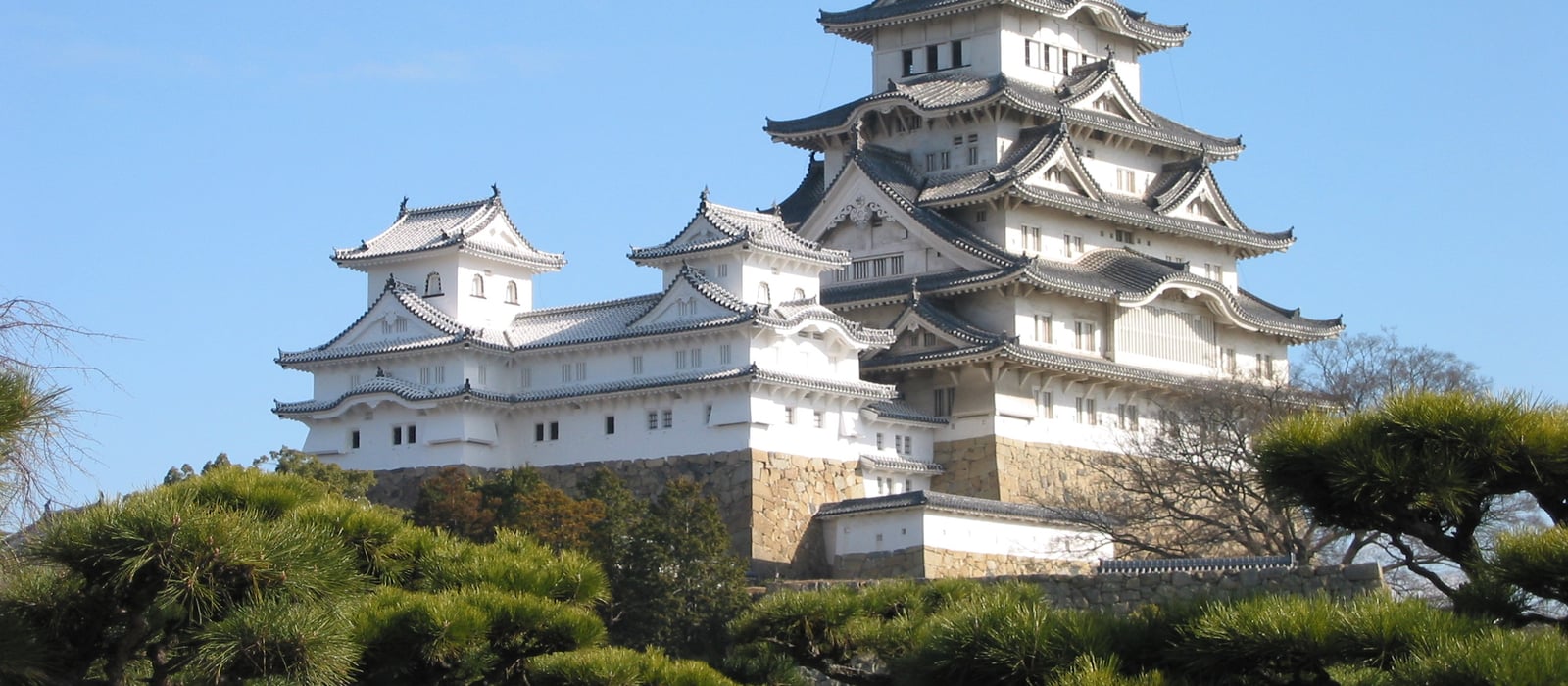
Hyogo Prefecture stretches from the Sea of Japan to the Seto Inland Sea and is a large prefecture made up of five former provinces: Settsu, Harima, Tajima, Tamba, and Awaji. Each area still keeps its own handicrafts and food culture. Seven items are designated as Traditional Crafts by the Minister of Economy, Trade and Industry: Tamba Tachikui-yaki, Izushi-yaki, Banshu Miki Uchihamono, Banshu Soroban, Toyooka Kiryu Zaiku, Banshu Kebari (fishing flies), and Osaka Karaki Sashimono. Tamba Tachikui-yaki is counted among Japan's Six Ancient Kilns, and in Miki and Ono in northern Harima, the division of labor for carpentry tools and soroban (abacuses) has been handed down. Items designated by the prefecture include Sugiharagami, Najio-gami, Myochin Hibashi, Ako Dantsu, and Arima's doll brushes. Among foods, Kobe Beef, Akashi's 'tamagoyaki' (Akashiyaki), and ikanago no kugini in spring are widely known. Hand-pulled somen from the Ibo River basin, Izushi sara soba, Tamba-Sasayama's botan nabe, and Matsuba crab from Tajima in winter are also local specialties. Each town also has its own flavors, such as Himeji oden, Kakogawa katsumeshi, and tansan senbei from Arima Onsen.
Hyogo's Traditional Crafts
Tamba Tachikui-yaki (Tamba Tachikui Ware)
Tamba Tachikui-yaki (Tamba Tachikui Ware)
Tamba Tachikui-yaki is pottery fired mainly in the Tachikui district of 今田町, Tamba-Sasayama City, Hyogo Prefecture, and is also commonly called 'Tamba-yaki' (Tamba ware). Its origins are said to date to the end of the Heian period or the beginning of the Kamakura period, and it is counted among Japan's Six Ancient Kilns, alongside Seto, Tokoname, Shigaraki, Echizen and Bizen. In the medieval period, jars and storage vessels were fired unglazed in anagama (tunnel kilns), but around 1611 (Keicho 16), at the beginning of the Edo period, the noborigama (climbing kiln) was introduced, and around the same time a kick wheel that turns counterclockwise was also adopted. When pieces are fired in a noborigama, ash from the pine firewood falls on them and melts together with the glaze, producing colors and patterns that differ from piece to piece. Because of the great variety of this yohen (kiln transformation: changes in color and texture that occur inside the kiln), it is also called 'Tamba no nanabake' (the seven transformations of Tamba). Around 50 kilns are still gathered in the village of Tachikui today, producing a wide range of wares from everyday tableware to flower vases and tea utensils. In 1978 (Showa 53) it was designated a Traditional Craft by the Minister of Economy, Trade and Industry under the name 'Tamba Tachikui-yaki'.

Izushi-yaki (Izushi Porcelain)
Izushi-yaki (Izushi Porcelain)
Izushi-yaki is porcelain made in Izushi-cho, Toyooka City, Hyogo Prefecture. Its greatest feature is a translucent whiteness described as 'whiter than snow', and it is known as a production area centered on white porcelain (hakuji), which is rare in Japan. Its raw material is 'Kakitani porcelain stone', a stone of pure, clear whiteness found at Kakitani in Izushi-cho. It began in 1784 (Tenmei 4), in the late Edo period, when 伊豆屋弥左衛門, a wealthy Izushi merchant, opened a kiln for earthenware. In 1793 (Kansei 5), a potter from Hizen succeeded in firing porcelain, and the kiln later developed as a kiln of the Izushi domain. In the Meiji period, elaborate works with relief carving and openwork on white porcelain were made, and they won a gold medal at the 1904 St. Louis World's Fair. Today, kilns in the castle town still make everything from everyday tableware to vases and ornaments. Izushi sara soba, a specialty of the castle town, is also served on small plates of Izushi-yaki. In 1980 (Showa 55) it was designated a Traditional Craft by the Minister of Economy, Trade and Industry.
Banshu Miki Uchihamono (Banshu Miki Forged Blades)
Banshu Miki Uchihamono (Banshu Miki Forged Blades)
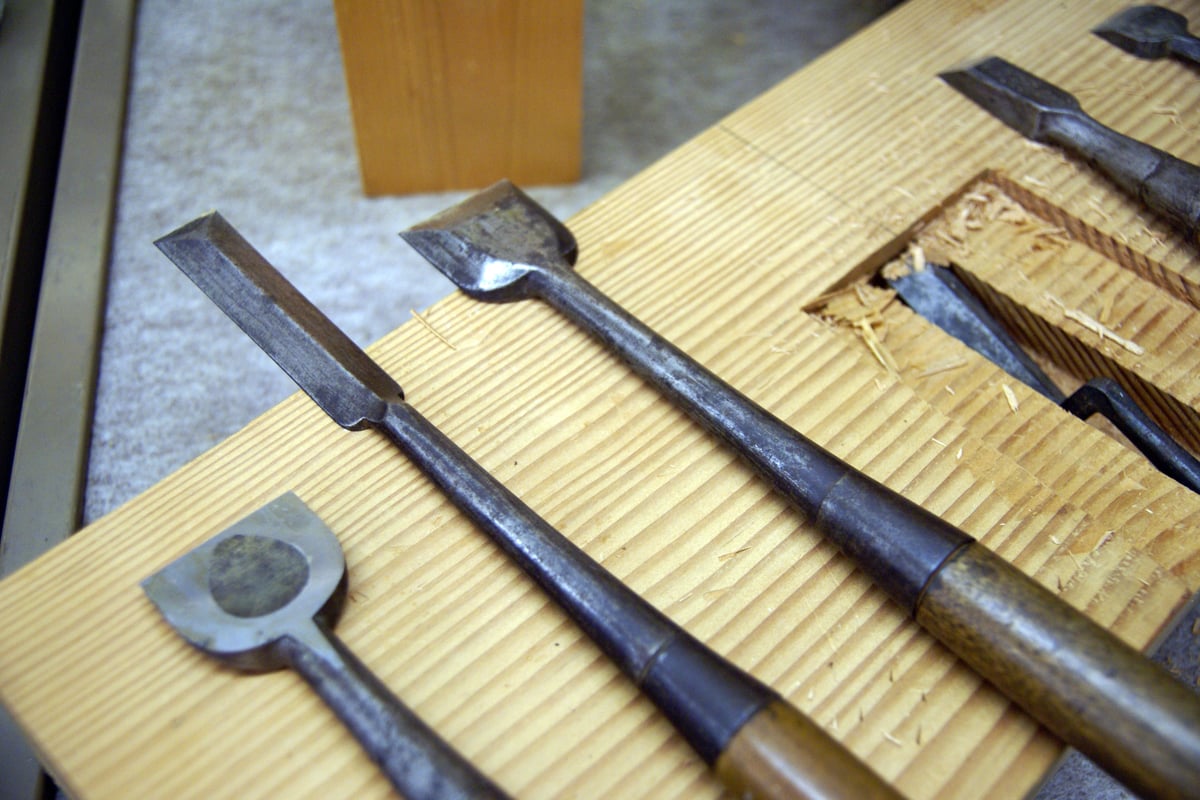
Banshu Miki Uchihamono are forged blades (uchihamono) made in Miki City, Hyogo Prefecture, in five items: saws (nokogiri), chisels (nomi), planes (kanna), trowels (kote) and knives (kogatana). The origins of blacksmithing in Miki are said to go back about 1,500 years, to an exchange of techniques between the local 'Yamato smiths' (大和鍛冶) and the 'Korean smiths' (韓鍛冶) who came from Baekje. A major turning point was Hashiba Hideyoshi's attack on Miki Castle, which began in 1578 (Tensho 6). To rebuild the town, which had been reduced to burnt ruins, Hideyoshi exempted it from taxes to bring people back, and the carpenters who gathered there, along with the blacksmiths who made their tools, brought the town back to life. Later, when the carpenters went to work in other regions, the quality of the tools they brought with them gained a reputation, and the name 'Miki, the town of hardware' spread. Their hallmark is a keen sharpness developed through forging Japanese iron and steel, and about 30 hand-forging smithies are said to remain today. In 1996 (Heisei 8) they were designated a Traditional Craft by the Minister of Economy, Trade and Industry.
Myochin Hibashi (Myochin Fire Tongs)
Myochin Hibashi (Myochin Fire Tongs)
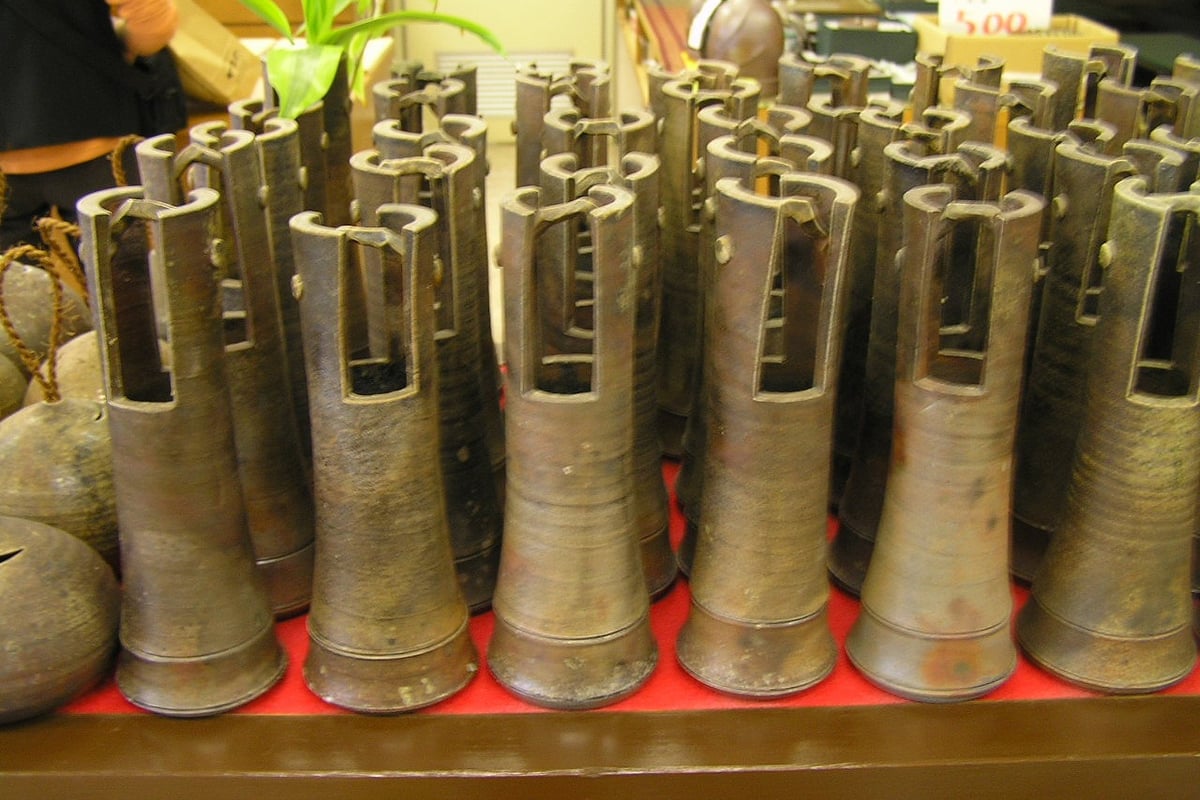
Myochin Hibashi are iron fire tongs made in Himeji City, Hyogo Prefecture. Hibashi are metal chopsticks used to pick up charcoal in a hibachi brazier or an irori hearth. Their makers, the Myochin family, come from a line of armorers (craftspeople who make armor and helmets) said to date back to the late Heian period, and in the Edo period a branch of the family was also in Himeji. When the age of the samurai ended and demand for armor disappeared, the family began making fire tongs, putting its iron-forging skills to use. Their greatest feature is the clear, high-pitched tone that rings out when the tongs touch each other. When kerosene heaters became the main form of heating and demand for fire tongs declined, the 'hibashi wind chime', with four fire tongs hung together, was devised in 1965 and spread throughout Japan. Its tone is loved by musicians in Japan and abroad. Today, production centers on items for enjoying sound, such as hibashi wind chimes and door chimes. In 1993 (Heisei 5) Myochin Hibashi were designated a Hyogo Prefecture Designated Traditional Craft.
Banshu Soroban (Banshu Abacus)
Banshu Soroban (Banshu Abacus)
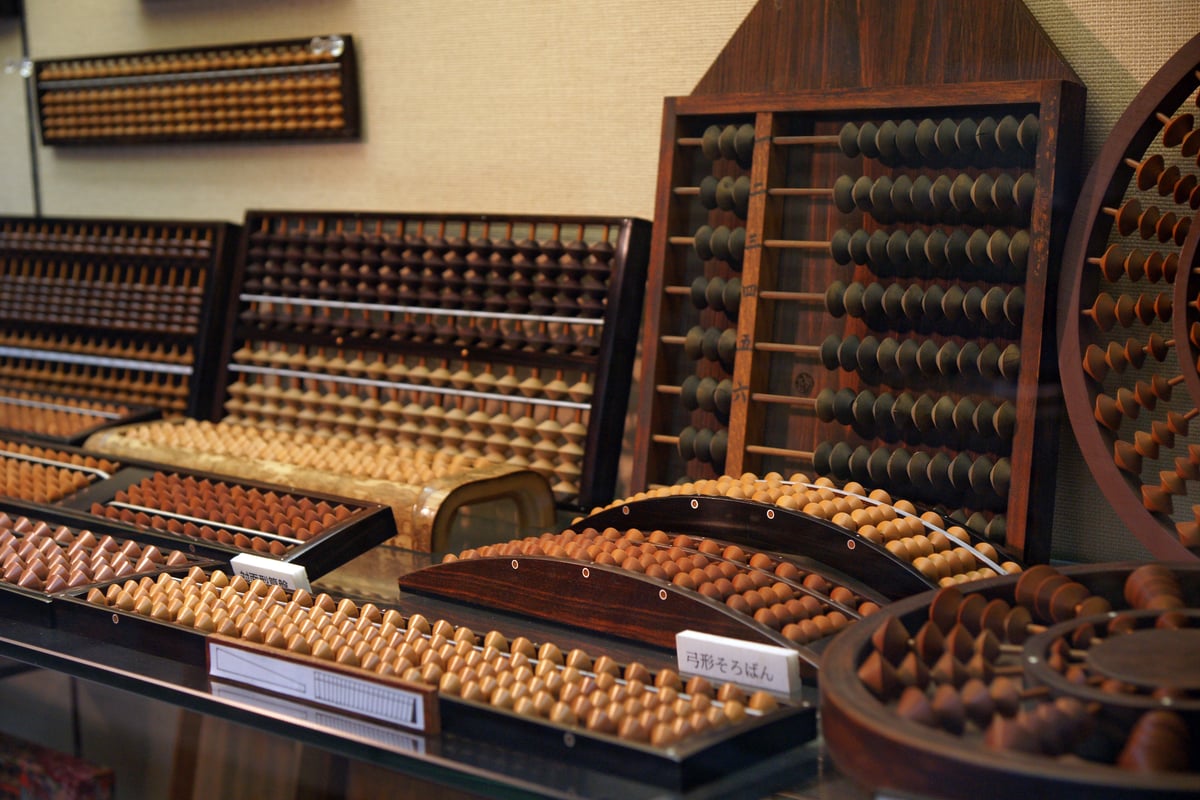
Banshu Soroban are soroban (abacuses) made mainly in Ono City, Hyogo Prefecture. The soroban is said to have been brought from China to Nagasaki at the end of the Muromachi period. Soroban making in Banshu is said to have been triggered by Toyotomi Hideyoshi's attack on Miki Castle in the Tensho era (1573–1592). Residents who fled the fighting to Otsu in Omi are said to have learned how to make Otsu soroban there and, after returning home, to have begun making them around Miki and Ono. The craft spread as handwork during the agricultural off-season, and developed greatly in the Edo period as reading, writing and the soroban became widespread through terakoya (temple schools). Production is divided among those who carve the beads, those who finish the beads, those who make the bamboo rods (higo) for the axes, and those who assemble the soroban, with more than 100 steps. Ono City is Japan's largest production area, accounting for about 70% of the country's soroban production. In 1976 (Showa 51) Banshu Soroban were designated a Traditional Craft by the Minister of Economy, Trade and Industry.
Toyooka Kiryu Zaiku (Toyooka Wickerwork)
Toyooka Kiryu Zaiku (Toyooka Wickerwork)
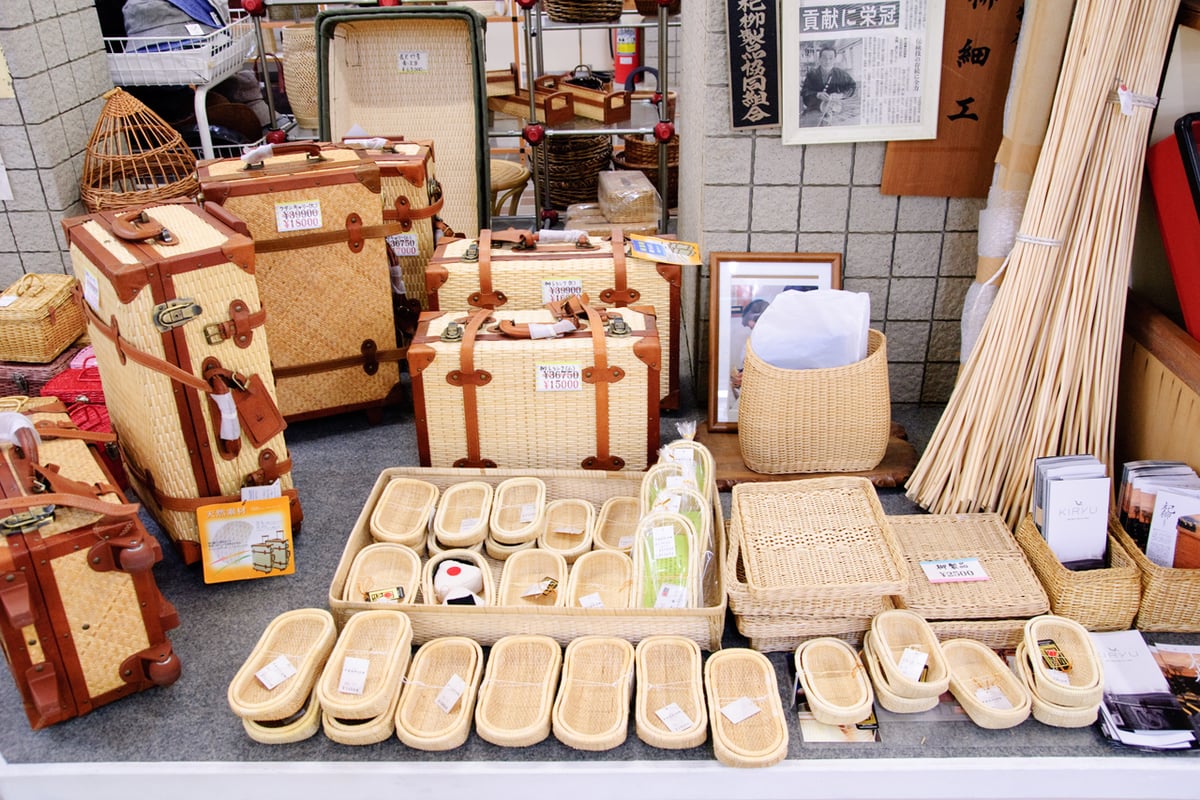
Toyooka Kiryu Zaiku is wickerwork made in Toyooka City, Hyogo Prefecture, by weaving the branches of the koriyanagi willow (kiryu). Koriyanagi is a shrub of the willow family that once grew wild in the wetlands along the Maruyama River (Maruyamagawa). According to Hyogo Prefecture, the craft began in the Nara period, and willow boxes made in Tajima Province at that time survive in the Shosoin repository. In the Edo period, under the patronage of the Kyogoku family, lords of the Toyooka Domain, Toyooka became known throughout Japan as a production center of yanagi-gori (willow wicker trunks) used to store clothing and other items. In the Meiji era, the wicker-trunk bag (kori kaban), a trunk fitted with handles and locks, was created, and it became the starting point of today's Toyooka, 'the town of bags.' A characteristic of the craft is that each piece is woven by hand, combining techniques such as bottom weaving, rope weaving, rim weaving and lid weaving. Products are divided into three categories: yanagi-gori, small trunks, and baskets of willow or rattan. It was designated a Traditional Craft designated by the Minister of Economy, Trade and Industry in 1992 (Heisei 4).
Sugiharagami (Sugihara Washi Paper)
Sugiharagami (Sugihara Washi Paper)
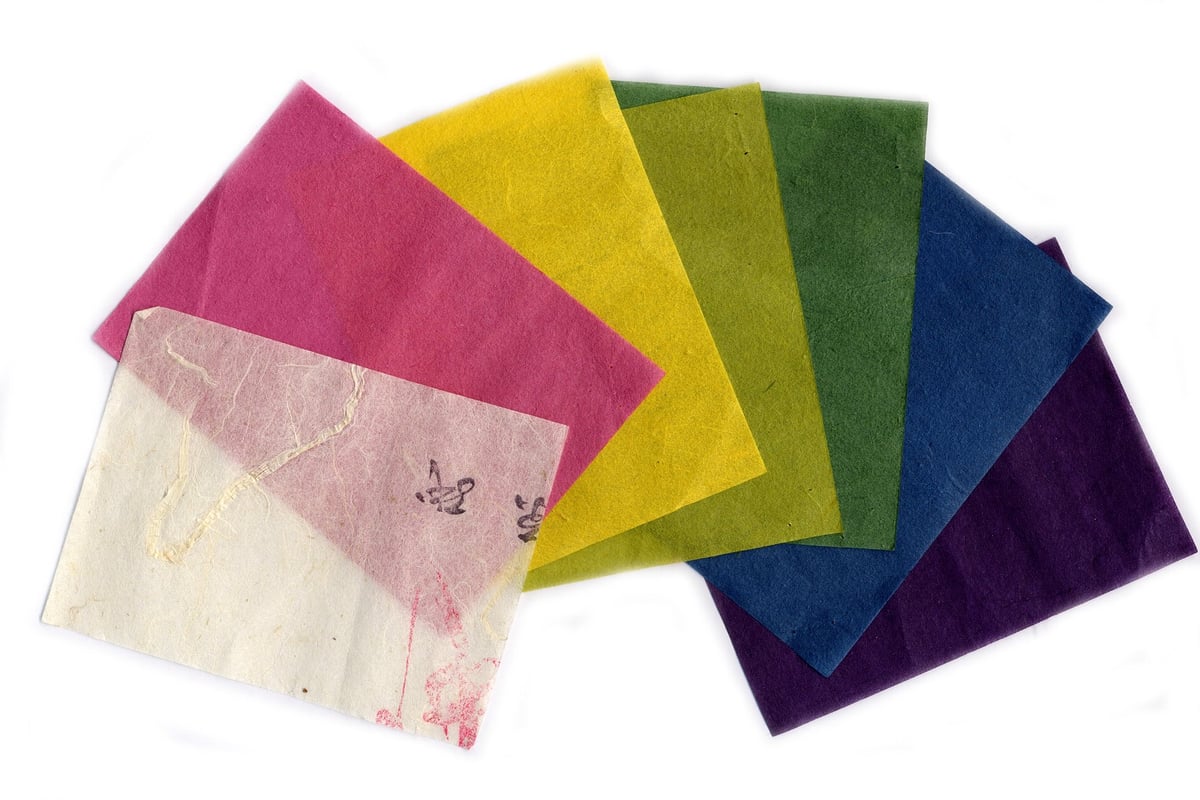
Sugiharagami is handmade washi paper made in Kami-ku, Taka Town (Takacho), Hyogo Prefecture. Only kozo (paper mulberry; a shrub of the mulberry family and a representative raw material of washi) is used as its raw material, and it is characterized by a gentle whiteness and a soft texture. It is thought to descend from the 'Harima paper' of the Nara period, and in the Heian period paper was made at Sugihara-no-sho (椙原庄), a manor of the Fujiwara clan. In the Kamakura period it became the official paper of the shogunate, and in the Muromachi period it was so highly valued that it was recorded that 'samurai will not write letters on anything but Sugihara.' From the Meiji era onward it declined under pressure from Western-style paper, and production ceased for a time in 1925 (Taisho 14). Papermaking was recreated in 1970, and it was revived when the town-run Sugiharagami Research Institute was established in 1972. It was designated a Hyogo Prefecture Important Intangible Cultural Property in 1983 and a Hyogo Prefecture Designated Traditional Craft in 1993.
Najio-gami (Najio Gampi Paper)
Najio-gami (Najio Gampi Paper)
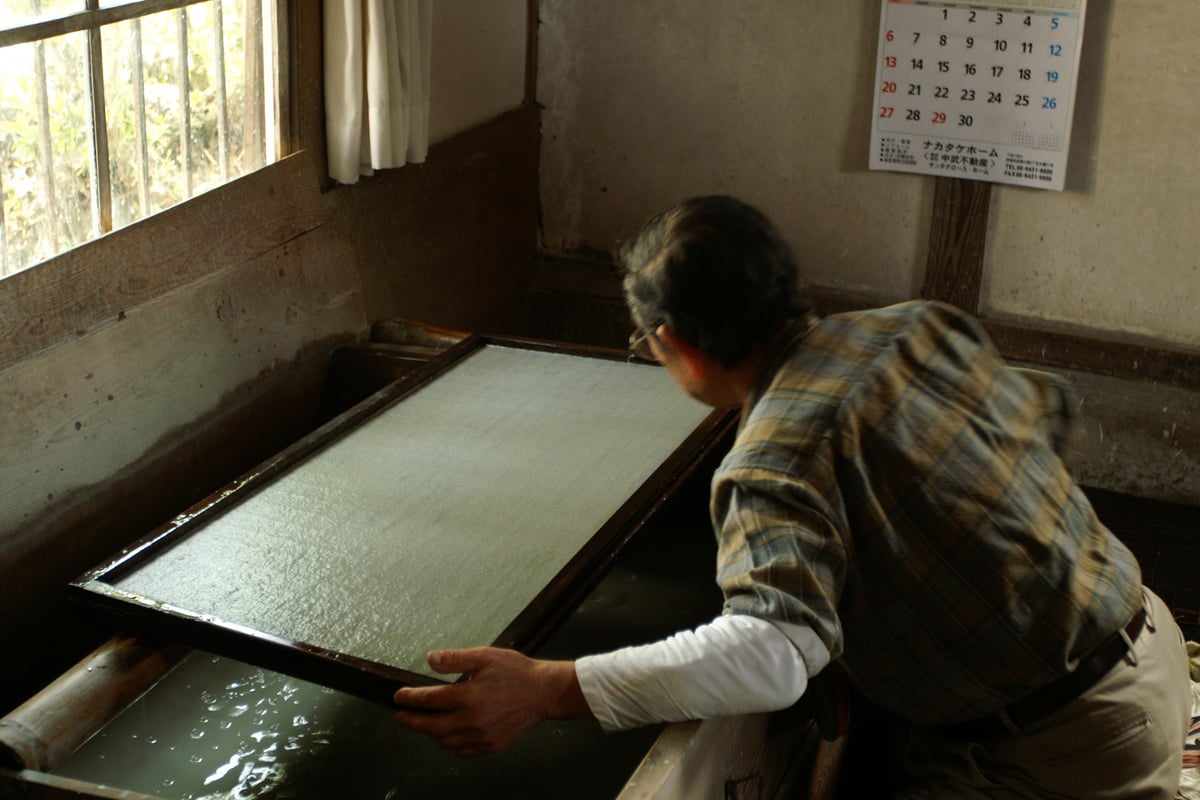
Najio-gami is handmade washi paper made in Najio, 塩瀬町, Nishinomiya City, Hyogo Prefecture. It is known for a unique technique in which mud from the area is mixed into the fibers of gampi (a shrub of the daphne family, Thymelaeaceae, used as a raw material of washi) before the paper is formed. Because it contains mud, it is said to be less prone to insect damage, less likely to fade or discolor in sunlight, and less prone to shrinking and stretching. The technique is said to have come from Echizen (Fukui Prefecture), and in the Edo period the area prospered so much from papermaking that it was called 'Najio Sengen' (Najio of a thousand households). It was valued as paper for han-satsu (domain paper money) and for fusuma (sliding doors) and folding screens, and today it is still used to make the base paper for hakuuchi-gami (paper for beating gold leaf), used when beating gold and other metal leaf thin, as well as maniai-shi (fusuma paper). It has also been used in the restoration of cultural properties such as Nijo Castle and Nishi Honganji. It was designated a Hyogo Prefecture Intangible Cultural Property in 1983 and a Hyogo Prefecture Designated Traditional Craft in 1993. In 2002, 谷野武信 was recognized as the holder of the national Important Intangible Cultural Property 'Najio gampi paper' (名塩雁皮紙).
Ako Dantsu (Ako Hand-woven Carpets)
Ako Dantsu (Ako Hand-woven Carpets)
Ako Dantsu is a cotton floor covering hand-woven in Ako City, Hyogo Prefecture. Dantsu (pile carpet) refers to a thick floor covering woven by knotting the threads that form the pile onto the warp threads. In the late Edo period, 児島なか of 中村 (present-day 中広, Ako City) was captivated by a Chinese dantsu seen in Takamatsu and, after long years of trial and error, created Ako Dantsu. It was commercialized in the Meiji era, spread as a side job for women working in the salt fields, and flourished greatly into the Taisho era. Together with Nabeshima Dantsu of Saga and Sakai Dantsu of Osaka, it is counted among 'Japan's three great dantsu.' It is characterized by its densely packed cotton pile and by 'tsumi' (trimming), in which the boundaries between colors are trimmed with hand shears (nigiri-basami) to make the patterns stand out. With brown, blue and white as the base colors, auspicious patterns such as kikko (tortoiseshell) and kani-botan (crab and peony) are woven in. Production nearly died out in the Showa era, but the Association for Passing Down Ako Dantsu (赤穂緞通を伝承する会) was formed in 1999, and the techniques are being handed down. It was designated a Hyogo Prefecture Designated Traditional Craft in 2007.
Arima Ningyo Fude (Arima Doll Brushes)
Arima Ningyo Fude (Arima Doll Brushes)
Arima Ningyo Fude are brushes with a karakuri (mechanical trick) device, made at Arima Onsen in Arima-cho, Kita Ward, Kobe City. When you pick up the brush to write, a small doll pops its head out of the end of the shaft. The shaft is wrapped with colorful silk threads that form beautiful patterns. According to Hyogo Prefecture, its origins are said to date back to the Muromachi period, and it is recorded as a specialty of Arima in the 有馬名所鑑 (a guide to the famous places of Arima), published in 1678 (Enpo 6). It is said to have been devised from the practical Arima brushes that had long been made there, and it has been loved as a souvenir of Arima Onsen. It is also popular as a celebratory return gift (hikidemono) associated with wishes for children. At the Japan World Exposition in 1970 it was exhibited at the Local Folk Crafts Pavilion, where it was selected as a prize-winning work and became widely known. It was designated a Hyogo Prefecture Designated Traditional Craft in 1993 (Heisei 5). Today, 灰吹屋西田筆店 at Arima Onsen is the only workshop.
Hyogo's Local Food
Akashiyaki
Akashiyaki
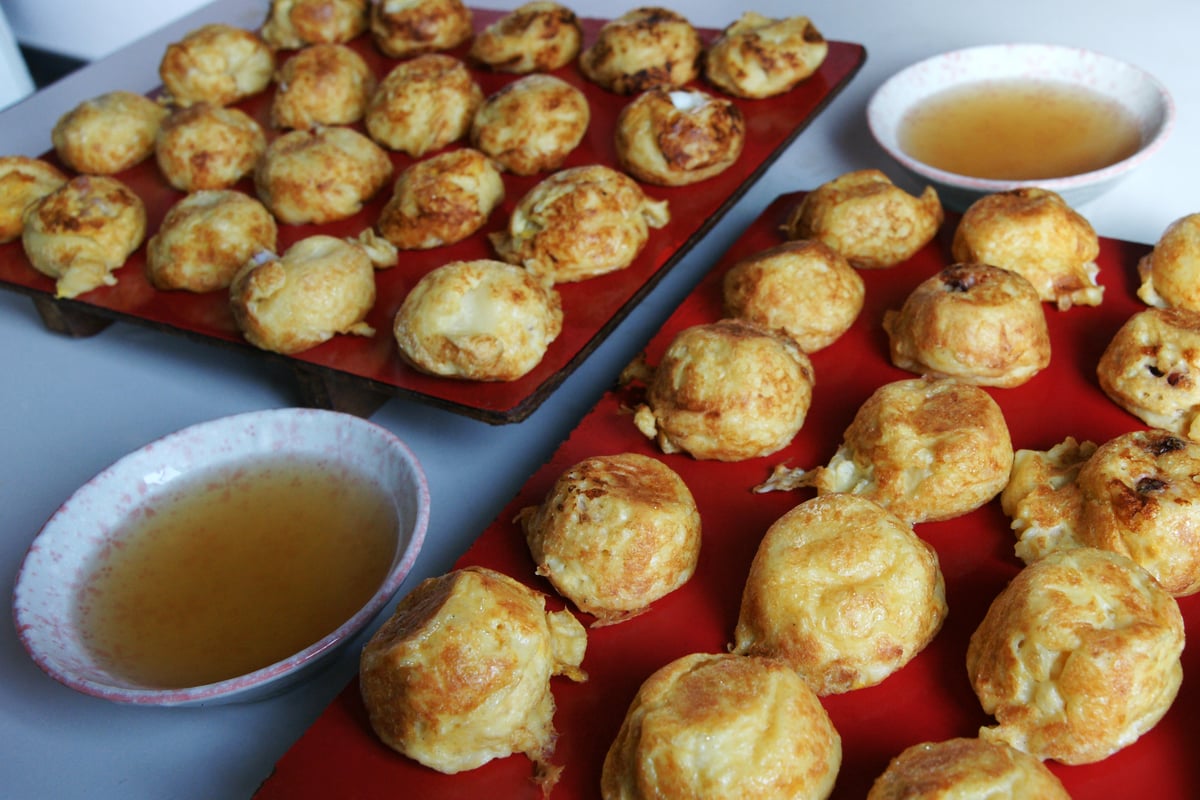
Akashiyaki is a local dish of Akashi City, Hyogo Prefecture: an egg-rich batter filled with octopus is cooked into rounds, which are dipped in warm dashi broth to eat. Locally it has long been called 'tamagoyaki'. The batter is made by mixing wheat flour with jinko (starch obtained by removing the gluten from wheat flour; also called ukiko), giving it a soft, fluffy texture. It looks similar to takoyaki, but the big difference is that it is enjoyed with dashi rather than sauce. It is cooked in a copper pan and served on a slightly tilted wooden board called an ageita. It is said to have originated when egg yolks left over from making 'Akashi-dama', imitation coral made from egg whites, were combined with octopus, which is plentiful in Akashi, and cooked. There are about 70 shops in Akashi City (as of 2021), and it is enjoyed by children and adults alike as an everyday lunch or snack.
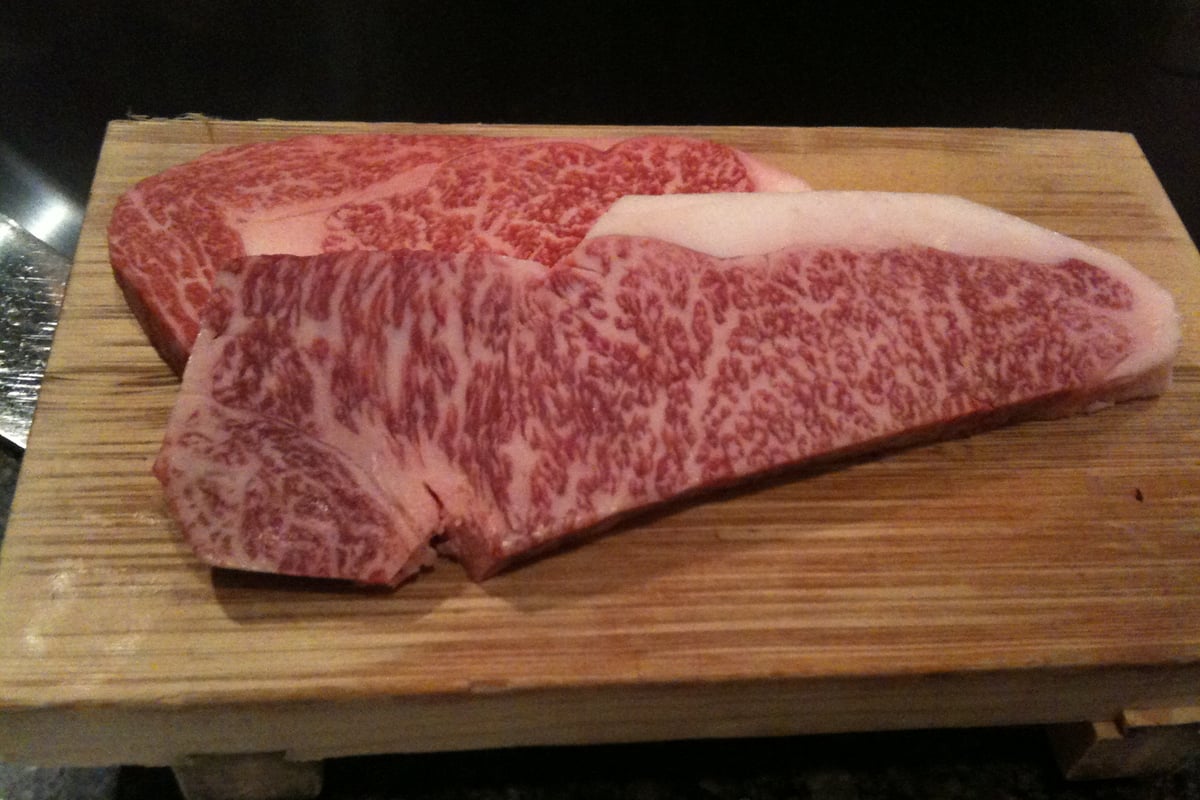
Kobe Beef
Kobe Beef
Kobe Beef is a brand name given only to beef from Hyogo-raised Tajima cattle (Tajima-ushi / Tajima-gyu) that meets strict standards. Also called 'Kobe Meat' (Kobe Niku) and 'Kobe-gyu', it was registered as a national Geographical Indication (GI) in 2015 (Heisei 27). The standards are set by the Kobe Beef Marketing and Distribution Promotion Association, established in 1983 (Showa 58). The Tajima cattle that serve as the source cattle (motoushi) originate from cattle used for farm work for about 1,200 years in the Tajima region of northern Hyogo Prefecture. After the Port of Kobe opened in 1868 (Meiji 1), foreigners praised its flavor highly, and the name 'Kobe Beef' spread around the world. It is characterized by fine marbling and the sweetness of fat that seems to melt in the mouth. Certified meat is stamped with the 'Nojigiku stamp', shaped like the nojigiku, Hyogo's prefectural flower. Besides being enjoyed as steak and sukiyaki, it is known overseas as a byword for premium wagyu.
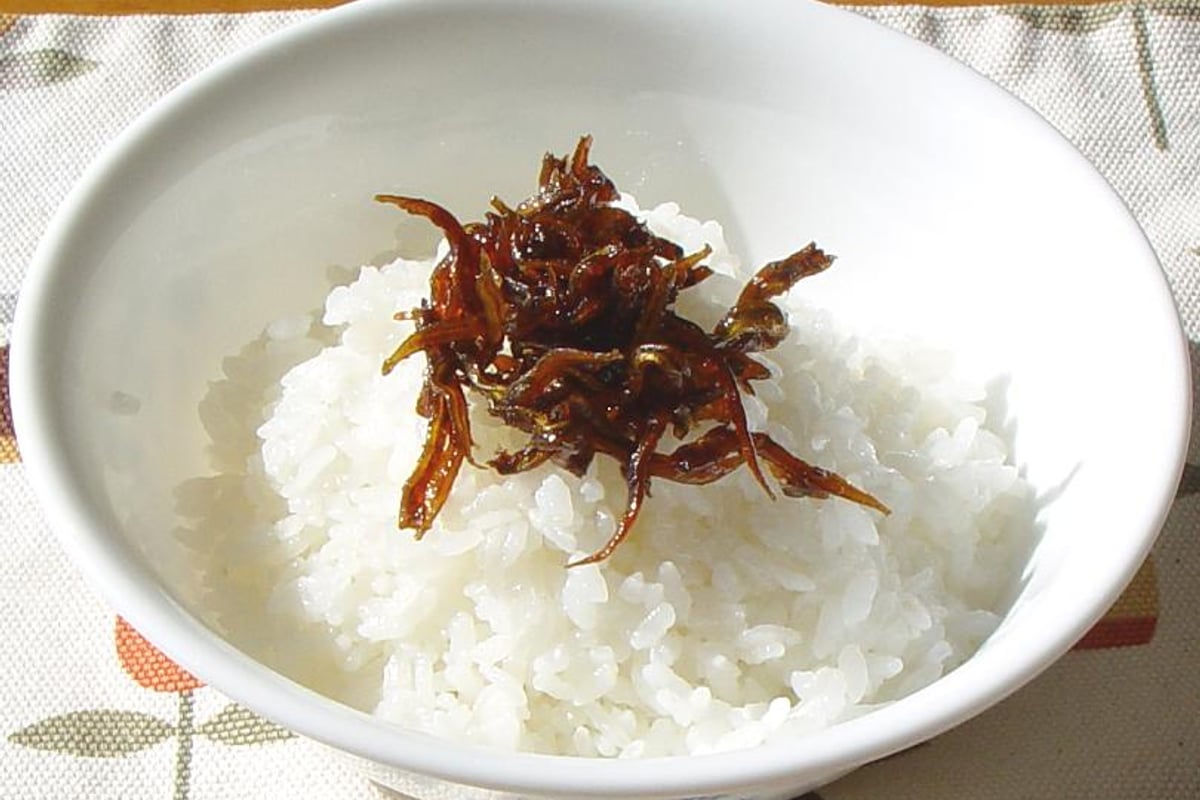
Ikanago no Kugini (Simmered Sand Lance)
Ikanago no Kugini (Simmered Sand Lance)
Ikanago no kugini is a tsukudani made by simmering shinko, the juvenile fish of the sand lance (ikanago; a small fish of the family Ammodytidae in the order Perciformes), with soy sauce, sugar, ginger, and other seasonings until sweet and savory. It has long been made along Hyogo Prefecture's Seto Inland Sea coast, including Harima, Settsu, and Awaji. It is called 'kugini' ('nail-simmered') because the finished fish look like bent, rusty nails. Kobe is considered its birthplace, and it was originally a dish made in fishing households. From the 1980s onward, it became widely known among ordinary households as well. The shinko fishing season opened every year between late February and early March and lasted only about a month. Locally it is said that 'when you smell ikanago, spring is on its way', and the dish is cherished as a seasonal sign of spring. In the past, many households bought shinko by the kilogram, cooked them at home, and sent the kugini to relatives and acquaintances. In recent years, however, catches have dropped sharply and the fishing season has become shorter, making shinko hard to obtain.
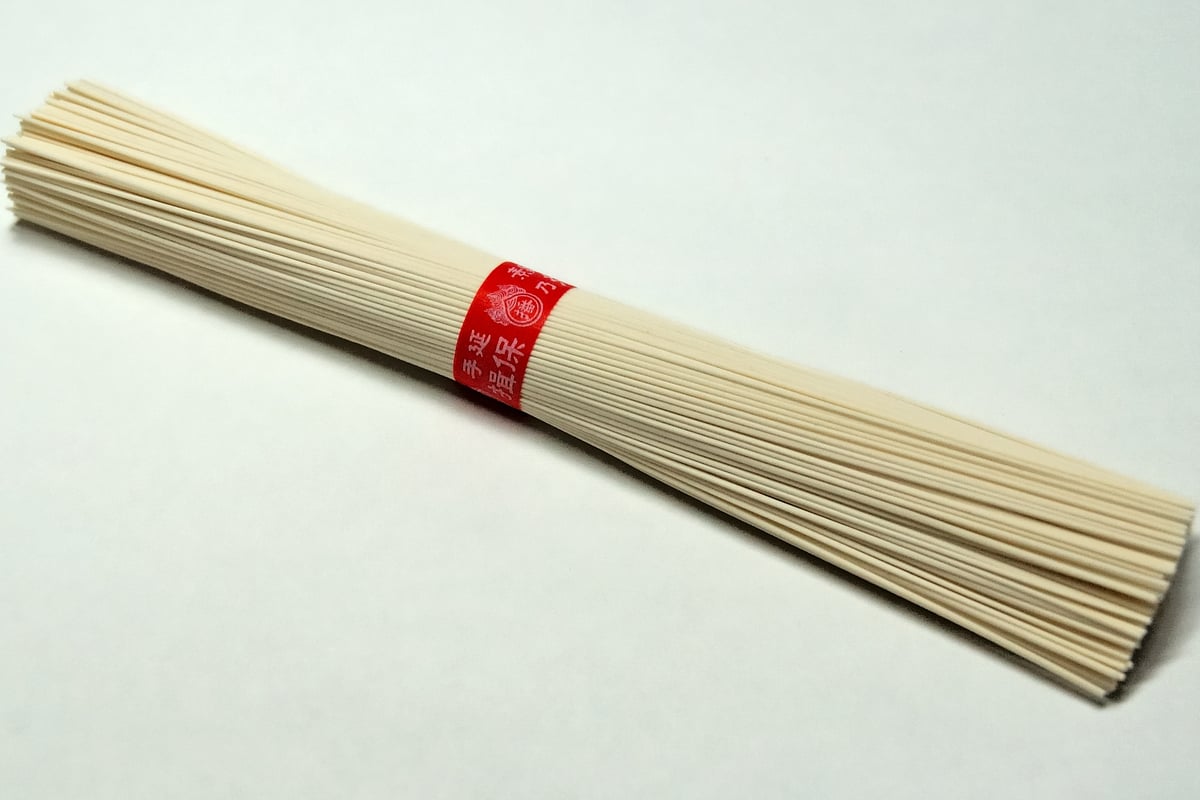
Banshu Somen (Ibo no Ito)
Banshu Somen (Ibonoito Hand-stretched Noodles)
Banshu somen is hand-pulled somen made in the Harima region of southwestern Hyogo Prefecture. The main production areas lie in the basin of the Ibo River (Ibo-gawa), including Tatsuno City, Shiso City, Taishi Town, Sayo Town, and Himeji City. It is made from wheat flour, salt, and water using the 'tenobe' (hand-pulled) method, in which the dough is twisted while being stretched thinner little by little. It does not easily turn soft when boiled and is characterized by a smooth texture and a firm, clean bite. Its representative brand is 'Ibo no Ito' from the Hyogo Prefecture Tenobe Somen Cooperative. Ibo no Ito boasts the largest production volume of any hand-pulled somen in Japan, and in 2024 (Reiwa 6) it was registered as a national Geographical Indication (GI). Somen-making in Banshu has a history of about 600 years, and the word 'saumen' appears in a temple record from the Muromachi period. Blessed with wheat from the Banshu Plain, the clear waters of the Ibo River, and salt from Ako, it has been handed down as work for the winter agricultural off-season. It is eaten year-round: as chilled somen in summer and as warm nyumen in winter.
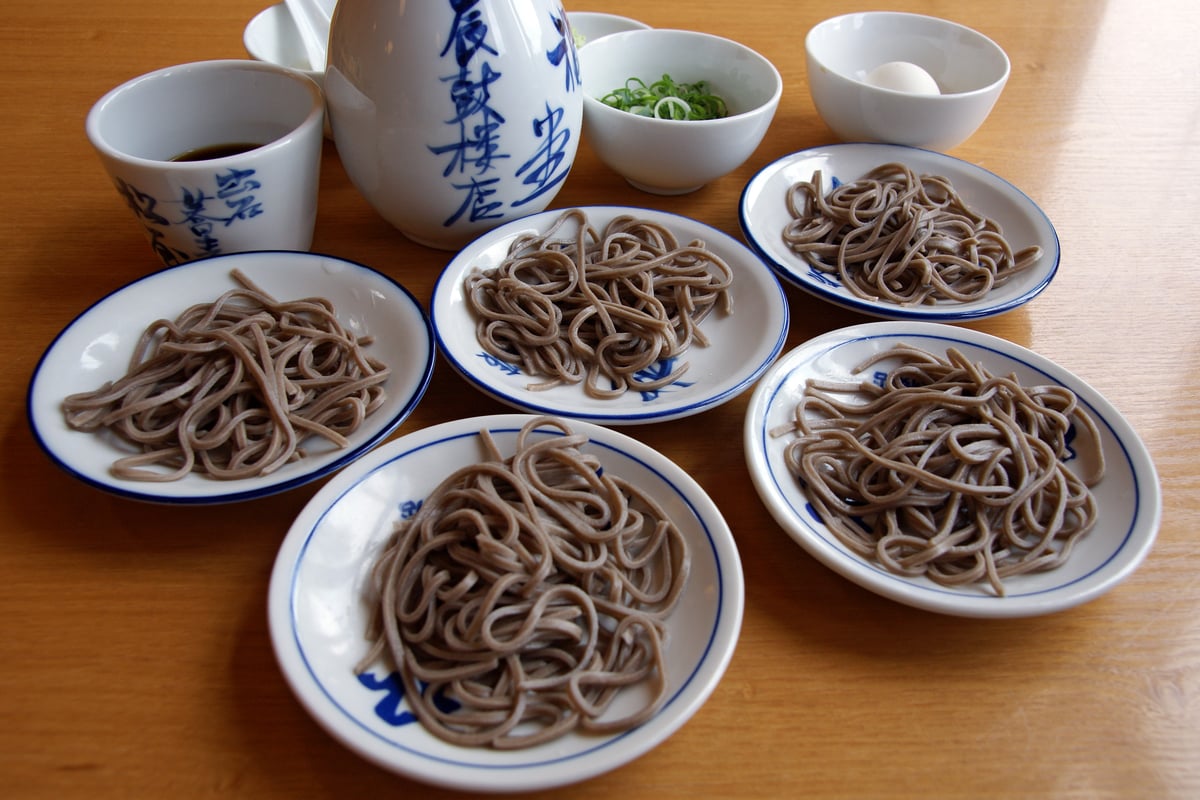
Izushi Sara Soba
Izushi Sara Soba
Izushi sara soba is soba served portioned onto small plates, a tradition of Izushi-cho in Toyooka City, Hyogo Prefecture. In the castle town of Izushi, boiled soba is served a little at a time on small plates of Izushi-yaki, a white porcelain. A standard serving is five plates, and diners can add as many more as they like, one plate at a time. It comes with dipping broth in a tokkuri (a small flask) and condiments such as green onion, wasabi, egg, and grated yam (tororo). It is said to have begun in 1706 (Hoei 3). According to tradition, the start came when the domain lord 仙石政明, transferred to Izushi from Ueda in Shinshu (present-day Ueda City, Nagano Prefecture), brought soba makers along. Serving it on small plates began around the end of the Edo period, and is said to have started with the use of small, shallow plates that were easy to carry at street stalls. Over more than 300 years, craftspeople have kept refining it, and today it is a specialty of Izushi, with about 40 shops in the town (as of 2021).
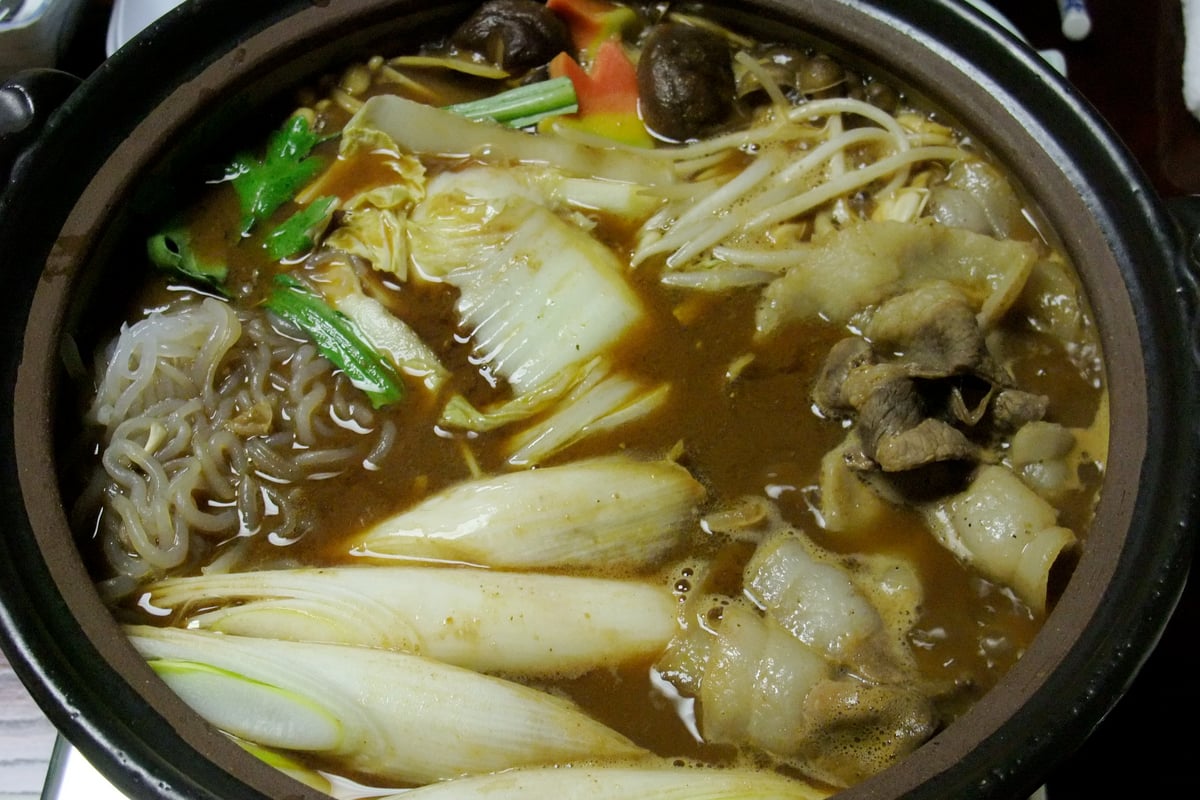
Botan Nabe (Wild Boar Hot Pot)
Botan Nabe (Wild Boar Hot Pot)
Botan nabe is a local dish of Tamba-Sasayama City, Hyogo Prefecture, in which wild boar meat (shishiniku) is simmered with vegetables in a miso-based broth. One explanation of the name is that the thinly sliced boar meat is arranged on a large platter like the petals of a peony (botan). Tamba-Sasayama is known as one of Japan's leading boar hunting grounds, and the dish is at its best from around mid-November, when the hunting season opens, to mid-March. According to the Ministry of Agriculture, Forestry and Fisheries, the dish is said to have begun around 1908 (Meiji 41), when the Army's 70th Infantry Regiment, stationed in Sasayama Town, put the meat of boars caught during training into miso soup. At first it was called 'ino nabe' (boar pot). In 1931 (Showa 6), the word 'botan nabe' was used in the lyrics of the folk song 'Sasayama Kouta,' and the name is said to have spread from there. Local ryori ryokan (inns known for their cuisine) and others served it as a winter specialty, and it also became a dish for entertaining guests at New Year and on special occasions. In 2022 it was recognized as one of the Agency for Cultural Affairs' '100-Year Foods.'
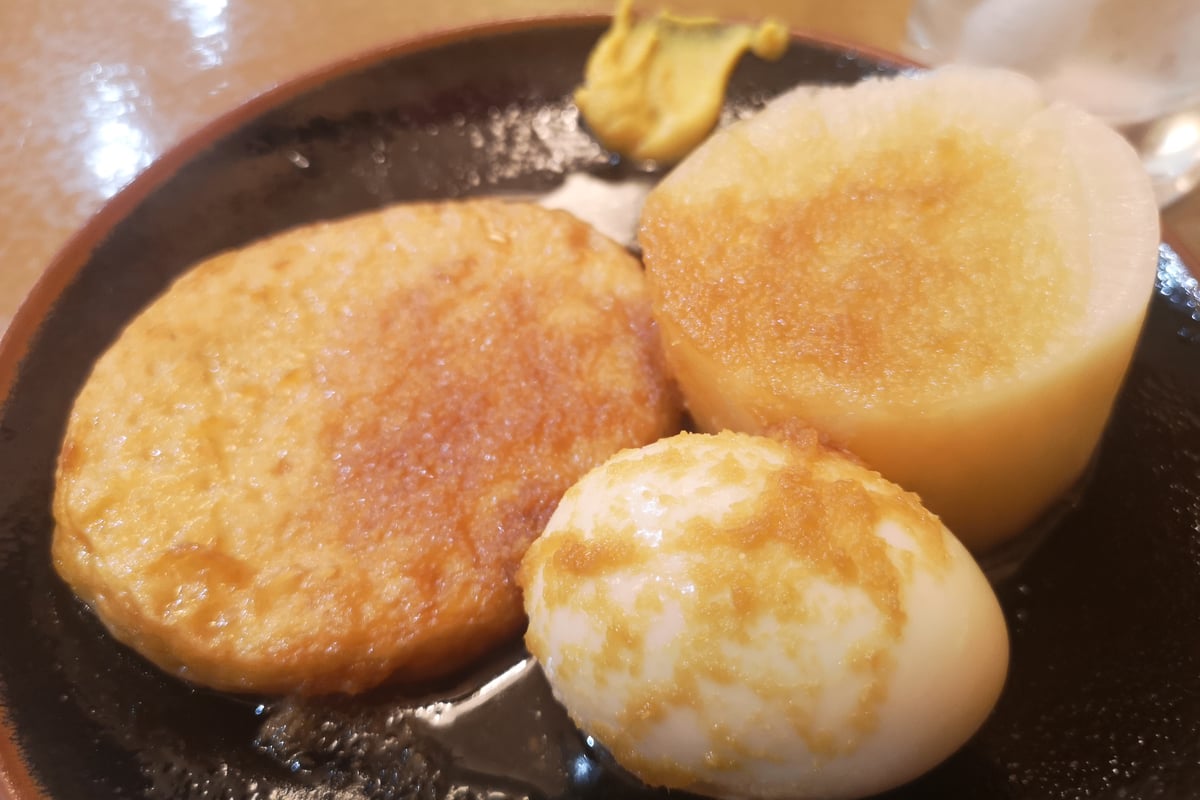
Himeji Oden
Himeji Oden (Oden with Ginger Soy Sauce)
Himeji oden is a local specialty of Himeji City, Hyogo Prefecture, in which oden is eaten with ginger soy sauce (shoga joyu), either poured over it or used as a dip. Oden is usually served with mustard, but in Himeji people use koikuchi (dark) soy sauce mixed with grated ginger. What defines Himeji oden is not a special broth or special ingredients but this way of eating itself. Himeji has two kinds of oden, 'kantodaki,' with a strong, sweet seasoning, and lightly seasoned oden, but either one is called Himeji oden as long as it is eaten with ginger soy sauce. Originally this was the way of eating oden only in a limited area centered on Himeji and stretching from around Kakogawa to Aioi. It is also said to have started in the early Showa period, when people poured ginger soy sauce over sweet-and-savory kantodaki to adjust the flavor. In 2006 (Heisei 18), it was named 'Himeji oden' as part of a town revitalization effort. Today it is said to be available at about 100 establishments in the city, and it is eaten both at home and at celebratory gatherings such as autumn festivals.
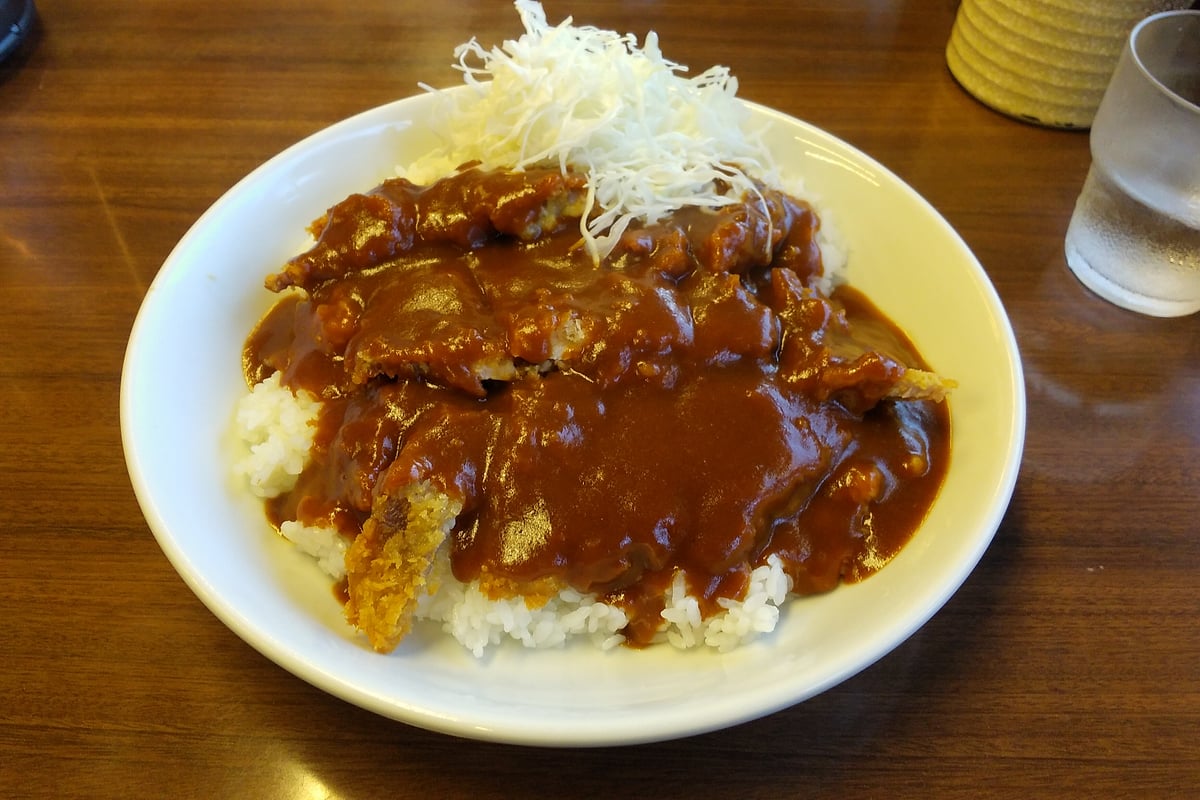
Kakogawa Katsumeshi
Kakogawa Katsumeshi (Beef Cutlet on Rice with Demi-glace)
Kakogawa katsumeshi is a local specialty of Kakogawa City, Hyogo Prefecture, consisting of rice on a Western-style plate topped with a beef cutlet (beef katsu), covered with a demi-glace-style sauce, and served with boiled cabbage. It is served on a flat Western-style plate rather than in a bowl, and the rule is to eat it with chopsticks rather than a spoon or fork. It is said to have been first served by 'Iroha Shokudo' (いろは食堂), a diner that opened in 寺家町, Kakogawa Town, in 1947 (Showa 22), just after the end of the war. According to tradition, it began when the diner ran short of plates while serving beef cutlets and put the rice and cutlet on a single plate with sauce poured over them. As 'Western-style food that can be eaten casually with chopsticks, without a knife and fork,' it spread to diners and coffee shops throughout the city. Today, some places also make it with pork cutlets, chicken cutlets, or shrimp cutlets. The Kakogawa Tourism Association's 'Katsumeshi Map' lists 94 establishments in and outside the city. In 2023 it was recognized as one of the Agency for Cultural Affairs' '100-Year Foods.'
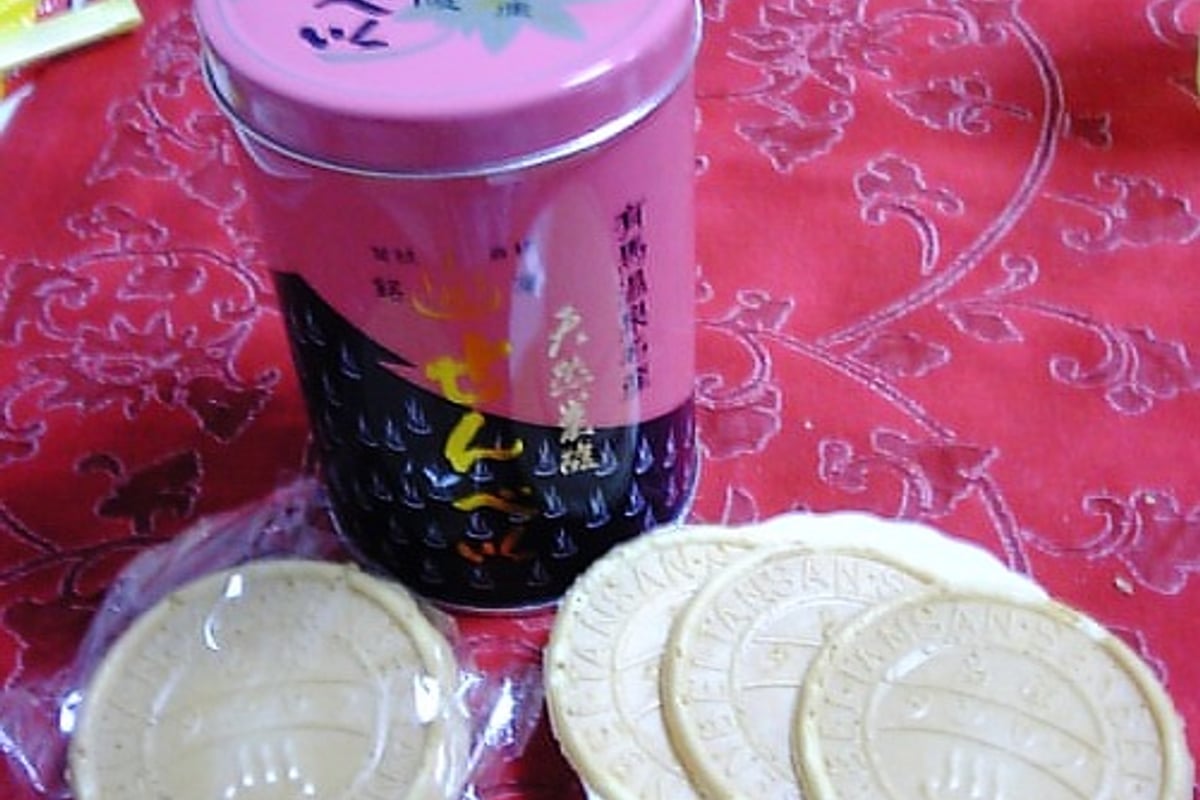
Tansan Senbei (Carbonated-Spring Crackers)
Tansan Senbei (Carbonated Spring Water Crackers)
Tansan senbei are thin baked crackers, a specialty of hot spring resorts in Hyogo Prefecture, made by adding water from carbonated springs (tansansen) to wheat flour, starch, sugar, and salt. Made without eggs or butter, they are known for their light, crisp texture and simple sweetness. At Arima Onsen in Kita Ward, Kobe, considered their birthplace, a government inspection in 1875 (Meiji 8) found that the carbonated spring water was also suitable for drinking. Crackers that made use of this water were devised, and Mitsumori Honpo (三津森本舗), founded in 1907 (Meiji 40), is known as the original shop. Besides Arima Onsen, they are also made at Takarazuka Onsen and Kinosaki Onsen, where carbonated springs also flow, and in each place they became established as a hot spring souvenir. Tansan senbei shops are dotted around the Arima hot spring town, and at some you can watch craftspeople bake them one at a time on iron plates. There is also a theory that they were based on a baked confection from the Czech spa town of Karlovy Vary, but some points about who originated them remain unclear.
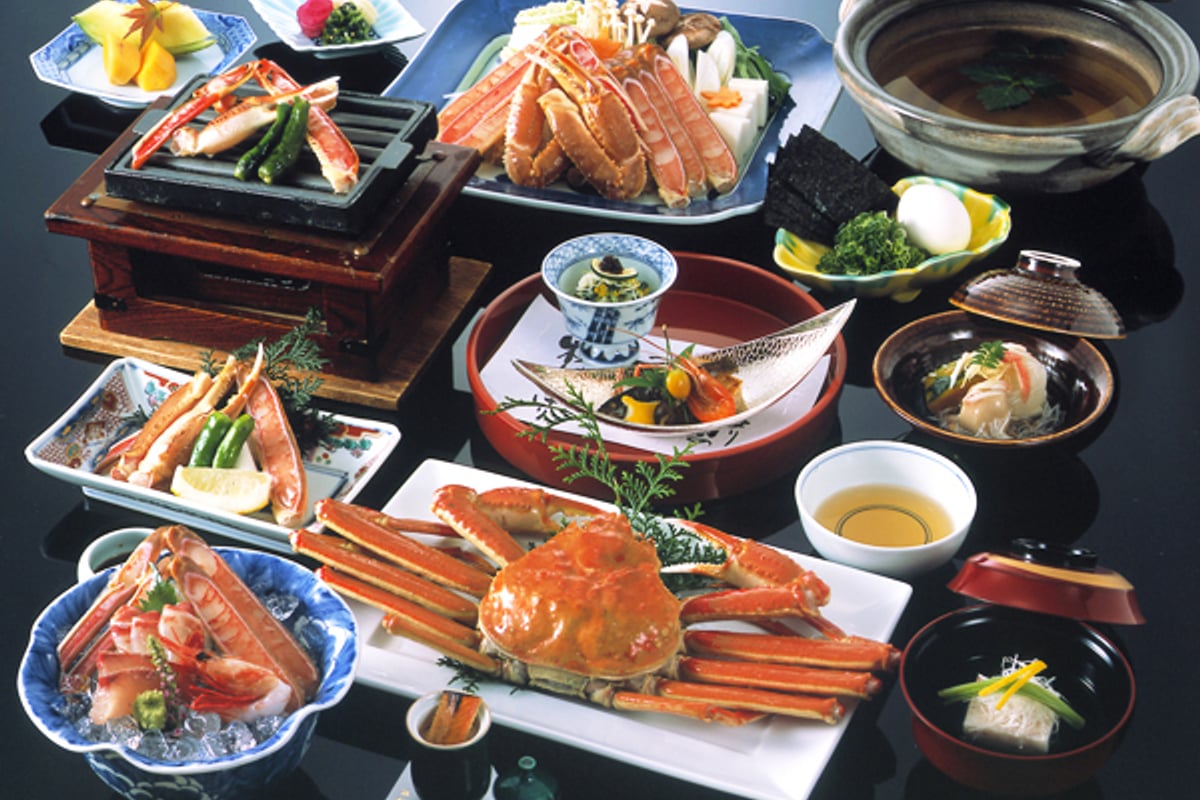
Tajima Matsuba Crab
Tajima Matsuba Gani (Snow Crab of Tajima)
Matsuba crab (matsubagani) is the name used in the San'in region for male snow crab (zuwaigani). In the Tajima area of northern Hyogo Prefecture, it is landed at fishing ports in Shin'onsen Town, Kami Town, and Toyooka City, and it has become a signature winter delicacy. It is landed at five fishing ports, including Hamasaka Fishing Port at the prefecture's northwestern tip, and the catch is among the largest in Japan. Each port has its own brand, and the crabs are shipped with tags attached to their legs as 'Tsuiyama Kani,' 'Shibayama Gani,' 'Kasumi-ko Matsuba Gani,' and 'Hamasaka-san Matsuba Gani.' The season opens every year on November 6; male Matsuba crabs can be caught until March 20 of the following year, while female seko-gani can be caught only until the end of December in order to protect the stock. Besides being boiled in salted water and eaten with nihaizu (vinegar-soy dressing), the crab is also used in takikomi gohan (rice cooked with ingredients), zosui (rice porridge), miso soup, and more. Kasumi Fishing Port is also the only place in the prefecture where red snow crab (benizuwaigani) is landed; these are called 'Kasumi crab' and are a different crab from Matsuba crab.
Model Course
Tamba ware kilns and botan nabe in Tamba-Sasayama
First, head to 立杭陶の郷 in Kamitachikui, Konda-cho. At 'Kamamoto Yokocho' (kiln alley), you can compare and choose works from about 50 kilns. At the pottery class, you can try clay modeling or painting (clay modeling from about 2,420 yen). In the afternoon, move to the castle town near the Sasayama Castle ruins and enjoy botan nabe at the castle-town branch of the wild boar meat specialist おゝみや or at the ryokan restaurant 近又. Botan nabe is in season in winter; check with each restaurant for serving periods and whether reservations are needed.
White Izushi-yaki, sara soba, and wickerwork in the castle town of Izushi
In the castle town of Izushi, start by browsing Izushi-yaki shops and kilns. At 上田陶磁器店 in Yagi, you can also see a display of 'Ko-Izushi' (Izushi-yaki from the Edo period). At 永澤兄弟製陶所 in Uchimachi, you can try painting on white porcelain. For lunch, have sara soba served on small Izushi-yaki plates at 近又 or さらそば 甚兵衛. At 伝統工芸館 杞柳 near the Izushi Castle ruins, you can handle Toyooka Kiryu Zaiku products.
Tagged Matsuba crab in winter at Kinosaki Onsen and Hamasaka
The fishing season for male Matsuba crab runs from November 6 to March 20. At おけしょう鮮魚の海中苑 in the Kinosaki Onsen hot spring town, you can enjoy a full crab course at the second-floor restaurant (from about 13,500 yen, minimum two servings). Shops in the hot spring town also carry small Toyooka Kiryu Zaiku baskets and bags. If you stay overnight, you can also enjoy tagged Matsuba crab landed at the port at the kappo ryokan 荒岩 in Hamasaka.
Tamagoyaki and ikanago no kugini at Akashi's Uontana
Walk south from JR Akashi Station to reach the Uontana shopping street. At 座古海産 in Honmachi, you can buy homemade ikanago no kugini (about 860 yen for 120 g). For lunch, enjoy 'tamagoyaki' (Akashiyaki) dipped in dashi at 本家きむらや, founded in 1924 (Taisho 13), or at ふなまち. In front of the station, パピオスあかし also houses 松竹, known for its nicely browned tamagoyaki.
Myochin Hibashi in Himeji, with Himeji oden in ginger soy sauce and Kakogawa katsumeshi
At 播産館 inside じばさんびる, right outside JR Himeji Station, you can choose from Harima crafts, including Myochin Hibashi wind chimes. In the evening, enjoy Himeji oden with ginger soy sauce poured over it at 停主 or 十七八 near the station. The next day, take the JR to Kakogawa and have Kakogawa katsumeshi, eaten with chopsticks, at 洋食 エデン, a two- to three-minute walk from the station.
Doll brushes and tansan senbei at Arima Onsen, finishing with Kobe Beef
灰吹屋西田筆店 at Arima Onsen is said to be the only workshop that makes Arima Ningyo Fude (about 3,300 yen each). At 有馬玩具博物館, you can also try making a doll brush (about 5,000 yen, reservation required). At 三津森本舗本店 on Yumotozaka, you can watch craftspeople hand-bake the crackers through a glass window. In the evening, head down to Sannomiya in Kobe and enjoy a Kobe Beef steak at モーリヤ本店, founded in 1885 (Meiji 18).
Miki hardware, Ono soroban, and Sugiharagami papermaking in northern Harima
At 三木市立金物資料館, you can learn the history of Miki hardware, centered on carpentry tools. Admission is free. At the hardware exhibition and sales hall of 道の駅みき, you can pick up and choose from about 20,000 hardware items. At そろばんビレッジ in Ono City, you can make an original soroban by choosing the colors of the frame and beads (from about 1,800 yen for 9 rods, reservation required). Go further north and try papermaking at the 杉原紙研究所 in Taka Town (from about 450 yen for two postcards, reservation required).
Western Harima: from Ibo no Ito's Somen no Sato to an Ako Dantsu workshop gallery
At 揖保乃糸資料館 そうめんの里 in Tatsuno City, you can learn about the history and production process of hand-pulled somen. The restaurant on the first floor serves somen dishes made with Ibo no Ito. In the afternoon, head to Ako and visit 赤穂緞通工房ギャラリー東浜 in Higashihama-cho. Visits are booked through its official website. 赤穂市立歴史博物館 also holds materials on Ako Dantsu.
The history of mud-infused Najio-gami in Najio, Nishinomiya
名塩和紙学習館 is a branch of the Nishinomiya City Local History Museum. The second floor displays the history of Najio-gami and papermaking tools, and admission is free (closed on Mondays). Najio-gami is a washi made by mixing local mud into gampi fibers and forming sheets. Base paper for hakuuchi-gami, used to beat gold leaf thin, and fusuma paper are still made today, and the paper has also been used to restore cultural properties such as Nijo Castle. Papermaking workshops (about 700 to 1,000 yen) require advance application.
Events
Tamba Ware Pottery Festival 'Aki no Sato Meguri' (丹波焼陶器まつり「秋の郷めぐり」)
Autumn (in 2026: October 9 to 18) / Konda-cho, Tamba-Sasayama City (立杭陶の郷, individual kilns, 兵庫陶芸美術館, and other venues)
View details →Miki Hardware Festival (三木金物まつり)
Autumn (in 2026: November 7 and 8) / Miki City (三木山総合公園, 三木市文化会館, and other venues)
View details →