Image: Wikimedia Commons
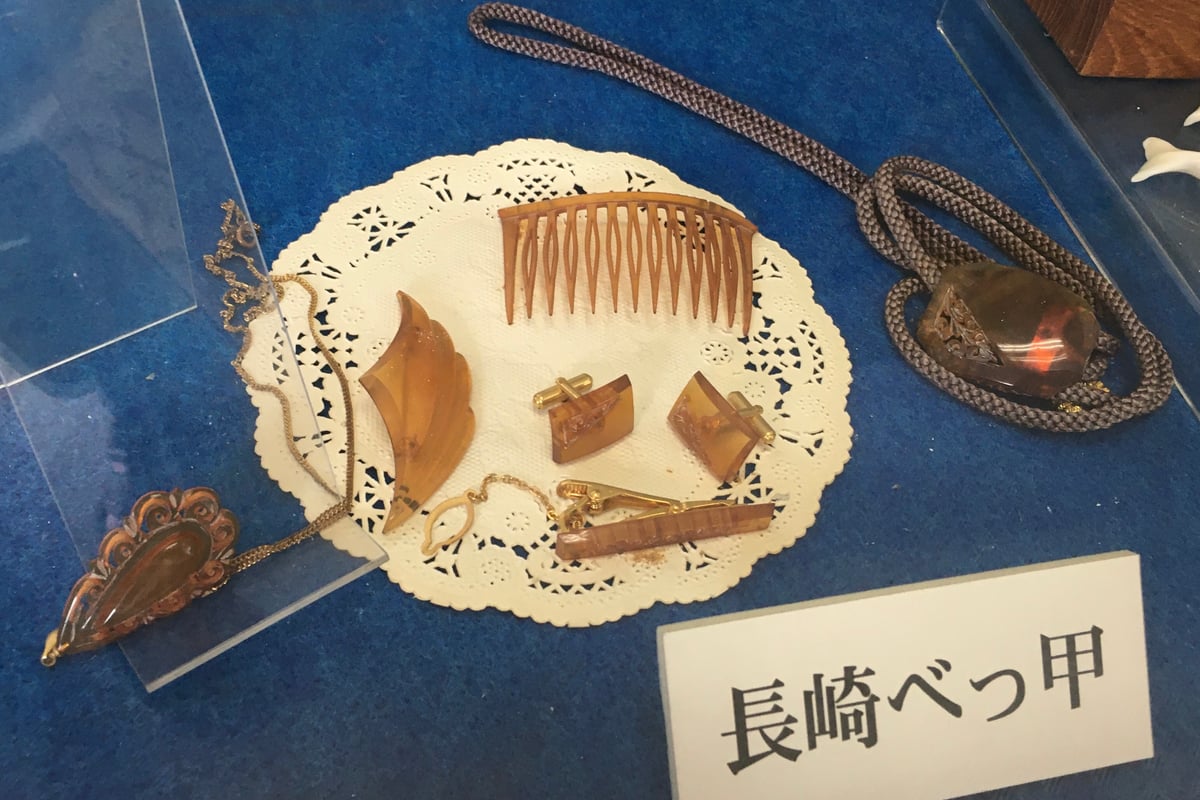
Nagasaki tortoiseshell (bekko) is a traditional craft of Nagasaki made by working the shell of the hawksbill turtle, a type of sea turtle. In the Edo period, under the policy of national isolation (sakoku), Nagasaki Port was the only port for trade with the Netherlands and China, and because the raw hawksbill shell was easy to obtain there, tortoiseshell craft is said to have developed in Nagasaki. Nagasaki's techniques are described as having later spread to Edo and elsewhere. After Japan opened to the world, the craft also became popular with foreigners, and its techniques and designs were refined. Its greatest feature is the technique of joining shell pieces together using only water, heat and pressure, without any adhesive. For this reason it is also called 'the art of water and heat.' Besides accessories such as kanzashi (ornamental hairpins) and brooches, decorative objects such as treasure ships are also made. In 2017 it was designated a Traditional Craft by the Minister of Economy, Trade and Industry. Meanwhile, international trade in hawksbill turtles is banned under the Washington Convention (CITES), and Japan ended its imports in 1992. Craftspeople carry on the techniques while carefully using raw materials imported in the past.
Origin
Tortoiseshell craft is said to have come to Japan from China in the Asuka and Nara periods, and pieces survive in the Shosoin repository. In Nagasaki, tortoiseshell craft began from the 17th century onward, when foreign merchant ships brought in hawksbill shell. The 'Nippo Jisho' (Japanese-Portuguese Dictionary), compiled in Nagasaki in 1603, is described as recording the hawksbill as 'the turtle shell from which the Chinese make crafted goods.'
History
In the Kyoho era (1716–1735), tortoiseshell craftsmen are said to have worked in neighborhoods along the Nakashima River such as Sakaya-machi and Fukuro-machi. In the Edo period it was an expensive luxury, and in the Genroku period it was even subject to sumptuary laws. After Japan opened its ports in the Ansei era, it became popular with residents of the foreign settlements and with Russians, and in the Meiji era the techniques are said to have advanced as craftsmen met elaborate orders such as model ships. In January 2017, it was designated a Traditional Craft by the Minister of Economy, Trade and Industry.
Features
The color and texture differ by part of the hawksbill, such as the back shell, the tsume (marginal scutes) and the belly shell, and craftspeople judge these differences when choosing their material. Amber-colored parts and jet-black parts are said to be especially valuable. Tortoiseshell is made of the same protein as hair and nails and softens when heated, so it can be bent to create three-dimensional works. Today only raw material imported in the past can be used, which has made it increasingly rare.
Techniques
Laminating (the water-and-heat technique)
Many thin sheets of tortoiseshell are layered and pressed while water and heat are applied, forming a single plate of even thickness. The method described is to tack the sheets together with a heated iron plate and then press them in a vise. Because no adhesive is used, it is called 'the art of water and heat.'
Carving and bending
The cut-out material is shaved and fine patterns are carved into it to give a three-dimensional effect. It can also be softened with heat and bent. 長崎市べっ甲工芸館 is described as having a spiny lobster piece whose body and leg joints can be bent to change its pose.
Materials Used
Production Process
- 1
Design and choosing material
The design is drawn while taking into account the size and thickness of the raw material. Pieces with matching colors and patterns are chosen from the back shell, tsume and belly shell.
- 2
Kirimawashi and kisagi (cutting out and scraping)
The material is cut out with a fretsaw, and impurities on the surface are scraped away with a small knife or file to make it smooth.
- 3
Hibashi and pressing
The pieces are tacked together with heated iron tongs, then pressed while water and heat are applied to form a plate of uniform thickness. No adhesive is used.
- 4
Oshigote and carving
The material is pressed against a wooden mold with a heated iron to shape it, and fixed with egg white. Patterns are then carved into it.
- 5
Polishing and assembly
The surface is polished to bring out an amber luster, and metal fittings and other parts are assembled to finish the piece.
| Main Production Areas |
|
|---|
Artisans & Workshops
鼈甲屋たがわ
A tortoiseshell shop in Imahakata-machi, Nagasaki City, described as having honed its craft in Nagasaki over three generations. In addition to making and selling necklaces, brooches, kanzashi and good-luck ornaments, it also accepts repairs and repolishing. Open 10:00–16:00, closed on weekends and public holidays.
Official site →喜山(藤田誠さん)
A tortoiseshell carver who works in his home workshop in Kamikoshima, Nagasaki City. He is the third generation of a family business dating back to the Taisho era, is said to be the only carver in Japan specializing in tortoiseshell, and is described as having about 60 years of experience as a craftsman. He has no shop of his own and supplies his works to retailers.
Official site →How to Buy
- 鼈甲屋たがわ (Bekkoya Tagawa)
- Besides the shop itself, products are also available through its online shop and the furusato nozei (hometown tax donation) program. The furusato nozei site lists items only genuine tortoiseshell can offer, such as a 176,000-yen brooch and a 550,000-yen kanzashi. Prices are subject to change.Where to buy →PR
- Rental workshop at 長崎歴史文化博物館 (Nagasaki Museum of History and Culture)
- In the workshop on the museum's second floor, visitors can watch craftspeople making tortoiseshell pieces and buy items such as pendants and brooches, according to the museum (except Wednesdays).Where to buy →PR
Hands-on Experiences
長崎市べっ甲工芸館
長崎県長崎市松が枝町4-33
An exhibition hall housed in the Former Nagasaki Customs Sagarimatsu Branch Office (built in 1898), an Important Cultural Property of Japan. It displays fine pieces from around the country, such as treasure ships and spiny lobsters, and also screens a video of the production process. Admission is listed as 100 yen for adults, open 9:00–17:00.
View details →FAQ
Q. What is the situation with tortoiseshell raw material today?
A. The hawksbill turtle is listed in Appendix I of the Washington Convention (CITES), the category most in need of protection, and Japan ended its imports in 1992. The industry began research on land-based aquaculture in Japan in 2001, and is described as having commercialized land-based farming of hawksbill turtles in 2017.
Q. Are there still many tortoiseshell shops in Nagasaki?
A. About 60 years ago there were about 300 tortoiseshell-related businesses in Nagasaki Prefecture, but the number is described as having fallen to about 20 today. Even so, Nagasaki, where the Japan Bekko Association has its headquarters, is regarded as a place closely tied to tortoiseshell craft.